
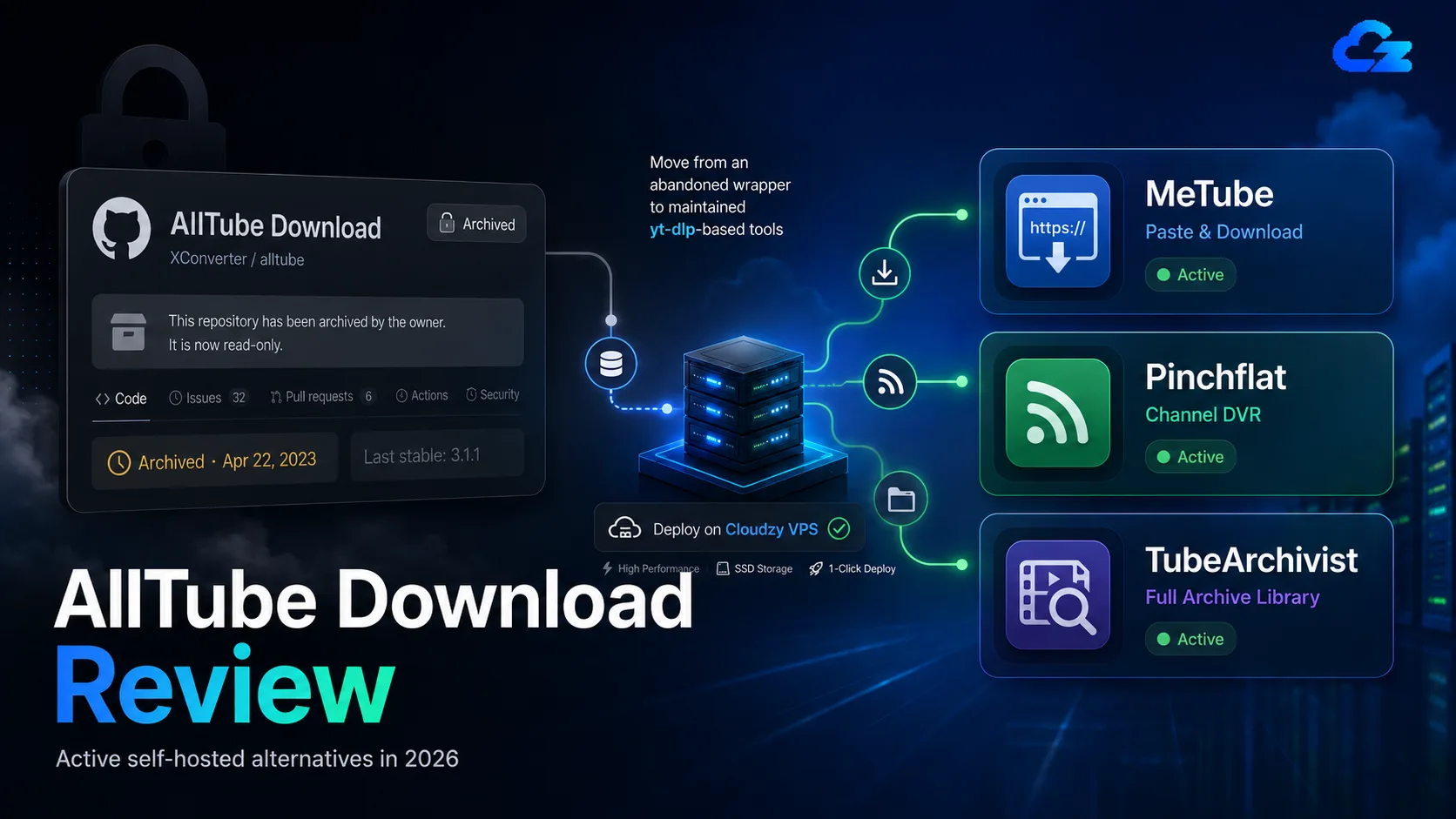
El repositorio de AllTube Download en GitHub está archivado desde el 22 de abril de 2023, y la última versión estable (3.1.1) salió 42 días antes. Si estás leyendo esto en 2026, tienes delante un proyecto que no ha recibido una actualización de código en tres años.
Todavía puedes encontrar guías de instalación de AllTube, en blogs sobre Synology NAS, en páginas de marketing de grandes proveedores, en listículos que no se han depurado desde hace tiempo. Ninguno te dice que el repositorio es de solo lectura. Así que, si buscaste "AllTube" esperando una herramienta actual, este artículo hace dos cosas: te da la reseña honesta (es corta, porque la respuesta es corta) y luego repasa lo que yo desplegaría hoy en un VPS para el mismo trabajo: MeTube, Pinchflat y TubeArchivist.
TL;DR
- AllTube Download fue archivado por su autor el 22 de abril de 2023. Última versión estable: 3.1.1 (11 de marzo de 2023). No lo despliegues.
- MeTube es el reemplazo activo más parecido, una interfaz web para yt-dlp, última versión de abril de 2026, funciona en Docker.
- Pinchflat está pensado para suscripciones a canales (un DVR personal de YouTube).
- TubeArchivist sirve para archivado completo con biblioteca, búsqueda e integración con Jellyfin.
Aviso legal: Todo lo que se trata aquí es únicamente con fines educativos y de prueba. Nada en este artículo recomienda infringir los términos de servicio de una plataforma ni la ley de derechos de autor de ningún país. Usa las herramientas con contenido que tengas derecho a descargar.
AllTube está archivado: la reseña breve
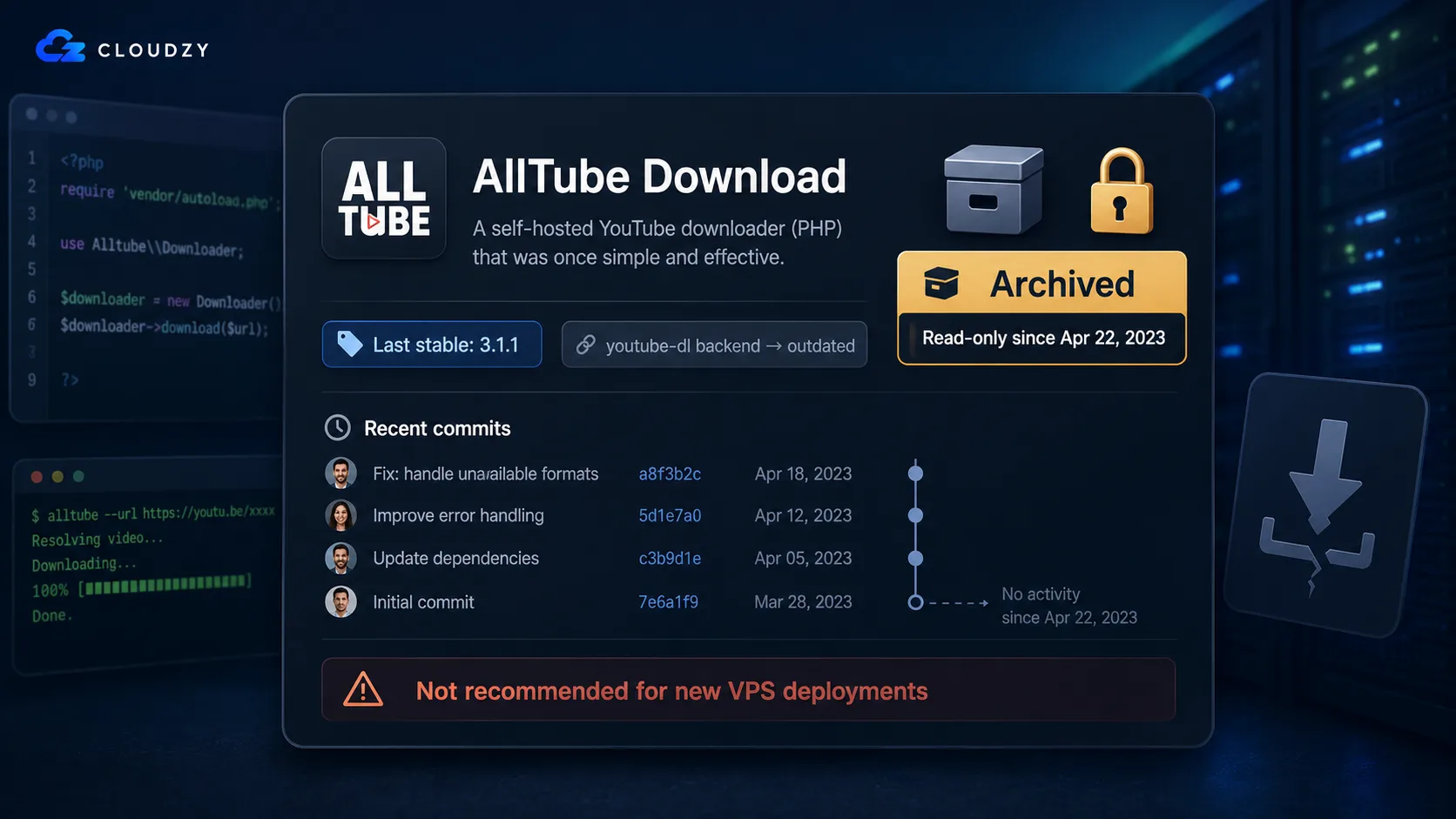
Hay una última etiqueta de preversión llamada 3.2.0-alpha que llegó el mismo día en que se archivó el proyecto; su único cambio destacable fue reemplazar el backend de youtube-dl por yt-dlp. Esa alpha no ha tenido ninguna actualización desde entonces.
Unas semanas antes, se abrió un Issue de GitHub en el repositorio de AllTube con el título "End of support" (fin del soporte). Es la señal de la comunidad de que esto fue deliberado. No una pausa, ni unas vacaciones. Un cierre.
Cuando AllTube funcionaba, era algo agradable. Una interfaz web en PHP limpia para youtube-dl sin base de datos, con poca huella y compatible con cientos de sitios a los que youtube-dl podía llegar. Pegabas una URL, elegías un formato y obtenías un archivo. Nada más. Toda la herramienta eran unos 800 KB de PHP haciendo bien un solo trabajo.
Lo que lo mató no es realmente culpa de AllTube. El propio youtube-dl se ralentizó drásticamente (el fork, yt-dlp, es el proyecto que de verdad se mantuvo al día). La maquinaria de formatos de YouTube ha seguido cambiando: restricciones de itag, las continuas actualizaciones de cifrado, descifradores de firmas que hay que parchear cada pocos meses. Un envoltorio sobre un backend estancado no puede seguir ese ritmo por sí solo. Sin actividad de mantenimiento durante tres años, AllTube tampoco puede.
Encontrarás usuarios en un hilo del foro de YunoHost sobre el estado de AllTube que reportan descargas rotas y archivos con la resolución equivocada. Esa es la señal práctica. AllTube no se mantiene de forma fiable, y la dependencia subyacente dejó de moverse mucho antes que el propio repositorio.
El veredicto de Bill: AllTube fue una buena herramienta. No es una opción vigente. Si quieres una interfaz de navegador para yt-dlp en 2026, instala MeTube. Pasa página.
Qué instalar en su lugar: el stack autoalojado de yt-dlp en 2026
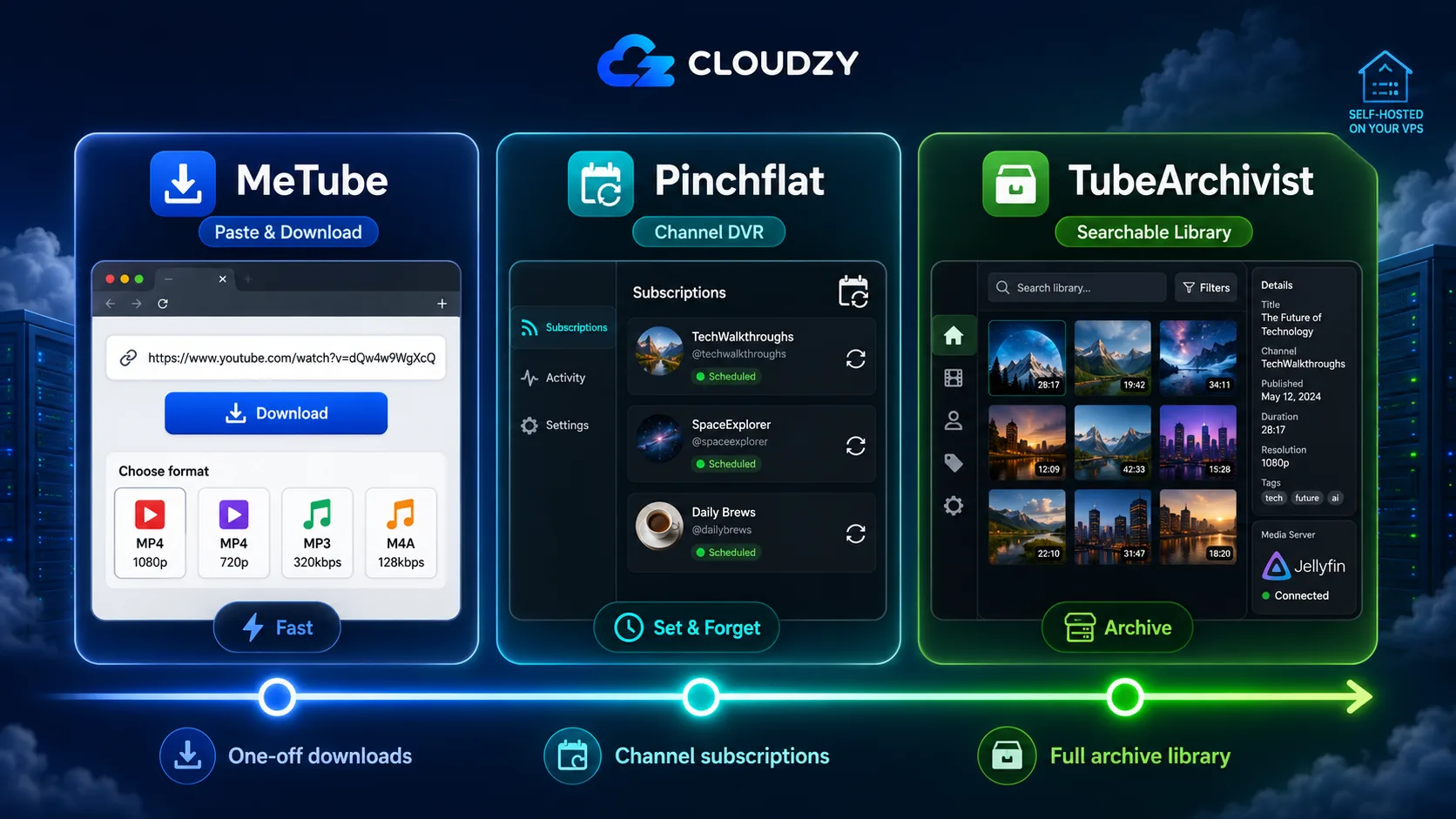
Estas tres herramientas se sitúan en tres puntos distintos del mismo espectro: descargas puntuales en el extremo casual, suscripciones a canales en el medio, y una biblioteca de archivado completa en el extremo más pesado. En realidad no compiten entre sí. Son respuestas a preguntas distintas.
La categoría se ha consolidado en torno a yt-dlp como backend. Ahora la diferencia está en la interfaz y en el caso de uso. MeTube es el reemplazo más directo si llegaste aquí buscando "AllTube pero mantenido". Pinchflat es para el flujo de "quiero un feed personal de cinco YouTubers". TubeArchivist es para el flujo de "quiero un YouTube autoalojado con una biblioteca de verdad".
MeTube: el reemplazo más parecido a AllTube
La imagen nightly de Docker de MeTube descarga automáticamente la última versión de yt-dlp en cada compilación. Esa sola decisión de diseño es la razón estructural por la que MeTube no se pudre en silencio como le pasó a AllTube. Cuando YouTube cambia un formato o un cifrado, yt-dlp se parchea en cuestión de horas, y tu instancia de MeTube lo recoge la próxima vez que el contenedor se reconstruye. Tú no haces nada. Sin issues de "arreglo" a las que suscribirte, sin parchear PHP de madrugada.
El repositorio de MeTube en GitHub tiene 13.5k estrellas, licencia AGPL-3.0, y su última versión es del 28 de abril de 2026. El despliegue es el flujo estándar de Docker / docker-compose; hay un README de una página y la mayoría de la gente lo tiene funcionando en cinco minutos. El conjunto de funciones cubre lo que hacía AllTube y más:
- Descargas de vídeo y audio
- Subtítulos y miniaturas
- Compatibilidad con listas de reproducción
- Suscripciones a canales
- Preajustes de formato y calidad
- Integración con SponsorBlock
La interfaz es de una sola página: pega y listo.
Cuándo MeTube es la elección correcta: un flujo personal de pegar y descargar, lotes pequeños ocasionales, un VPS de 1-2 GB de RAM. Si tu caso de uso es "quiero bajar este vídeo, a veces una lista de reproducción, de vez en cuando algo solo de audio", esta es la herramienta. Es el reemplazo de AllTube para el que se escribió este artículo.
Cuándo MeTube no es la elección: archivado sistemático y pesado de muchos canales (usa TubeArchivist) o un modelo de suscripción del tipo "vigila las nuevas subidas de este YouTuber para siempre" que configuras y olvidas (Pinchflat está hecho justo para eso). MeTube puede suscribirse a canales, pero su experiencia de uso está construida en torno a la descarga puntual. Si quieres un DVR de YouTube, hazte con el DVR de YouTube.
Pinchflat: para suscripciones a canales
Si tu problema es "quiero seguir a cinco YouTubers sin abrir YouTube", Pinchflat es la herramienta para ese trabajo concreto. Añades un canal o una lista de reproducción, defines una frecuencia, y descarga las nuevas subidas según una programación, organizadas por fuente. Piénsalo menos como un descargador y más como un RSS-para-YouTube personal que produce archivos de vídeo en lugar de un feed.
El repositorio de Pinchflat en GitHub se mantiene activamente, ronda las 4.9k estrellas, licencia AGPL-3.0, escrito en Elixir. La versión etiquetada más reciente al momento de escribir esto es la v2025.9.26 (26 de septiembre de 2025), con commits que continúan después de esa fecha, lo que la hace muy actual. Tiene una comunidad más pequeña que la de MeTube, pero está viva y en desarrollo.
Cuándo Pinchflat es la elección correcta: has sustituido de hecho tu bandeja de suscripciones de YouTube por un feed autoalojado y quieres que cada nueva subida se descargue automáticamente. Te gusta configurar las cosas una vez y olvidarte de ellas.
Cuándo Pinchflat no es la elección: descargas puntuales (MeTube es más rápido para eso) y gestión completa de biblioteca con metadatos ricos, búsqueda y una interfaz de Plex/Jellyfin (TubeArchivist está hecho para eso). El trabajo de Pinchflat es la descarga, no la biblioteca.
TubeArchivist: para archivado serio
TubeArchivist es el único de los tres que va más allá de "descargar archivos" hasta "gestionar una biblioteca". Indexa todo lo que descargas:
- Metadatos
- Miniaturas
- Páginas de canal
- Búsqueda
- Progreso de visualización
Está diseñado para funcionar junto a un servidor multimedia. La integración con Jellyfin es el caso de uso estrella. Acabas con algo que se parece a un YouTube autoalojado con tu propio contenido, en lugar de una carpeta de mp4 con nombres de archivo crípticos.
El repositorio de TubeArchivist en GitHub está activo, ronda las 7.9k estrellas, licencia GPL-3.0, escrito en Python, y su versión más reciente es la v0.5.10 del 28 de marzo de 2026. El README documenta el stack de Docker Compose y el emparejamiento con Jellyfin.
Esta es también la razón por la que TubeArchivist es el más pesado de los tres. La funcionalidad de biblioteca y búsqueda se apoya en Elasticsearch, lo que significa que el mínimo de RAM es notablemente más alto que el de MeTube o Pinchflat. Cuenta con 4 GB como mínimo, más si vas a indexar decenas de miles de vídeos.
Cuándo TubeArchivist es la elección correcta: quieres un reemplazo real y autoalojado de YouTube con biblioteca, búsqueda, páginas de canal y una salida lista para Jellyfin. No te importa ejecutar un contenedor de Elasticsearch. El emparejamiento con un servidor Jellyfin autoalojado es donde esta herramienta demuestra su valor.
Cuándo TubeArchivist no es la elección: un flujo de descargas ligero (es excesivo, estarías ejecutando Elasticsearch para bajar tres vídeos a la semana) o un VPS diminuto (no cabrá cómodamente).
Tabla comparativa rápida
Una comparación lado a lado de las cuatro, con AllTube incluido a modo de contexto, no porque alguien deba desplegarlo.
| Herramienta | Caso de uso principal | Backend | Mantenimiento activo | Licencia | Ideal para |
|---|---|---|---|---|---|
| AllTube Download | Interfaz de navegador para descargas puntuales | youtube-dl (3.2.0-alpha: yt-dlp) | Archivado en abril de 2023 | GPL-3.0 | Nadie, en 2026 |
| MeTube | Pegar y descargar en un navegador | yt-dlp | Activo (última versión de abril de 2026) | AGPL-3.0 | Un reemplazo directo de AllTube |
| Pinchflat | Suscribirse a canales y listas de reproducción, descarga automática | yt-dlp | Activo (última versión de septiembre de 2025) | AGPL-3.0 | Flujos de trabajo de DVR personal de YouTube |
| TubeArchivist | Archivo completo con biblioteca y metadatos | yt-dlp | Activo (última versión de marzo de 2026) | GPL-3.0 | Archivado serio combinado con Jellyfin |
Ejecutar cualquiera de estas en un VPS
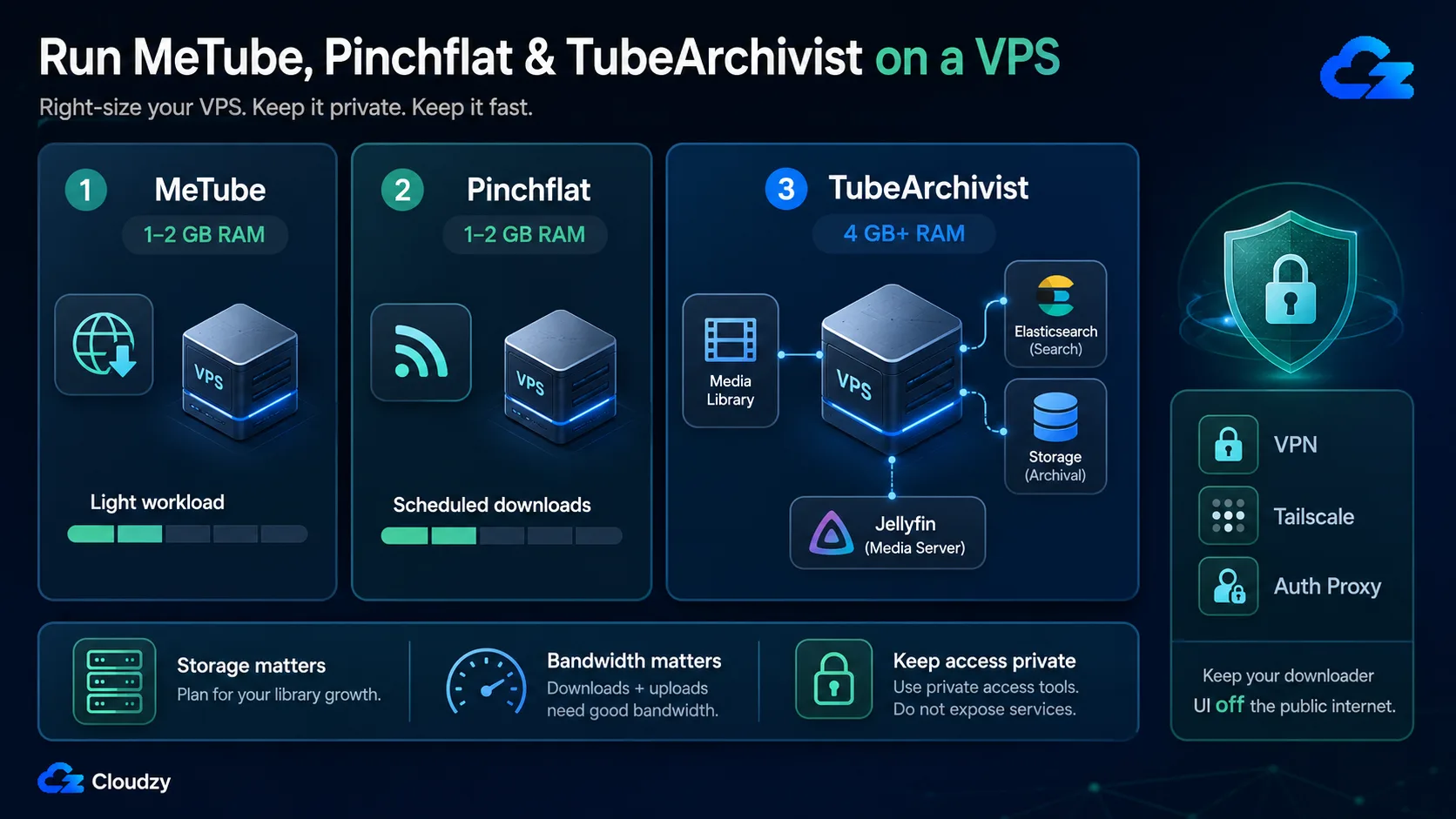
MeTube funciona sin problemas con 1 GB de RAM. Pinchflat es igual de ligero. TubeArchivist quiere cuatro, y la mayor parte se va a Elasticsearch. Esos son los números en torno a los que conviene planificar.
Para MeTube o Pinchflat: 1-2 GB de RAM, 2 vCPU y 20-60 GB de almacenamiento son un punto de partida cómodo para un uso personal casual. Los picos vienen de FFmpeg al fusionar cuando YouTube solo sirve flujos de audio y vídeo por separado. Es puntual, no sostenido, así que una instancia pequeña lo gestiona bien. TubeArchivist necesita 4 GB de RAM como mínimo (Elasticsearch es la dependencia que soporta la carga), y conviene al menos 60 GB de disco para empezar, más si vas a archivar canales.
Consejo pro: El almacenamiento es el número que hay que planificar, no la CPU. El uso casual de MeTube apenas mueve el disco. TubeArchivist más unos cuantos canales suscritos se comerá cientos de gigabytes a lo largo de un año. Elige un plan en el que puedas crecer, o elige un proveedor que te deje redimensionar sin reconstruir.
En los flujos de archivado lo que te pasa factura es el ancho de banda, no el cómputo. Si estás descargando canales en serio con Pinchflat o TubeArchivist, 1 TB de tráfico de salida mensual es un mínimo cómodo para un uso personal. Un archivado más intenso pedirá más.
Una nota práctica sobre la exposición: mantén estas instancias privadas. Una interfaz de yt-dlp pública en internet abierto atrae abusos rápidamente: bots, scraping y el tipo de atención que hace que marquen la IP de tu VPS. Enlázala a localhost detrás de Tailscale, ponla tras un proxy inverso con autenticación, o túnela a través de una VPN. No expongas la interfaz web al mundo y confíes en que salga bien.
Si quieres combinar esto con un servidor multimedia (el stack de TubeArchivist + Jellyfin es el obvio), ejecutar ambos en el mismo VPS funciona bien a pequeña escala. Hemos cubierto la parte de Jellyfin de ese stack en detalle. Consulta nuestra guía de Jellyfin vs. Plex para la parte del servidor multimedia. El stack completo (Jellyfin al frente, TubeArchivist como archivo, un VPS como anfitrión) es una de las configuraciones multimedia autoalojadas más limpias que puedes montar en 2026.
Si aún no has elegido un proveedor, nuestros planes Linux VPS cubren ese rango. Hay una opción de facturación por horas si solo quieres hacer pruebas, facturación mensual cuando te decidas, y una garantía de devolución del dinero si cambias de idea en las primeras dos semanas. Elige un plan con margen para crecer si es para archivar; el nivel más pequeño va bien para MeTube por sí solo.



Debate
Comentarios
Inicia sesión para unirte al debate.