

What Is an IP Scanner?
A network IP scanner is software that discovers and gathers information about devices connected to a computer network. These tools identify active IP addresses within specified ranges or subnets and determine host availability by sending data packets and analyzing responses.
Key capabilities include:
- Active IP address identification
- MAC address detection for device identification
- Device name and hostname resolution
- Open port discovery for security assessments
- Device type and OS identification
Benefits of Using an IP Scanner
Enhanced Network Insight
Scanners provide visibility into active devices, IP addresses, MAC addresses, and hostnames, helping administrators detect unwanted network devices.
Streamlined Network Management
Automation of device discovery simplifies adding and removing devices, enhancing administrator efficiency.
Strengthened Network Security
Detection of open ports and potential security issues enables administrators to set network access criteria and strengthen defenses.
Swift Troubleshooting
Device connectivity analysis enables rapid issue identification and resolution.
Optimized Resource Allocation
Understanding device distribution supports strategic load balancing and bandwidth management.
Efficient Inventory Management
Current tracking of network devices, hardware changes, and software installations simplifies inventory management.
Time and Cost Savings
Automation reduces manual effort, freeing administrators for higher-priority tasks.
Fits Networks of Any Size
Options are available for small home networks and large enterprise infrastructures, though features and licensing vary.
10 Best IP Scanners for Network Management
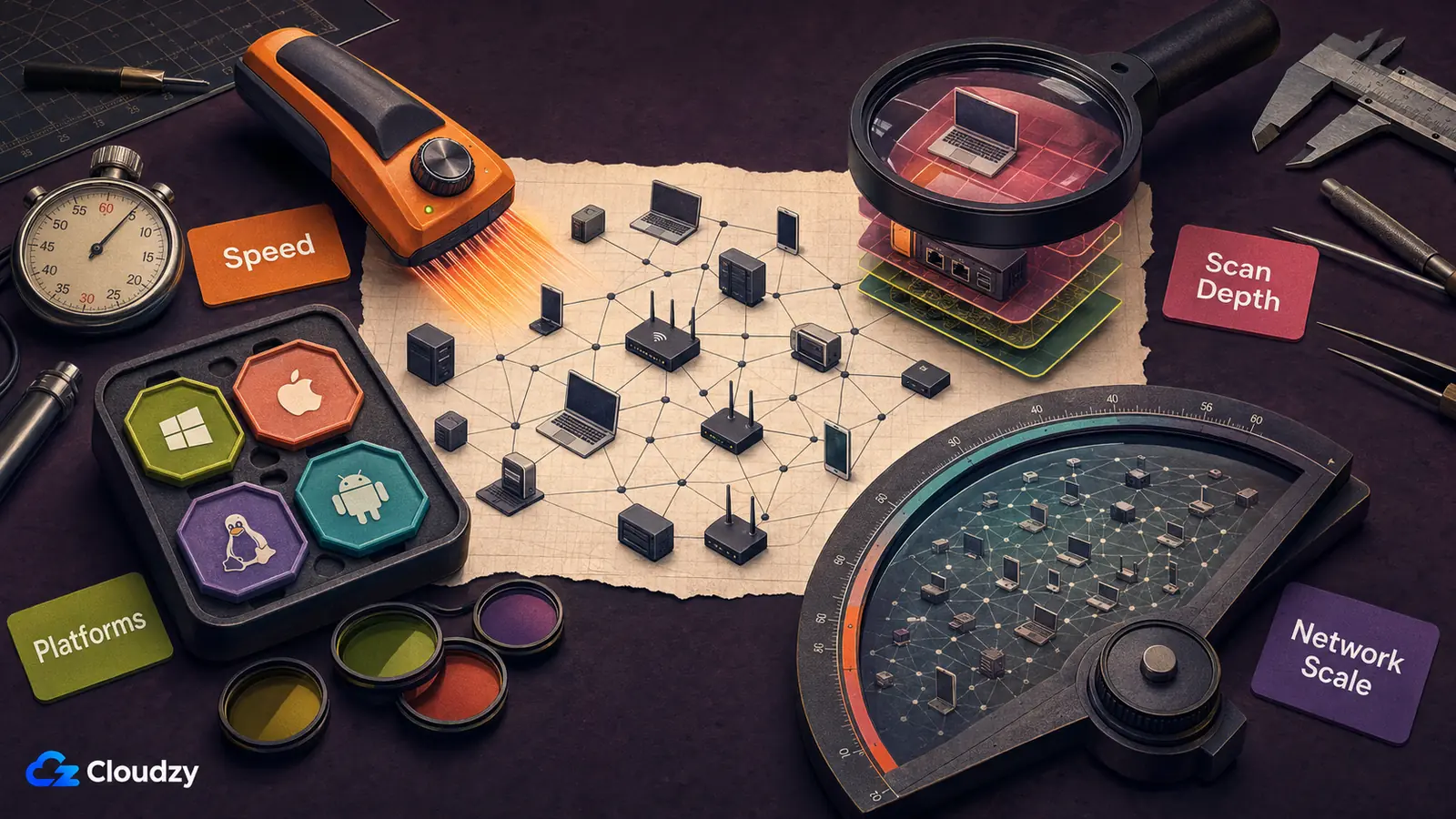
1. Angry IP Scanner
An open-source network scanner offering swift and efficient IP address and port scanning capabilities across Windows, macOS, and Linux. It requires no installation and is available free of charge. Limitation: not available for mobile devices. The current release is version 3.9.3, and standalone Windows and Linux builds require Java 17 or later.
2. Nmap/Zenmap
Nmap provides sophisticated scanning options including SYN, TCP, and UDP protocols. Zenmap wraps this functionality in a graphical interface for accessibility. Cross-platform support for Windows, macOS, and Linux.
3. Advanced IP Scanner
A reliable free option for Windows featuring a visually appealing interface for network device discovery. Includes remote control capabilities, RDP integration, and Wake-On-LAN technology for remote PC management.
4. SolarWinds IP Address Manager (IPAM)
An enterprise-focused option for Windows Server environments, IPAM offers centralized IP address allocation, automation, and subnet monitoring. Features include IP conflict detection and historical tracking. It supports multi-vendor DHCP and DNS management.
5. Lansweeper
A comprehensive network management tool combining IP scanning with asset discovery and IT inventory management. Offers customizable reporting capabilities and automated network scanning.
6. Colasoft MAC Scanner
A specialized Windows MAC address scanner focused on network troubleshooting and security. It displays IP addresses, MAC addresses, hostnames, and manufacturers for devices on detected subnets. The current version is 2.3 (released August 2024), available in a free edition and a paid Pro edition.
7. NetScanTools
An expansive Windows suite providing host discovery and network diagnostic tools. It includes DNS utilities, traceroute, packet monitoring, and SNMP scanning tools.
8. Fing
An application available on Android, iOS, Windows, and macOS. A strong option for mobile users, it offers network discovery, device detection, intruder identification, and bandwidth analysis. Additional features include Wi-Fi troubleshooting and parental controls. The free tier is limited to 3 scans per day; continuous monitoring and advanced device management require a paid plan. Fing's site lists the current paid tiers and their pricing.
9. SoftPerfect Network Scanner
A feature-rich, portable scanner supporting Windows, macOS, and Linux. Offers customizable scan types including ping-based detection, port scanning, and SNMP querying. Export results to HTML, XML, CSV, and TXT formats. The free, unlimited-duration trial displays a maximum of 10 devices (as of version 26.7); scanning larger networks requires a paid license.
10. Masscan
An open-source, asynchronous port scanner built for scanning large address ranges at high speed. It supports IPv4 and IPv6, offers banner grabbing for common protocols such as HTTP, SSH, and SSL, and runs on Linux, Windows, and macOS, with the highest performance on Linux. Released under the AGPL-3.0 license, its Nmap-like input and output formats make it a natural complement to Nmap for wide sweeps ahead of detailed follow-up.
Running Your Scans From an Always-On Host

An IP scanner is only as useful as the vantage point you run it from. Tools such as Nmap or Masscan give the most consistent results when they run from a fixed, always-on host rather than a laptop that sleeps, changes networks, or sits behind a home router. A persistent host keeps the same address, stays reachable for scheduled scans, and gives you a stable point to monitor any remote network it can access, such as through a VPN.
Two Cloudzy options fit this job: Linux VPS and cloud VPS.
Both run on AMD EPYC processors with NVMe SSD storage and up to 40 Gbps of network throughput, backed by a 99.95% uptime SLA, so a scanner scheduled overnight is still running when you check it in the morning. You keep full root access to install whichever tools you prefer.

On-demand cloud VPS on AMD EPYC processors with NVMe storage.
Buy Cloud VPS HourlyFrequently Asked Questions
How does an IP scanner work?
Scanners detect network IP addresses, retrieve details, and analyze information such as MAC addresses and hostnames.
What are the benefits?
Enhanced visibility, streamlined management, improved security assessments, efficient troubleshooting, optimized resource allocation, automated inventory management, and identification of unauthorized devices.
Are IP scanners suitable for all network sizes?
Yes, options exist for small home networks and complex enterprise infrastructures, but their features, licensing, and capacity limits differ.
Can they detect security vulnerabilities?
Some advanced scanners combine open-port discovery with dedicated vulnerability checks, enabling proactive vulnerability remediation.
How do IP scanners help with network planning and expansion?
IP scanners provide structural insights supporting informed expansion decisions and strategic scaling.
Related Reading




Discussion
Comments
Sign in to join the discussion.