

Choosing the best CMS for a small site starts with one question: does a vendor run the website for you, or do you run it yourself? A hosted builder such as Wix, Squarespace or Shopify handles the servers and the security work, and in return your site lives inside its plans. A self-hosted CMS such as WordPress, Ghost or Joomla gives you the files and the database, and in return someone has to keep it updated.
Once that question is answered, the list of realistic platforms gets short, and most of the remaining choice comes down to what the site has to do.
TL;DR
- A small site you will edit yourself, with no one to maintain it: a hosted builder such as Wix or Squarespace.
- An online store with the least setup: Shopify.
- A newsletter, blog or paid publication: Ghost, either self-hosted or on Ghost's own managed hosting.
- A site a freelancer builds and then hands to you: WordPress or a hosted builder, chosen by who will handle updates after the handoff.
- A large catalog, many languages or complex workflows: Drupal, Magento Open Source, Adobe Commerce, TYPO3 or Craft CMS, and only with a developer involved.
Hosted Builder or Self-Hosted CMS: Decide This First
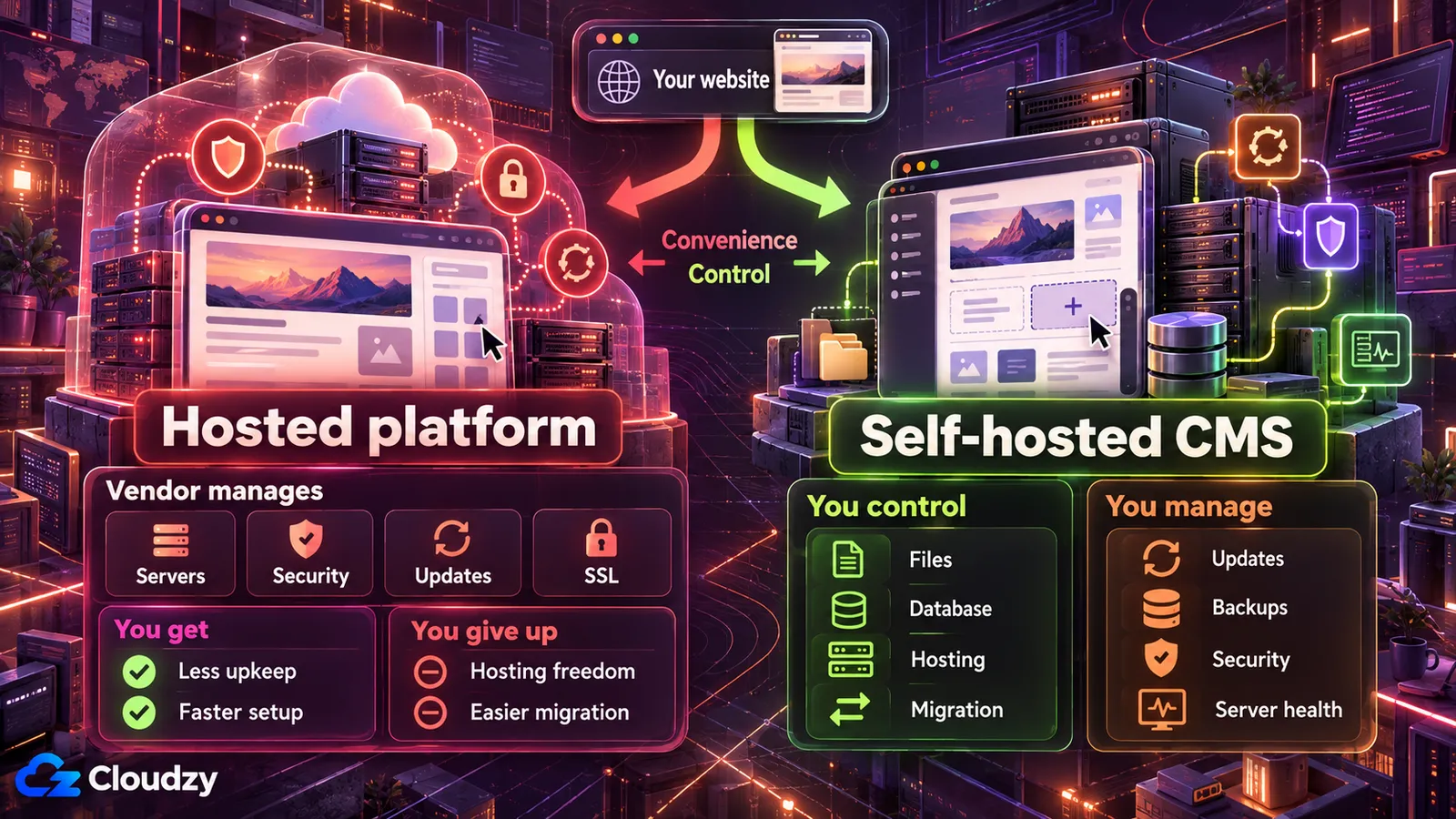
A Wix site cannot be moved to another host. Wix's help center explains that its SaaS architecture does not support external hosting, because the site depends on Wix's own technology to run.
A "website builder" and a "CMS" (content management system) are not opposites: hosted builders include content management, and self-hosted CMSs such as WordPress include page and theme editing. The split that affects an owner is who hosts and maintains the software.
The hosted side. The vendor runs the servers, applies security patches, and provides the SSL certificate (the file that lets the site load securely over HTTPS). You log in, edit, and publish. What you give up is control over the terms: features are tied to plan tiers, the subscription price is whatever the vendor sets at renewal, and leaving usually means rebuilding the site on a new platform. For a five-page service site that will be redesigned in a few years anyway, that rebuild can be a reasonable price for having no software to maintain.
The self-hosted side. You install the CMS software on a server you rent, so you control the site files and database and can move them to another host. The cost is ongoing work after launch. Someone has to:
- apply core software updates when they are released, including security releases
- update themes (the design templates) and plugins (add-ons), and check that the site still works afterwards
- run and test backups, so a failed update can be reversed
- upgrade the server's runtime when older versions stop receiving security fixes, such as the PHP version that WordPress and Joomla run on
- harden and watch the server itself: logins, firewall rules, and alerts when the site goes down
That "someone" can be you, a freelancer on a retainer, or a managed host that does the work for a higher fee. It cannot be no one. Self-hosting also has recurring costs of its own (the server, the domain, and any premium plugins), so it is not a way to avoid paying. It is a way to pay for control instead of convenience.
How the Platforms Compare
Cost is shown as a model rather than a price, because plan prices change often and vary by region.
| Platform | Who Hosts It | Cost Model | Moving Off Later | Best Fit |
|---|---|---|---|---|
| Wix | The vendor | Subscription plans; free plan on a wixsite.com address | Site can't be hosted elsewhere | Small sites edited without help |
| Squarespace | The vendor | Subscription plans after a 14-day trial | Tied to the platform's hosting | Design-led small sites and portfolios |
| Webflow | The vendor | Free Starter plan with 50 CMS items; paid plan for a custom domain or larger CMS site | Static code can be exported; CMS content and platform features need rebuilding elsewhere | Design-heavy sites with some custom code |
| Shopify | The vendor | Subscription after a 3-day trial | Tied to the platform's hosting | Online stores with minimal setup |
| WordPress | You (or a host you choose) | Free software; you pay for hosting | You own the files and database | Owned sites with someone to maintain them |
| Ghost | Either (self-hosted or Ghost(Pro)) | Free software, or a Ghost(Pro) subscription | You own the files and database | Newsletters and paid publications |
| Joomla | You (or a host you choose) | Free software; you pay for hosting | You own the files and database | Multilingual sites with a hands-on owner |
| Drupal | You (or a host you choose) | Free software; you pay for hosting and development | You own the files and database | Large or complex sites with a developer |
| Magento Open Source / Adobe Commerce | You (Open Source, or Commerce on-premises) or Adobe (Commerce cloud) | Free Open Source edition; Adobe Commerce is paid | You keep the files and database when self-hosted | Large catalogs with a development team |
| TYPO3 | You (or a host you choose) | Free software; you pay for hosting and development | You own the files and database | Large organizational sites with a developer |
| Craft CMS | You (or a host you choose) | Free Solo edition; paid Team and Pro | You own the files and database | Custom-designed sites built by a developer |
Hosted Builders
These four platforms sit on the hosted side of the first decision, so the trade described there applies to each of them. They differ in how much design freedom and how much commerce depth they give you.
Wix
Wix is a hosted website builder: Wix runs the servers, and you design and edit the site in its browser-based editor. It is aimed at people who want a working site without touching hosting at all.
Wix fits a small service business that needs pages, a contact form and perhaps bookings, and has no one to maintain software. The editor is also where Wix departs most visibly from the main self-hosted option: the feature table comparing Wix and WordPress sets drag-and-drop editing against a setup that asks for more effort and technical skill.
Pros:
- A free plan lets you build and test before paying
- Pages are edited visually, with no code
Cons:
- Free sites use an address like siteprefix.wixsite.com, so your own domain needs a paid plan
Squarespace
Squarespace is a hosted website builder built around designed templates, with hosting included. There is no free plan: Squarespace offers a 14-day free website trial before a subscription starts.
It suits a portfolio, restaurant or small service business where the look of the site carries weight and the owner wants to start from a finished design.
Pros:
- Designed templates as the starting point
Cons:
- A paid subscription once the trial ends
Webflow
Webflow is a hosted visual website builder with a built-in CMS for structured content such as blog posts or team pages. It is not limited to no-code work: Webflow says its builder avoids preventing additional customization through code.
That flexibility is also its cost for a non-developer. The editor uses web-design concepts (boxes, reusable style names called classes, and layout rules) that take time to learn, and that learning curve is the trade behind Webflow's customization compared with WordPress. The CMS side has plan limits as well: according to Webflow's pricing page, the free Starter plan allows 50 CMS items, but a custom domain or larger CMS site needs a paid site plan.
Pros:
- Detailed visual control over layout
- Custom code and scripts, site-wide or per page
Cons:
- A learning curve before editing feels routine
- 50-item CMS cap on the free plan
Shopify
Shopify is a hosted commerce platform: products, checkout, payments and the storefront run on Shopify's infrastructure. W3Techs reports that Shopify is used by 32.1% of all e-commerce systems in its surveys (as of October 2026).
Shopify fits an owner whose site exists mainly to sell, and who wants the store working without assembling one from plugins. Its pricing page offers 3 days free, followed by a low-cost introductory offer whose terms vary by region. A store that needs more control than a subscription platform allows can weigh free and open-source Shopify alternatives instead.
Pros:
- Checkout and payments included
Cons:
- A site that is mostly articles or service pages pays for commerce features it does not use
Self-Hosted Open-Source CMS Options
These three are free, open-source software that you install on a server. Each gives you ownership of the site along with its upkeep. They differ in what they are built to publish, and they are only part of the wider range of open-source CMS families.
WordPress
WordPress is open-source CMS software licensed under the GPL, which you install on your own hosting. It is the most widely used CMS: W3Techs reports that WordPress runs on 58.6% of websites whose CMS it can identify, which is 40.2% of all websites (as of October 2026).
Themes and plugins extend WordPress, and each one added is also code that someone, whether you, a freelancer or a managed host, has to keep updated and compatible.
Pros:
- Themes and plugins for a wide range of sites, from blogs to stores
Cons:
- An update to core, a theme or a plugin can break a page
Ghost
Ghost is an open-source publishing platform, released under the MIT license, built to publish articles, send newsletters and offer paid subscriptions to members. It is not a headless-only CMS: Ghost ships with a default front-end theme layer, and it can also be used headless when a developer builds a separate front end.
Ghost fits a writer or publication whose business is the audience itself. Newsletters and memberships are part of the core product, so that job does not depend on add-ons. Ghost(Pro) is Ghost's own managed hosting, which moves the upkeep to Ghost while keeping the same open-source software.
Pros:
- Built-in newsletters, memberships and paid subscriptions
- An editor designed around writing
Cons:
- Built for publishing, so a services site with complex page layouts is a weaker fit
Joomla
Joomla is a free, open-source CMS maintained by a volunteer community, with a current release of Joomla! 6.1.4 (September 2026). Its project describes it as extendable, multilingual and accessible.
In Joomla, menus and modules (the blocks that place content around a page) decide where content appears, so they have to be set up before the site behaves as intended. Joomla has also had a core Web Services API since version 4, so content can be delivered to other applications when needed.
Pros:
- Multilingual, as the project describes it
- A core Web Services API
Cons:
- A much smaller share of the web than WordPress: W3Techs puts Joomla at 1.1% of all websites (October 2026)
Self-hosting any of these three ends at the same requirement: a server that you, or whoever maintains the site for you, control. Cloudzy's WordPress VPS is that kind of server, a self-managed VPS (you install and maintain the software yourself) with root access (full administrator control of the server) and a 99.95% uptime SLA, and the same setup is offered as a Ghost VPS. Because it is self-managed, it fits a site with someone assigned to run the updates and backups above.
Platforms Worth Choosing Only With a Developer
The four platforms in this group are capable, but a non-developer should not choose them alone. Their setup, and many ordinary changes after launch, assume development skills, so the cost includes a developer's time for as long as the site exists.
Drupal
Drupal is open-source CMS software first released in January 2001, which makes it older than WordPress. It is built for structured, complex sites, and Drupal.org notes you can extend it with thousands of add-ons.
The project is moving toward non-developers: Drupal CMS 2.0 adds visual page building with Drupal Canvas and site templates. That lowers the entry point, but deciding how content is structured, which modules (add-ons) to install, and how major upgrades are handled still calls for a developer, which is where Drupal's path separates from WordPress.
Pros:
- Handles complex content structures and large sites
- Thousands of add-ons
- Free and open source under the GPL
Cons:
- Setup and structural changes assume a developer
- Upgrades and module compatibility need technical management
Magento Open Source and Adobe Commerce
Magento comes in two editions. Magento Open Source is the free, self-hosted edition. Adobe Commerce (formerly Magento Commerce) is the paid edition, which Adobe positions as including its cloud architecture and hosting. Adobe completed its acquisition of Magento in 2018.
Both editions are built for stores with large catalogs and dedicated development teams. For a small shop, the installation, extensions and upgrades cost more developer time than a small shop usually justifies. If you do have a developer, installing Magento on a VPS walks through the requirements and steps.
Pros:
- Built for large catalogs and complex store logic
- Deep customization for teams with the skills to use it
Cons:
- Installation and upgrades require a developer
- Adobe Commerce is a paid enterprise product
TYPO3
TYPO3 is an open-source CMS created by Kasper Skårhøj in 1997. Its current long-term support line is TYPO3 14, and thousands of extensions are listed in the TYPO3 Extension Repository.
Long-term support (LTS) releases give a fixed version to plan upgrades around. That predictability is most useful to an organization with a development team scheduling work years ahead, and least useful to an owner who needs to change a page next week.
Pros:
- Long-term support releases
- A large extension repository
- Free and open source
Cons:
- Setup and configuration assume a developer
Craft CMS
Craft CMS is a self-hosted CMS with its own proprietary license, not open source. Every Craft project starts with a free Solo license, and paid Team and Pro licenses add features such as user management.
Craft suits designers and developers building a custom site, who then hand content teams an editing interface shaped around that site. The templates behind it are written by a developer, so changing the design later means going back to one.
Pros:
- A free Solo edition for single-user projects
- Content structures are designed around the specific site
- Localization for multiple sites, languages and locales
Cons:
- Proprietary license, with paid editions for teams
- Design and structural changes require a developer
Where a Headless CMS Fits
A headless CMS stores and manages content but has no front end of its own. It delivers content through an API (a connection other software reads from), and a developer builds the website that displays it. The practical consequence for an owner is direct: changing page layout without a developer usually goes away, because the layout lives in code, not in the CMS. The technical side gets heavier too, since headless setups have more moving parts (a separate front end and back end) and require API integration work.
The main options fall into two groups. Strapi describes itself as an open-source, self-hosted headless CMS. Payload is also open source, and its team joined Figma with Payload remaining open source. Directus is self-hostable but source-available rather than open source, under its Monospace Sustainable Core License. On the vendor-hosted side, Sanity's editing Studio is open source but connects with Sanity's hosted APIs and Content Lake, and Storyblok is also offered as a hosted service.
Headless is a sound choice when a development team is building a site, an app and other channels from one content source. For a small site maintained by its owner, it adds a developer to every design change.
What AI Site Builders Do Now
Wix's first AI builder is already retired. As of 10 November 2024, Wix no longer supports sites created using the ADI (Artificial Design Intelligence) builder. Wix has since announced Wix Harmony as its new flagship AI website builder, built around an AI agent called Aria that edits the site from natural-language instructions.
The other hosted builders offer similar tools. Squarespace describes Blueprint AI as an AI design system for starting a new website, and Webflow's AI site builder generates a multi-page site from a description. Framer offers an AI website builder for designers and teams.
Self-hosted platforms add AI through extensions. For WordPress, the Jetpack AI Assistant block helps draft, transform, translate, and improve content, including translation into 12 languages, and Jetpack AI also generates titles and summaries. Drupal CMS 2.0 lists optional AI tools with governance.
None of this changes the first decision. AI can help create or edit a site, but the hosting model still determines who controls the software and how easily the site can move.
Which CMS Should You Choose?
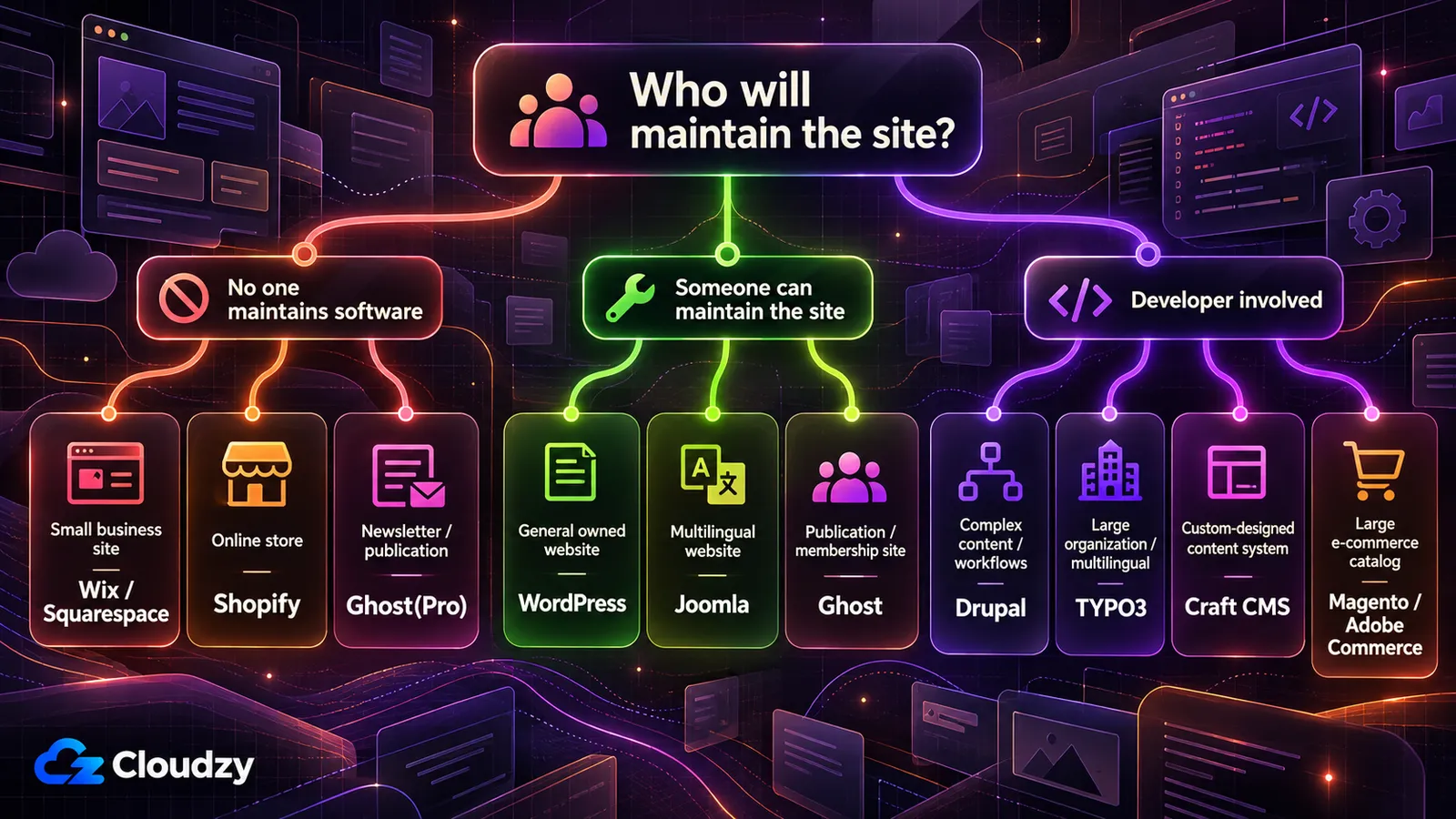
The right platform follows from who will maintain the site after launch and what the site mainly has to do. For a small site edited alone, the default recommendation here is a hosted builder. Self-hosting pays off when ownership or flexibility matters and someone can keep the software maintained.
- A small site you will edit yourself, with no one to maintain software. Choose Wix or Squarespace. Upkeep settles this one: with no one to apply updates, a hosted builder takes that work away.
- An online store you want running quickly. Choose Shopify, because setup time is the constraint and its checkout and payments work without assembling plugins. Move to Magento Open Source or Adobe Commerce only when the catalog is large and a development team is available.
- A newsletter, blog or paid publication. Choose Ghost, on Ghost(Pro) if no one will maintain a server. Fit settles this one: Ghost is built for this job.
- A site a freelancer builds and hands over to you. Choose WordPress if the freelancer or a managed host will keep handling updates, or a hosted builder if you will be alone after the handoff. The question to settle is who owns maintenance once the build is paid for, so agree on it before the build starts.
- A site you want to own outright, with someone to maintain it. Choose WordPress, or Joomla if multilingual content is central. Control is the priority here, because owning the site matters more to you than avoiding upkeep.
- A large catalog, many languages, or complex editorial workflows. Choose Drupal, TYPO3, Craft CMS or Magento, and only with a developer involved from the start. The limiting factor is complexity, which these platforms are built to carry and small-site tools are not.
Frequently Asked Questions
What Is the Best CMS Overall?
There is no single best CMS; the right one depends on who will maintain the site. WordPress is the most used, at 40.2% of all websites according to W3Techs (October 2026), but that popularity does not make it the right fit for every owner. If you will edit the site alone with no one to maintain software, a hosted builder such as Wix or Squarespace is usually the better choice. If you want to own the site and have help with upkeep, WordPress is a strong default.
Can I Move My Site From Wix to WordPress Later?
You can move your content, but not the Wix site itself. Wix's help center states that Wix sites cannot be hosted elsewhere, so moving to WordPress means recreating the design and pages on WordPress and copying the content across.
Do I Need a Developer to Run WordPress?
Not to publish content: writing posts and editing pages works through the WordPress admin panel. Keeping the site healthy does need regular attention from someone, whether that is you, a managed host or a freelancer, for the update, backup and security tasks every self-hosted site needs.
Which CMS Should I Use for an Online Store?
Start from one rule: use a hosted store unless someone will maintain a server for you. Shopify is the hosted route, with checkout and payments included. Magento Open Source and Adobe Commerce are the heavier self-managed or enterprise route, and they assume a development team from the start.


Discussion
Comments
Sign in to join the discussion.