


Crypto transaction fees can feel like a burden, especially when high fees eat into the value of the transaction itself. It doesn’t even matter if you’re trading or just experimenting with new wallets; these fees can add up quickly. However, not all cryptocurrencies have high transaction costs; some are designed to be much cheaper to transfer, making them more practical for everyday use.
Transaction fees are essential for maintaining the security and functionality of blockchain networks, paying miners or validators who process and validate transactions. Fees can vary based on factors like network congestion, transaction size, and the blockchain’s design. For example, Ethereum’s gas system can cause fees to spike, especially during times of high demand, while networks like Solana optimize for lower transaction fees by design.
For businesses, remittance senders, and everyday users, high transaction fees can negate the advantages of using crypto in the first place. In this guide, we’ll focus on the cheapest crypto to transfer, helping users save money while making crypto more accessible to all.
Top Cryptocurrencies with the Lowest Transaction Fees
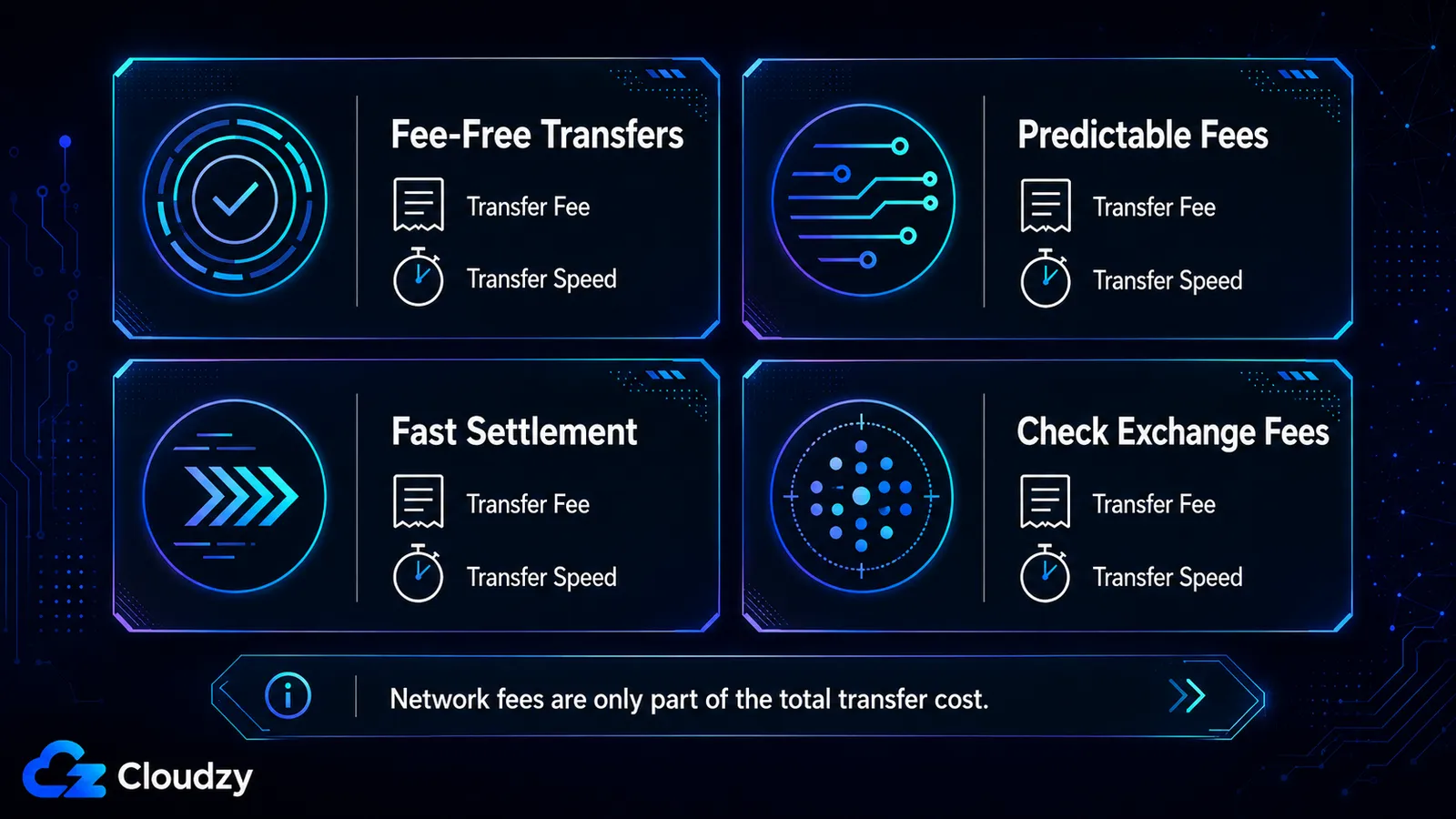
Alright, we’ve discussed why transaction fees are such a big deal, and now it’s time to talk solutions. Let’s cut straight to the point: not all cryptos are highway robbers when it comes to fees. Some are fast, cheap, and downright practical for everyday use. These options rank highly as crypto with the lowest transaction fees, making them perfect for frequent users. Others? Well, they’ll have you questioning your life choices after one transaction.
This section is all about the cheapest crypto to transfer. I’ve pulled together a mix of popular names and underrated gems because sometimes the best low-fee options aren’t the ones hogging the spotlight. Whether you’re sending a quick $5 to a friend or paying for something online, these cryptocurrencies won’t break the bank.
One important distinction before we get to the numbers: the figures below describe typical on-chain transfers, not exchange withdrawal fees. Costs can change with network activity, transaction complexity, priority settings, and the market price of each coin. An exchange may charge much more than the underlying blockchain requires, so always check the final fee shown by your wallet or platform before confirming a transfer.
| Cryptocurrency | Typical Network Fee | Typical Time | Best Fit |
|---|---|---|---|
| Nano (XNO) | No network fee | Usually under 1 second | Microtransactions, everyday payments |
| Stellar (XLM) | Minimum 0.00001 XLM per operation | Around 5 seconds | International payments, remittances |
| XRP | Normally 0.00001 XRP for a standard transaction | Around 3–5 seconds | Fast global transfers |
| Solana (SOL) | 0.000005 SOL base fee per signature, plus any priority fee | Usually under 1 second | Payments, tokens, dApps |
| Litecoin (LTC) | Variable; usually very low | First block in about 2.5 minutes | Everyday transfers |
| Bitcoin Cash (BCH) | Variable; generally a fraction of a cent | First block in about 10 minutes | Peer-to-peer payments |
| TRON (TRX) | Free within the daily bandwidth allowance; about 0.27 TRX otherwise | A new block about every 3 seconds | Frequent small transfers |
| Dogecoin (DOGE) | Recommended 0.01 DOGE per kilobyte | First block in about 1 minute | Tips and small everyday payments |
| Hedera (HBAR) | USD-denominated fee starting around $0.0001, paid in HBAR | Finality in a few seconds | Predictable low-cost transfers |
| Algorand (ALGO) | Normally 0.001 ALGO for a basic transaction | Finality in roughly 3 seconds | Fast, affordable payments |
Fee basis checked against current protocol documentation from Nano, Stellar, XRP Ledger, Solana, TRON, and Hedera. Fees remain subject to change.

Nano (XNO)
Nano doesn’t just win the title of the cheapest crypto to transfer; it redefines the game. Zero network fees. Near-instant transfers.
Nano’s unique block-lattice structure ensures every transaction is feeless and usually confirmed in under a second. It’s perfect for microtransactions or sending small amounts without feeling like you’re losing money. People love how simple and efficient it is, though availability on wallets and exchanges is more limited than it is for larger coins. By skipping transaction fees entirely, Nano keeps costs at an absolute zero while offering sustainability and speed that’s hard to beat. According to the Nano documentation, its network is designed around ultrafast transactions with zero fees.
With its feeless structure and lightning-fast speeds, Nano leads as the cheapest crypto to transfer for frequent, low-value transactions.
Stellar (XLM)
As a crypto with the lowest transaction fees, Stellar is a favorite for remittances and cross-border payments. With a network minimum of 0.00001 XLM per operation under normal conditions, it’s a low-fee crypto that makes global transfers affordable. Stellar connects financial systems worldwide, and transactions typically settle in around five seconds.
Users value its reliability for international payments, especially for remittances. Its consensus protocol keeps everything secure without energy-draining mining, making it a no-brainer for businesses or anyone trying to dodge high transfer costs. Keep in mind that Stellar can enter surge pricing when demand exceeds network capacity, as explained in the official fee documentation.
XRP
XRP is a go-to option for fast, affordable international transfers, making it a standout among crypto with the lowest transaction fees. A standard XRP Ledger transaction normally requires a minimum fee of 0.00001 XRP, although the required fee can rise when the network is busy. Transactions typically settle in around 3–5 seconds.
Users appreciate its efficiency and scalability, though some take issue with Ripple’s close association with banks and financial institutions. It’s important to keep the names straight: XRP is the asset being transferred, while Ripple is a company that builds products using XRP and the XRP Ledger. For anyone looking for crypto with the lowest transaction fees, XRP remains a strong option for low-cost, high-speed global transfers. The current minimum and load-based fee rules are available in the XRP Ledger documentation.
Solana (SOL)
To be completely honest with you, Solana is hard to beat. A standard transaction has a base fee of 0.000005 SOL per signature, plus an optional priority fee, and payments usually settle in under a second. It’s a top choice for developers, token users, and anyone working with dApps. Solana’s users value its scalability and ability to handle high volumes of transactions. It’s not just fast and cheap; it’s a low transaction fee crypto that’s built for high-throughput applications. See Solana’s current fee structure for the base-fee and priority-fee mechanics.
Litecoin (LTC)
Litecoin is, in some sense, Bitcoin’s no-nonsense sibling: faster, cheaper, and just as reliable. Its network fees vary with transaction size and demand but are generally low, while a new block is produced roughly every 2.5 minutes. People trust Litecoin for its stability and affordability, making it one of the cheapest coins to transfer without cutting corners.
Regardless of whether you’re transferring $5 or $500, Litecoin is a reliable option for anyone looking for the cheapest coin to transfer, and it has also stood the test of time while staying cost-efficient.
Bitcoin Cash (BCH)
Bitcoin Cash takes Bitcoin’s strengths and increases block capacity to keep everyday transfers affordable. It’s a clear standout among crypto with the lowest transaction fees for both small and large transactions. Its fees are generally a fraction of a cent, while the first on-chain confirmation takes about 10 minutes on average. That makes it useful for peer-to-peer payments, although an unconfirmed transaction appearing in a wallet is not the same as a confirmed transaction.
If scalability and low fees are your priorities, BCH remains a strong low transaction fee crypto option.
TRON (TRX)
TRON charges for transfers in bandwidth rather than a classic fee. Every account gets 600 free bandwidth points over a rolling 24 hours, and a basic TRX transfer needs about 270, so a couple of transfers a day cost nothing. When the free allowance runs out and you haven’t staked TRX for more bandwidth, the network burns TRX instead: about 0.27 TRX for that same transfer at the current rate. Blocks arrive roughly every three seconds, so transfers confirm quickly.
This model rewards regular users, who can stake TRX for more bandwidth. The rate is a chain parameter that TRON’s governance can change, and token transfers such as USDT on TRON also consume energy, so they usually cost more than a plain TRX transfer. TRON’s resource documentation lists the current rates.
Dogecoin (DOGE)
Dogecoin began as a meme coin, but its fee model is built to stay cheap. The Dogecoin Core wallet recommends a fee of 0.01 DOGE per kilobyte, and since version 1.14.5 that fee is charged on the exact transaction size, so a simple transfer of around 200 bytes costs about 0.002 DOGE. A new block arrives roughly every minute, so the first confirmation comes much sooner than on Bitcoin.
Wide wallet and exchange support makes DOGE easy to send and receive, and its low fees suit tips and small everyday payments. The recommended fee is a default rather than a fixed price, and very small outputs under the 0.01 DOGE dust limit are either rejected or cost extra. The Dogecoin Core fee recommendation explains these defaults.
Hedera (HBAR)
Hedera stands out because its transaction fees are priced in US dollars and converted into HBAR when the transaction is submitted. Basic transfers start at a tiny fraction of a cent, making the cost more predictable even when HBAR’s market price moves. Transactions also reach finality within seconds, which makes HBAR practical for micropayments, high-volume applications, and everyday transfers.
That predictable fee model gives Hedera a useful advantage over networks where costs swing sharply with token prices or congestion. The exact charge still depends on the transaction type and can change, so use Hedera’s mainnet fee estimator when you need a current figure.
Algorand (ALGO)
Algorand keeps things simple, affordable, and fast. A basic transaction normally carries a minimum fee of 0.001 ALGO, and transactions reach finality in roughly three seconds, making it a strong contender for the cheapest crypto to transfer. Built on a pure proof-of-stake system, Algorand is as energy-efficient as it is cost-effective.

Final Thoughts
Minimizing transaction fees doesn’t have to be a headache, especially when you rely on the cheapest crypto to transfer. That said, aside from choosing one of the cheapest cryptos to transfer, there are plenty of practical strategies to keep costs low. For Bitcoin transfers, use a wallet that supports native SegWit addresses, which can reduce transaction size and therefore lower the fee compared with older address formats. If you’re deciding between wallet types, Cloudzy’s guide to cold storage wallets explains the security side of that choice.
If you’re frequently trading, limit orders may qualify for lower maker fees, depending on the exchange. If your wallet or platform supports transaction batching, combining several payments can also reduce the average on-chain cost per recipient.
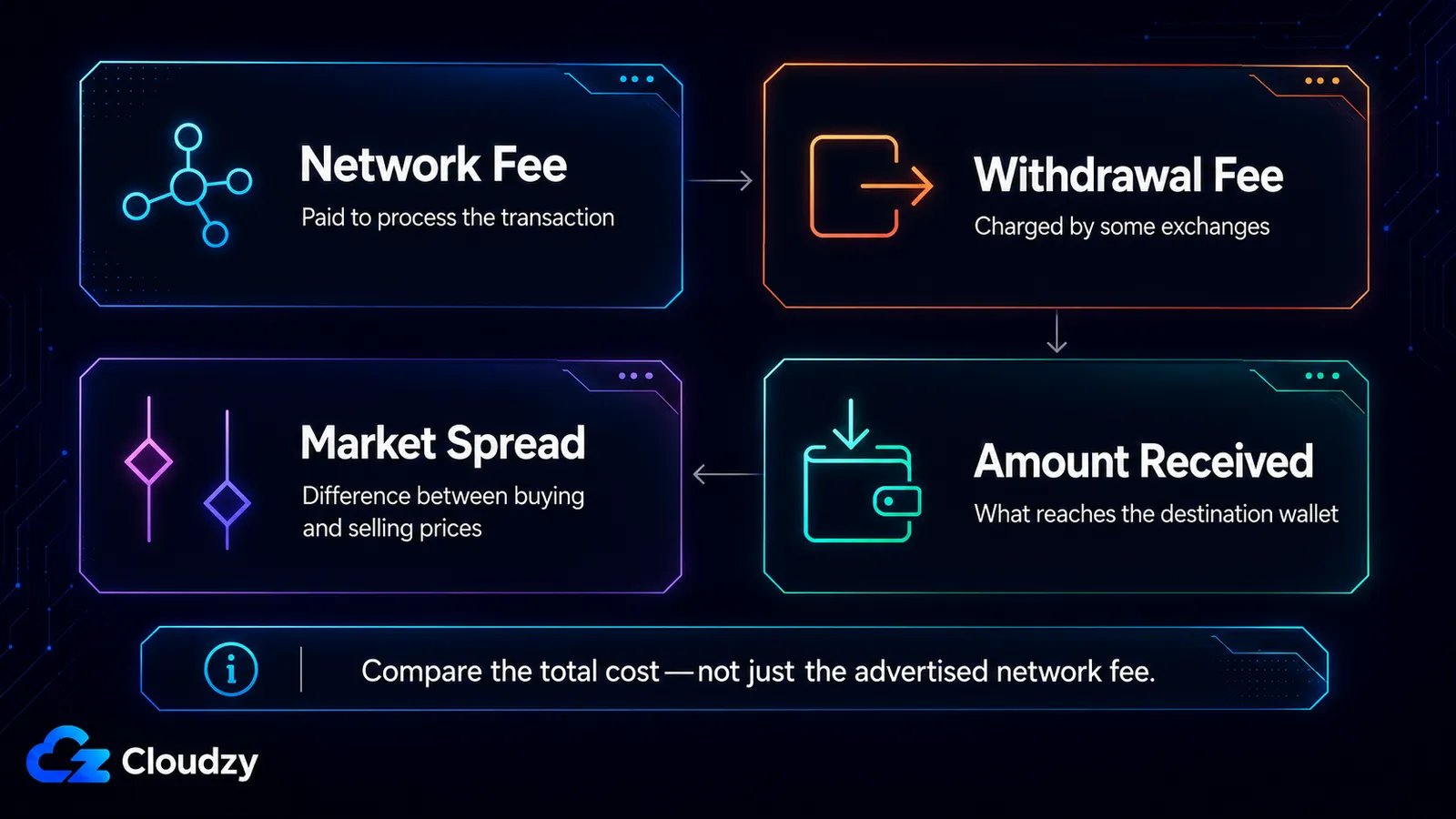
For faster, cheaper Bitcoin payments, explore layer-2 solutions like the Lightning Network or keep an eye on network congestion and plan your transfers during off-peak times. Compare the full cost before using a decentralized or centralized exchange, since trading fees, network fees, spreads, and withdrawal charges vary widely across platforms.
Finally, consider leveraging native exchange tokens for discounted trading fees or monitoring withdrawal fees to avoid unnecessary costs. Most importantly, confirm that the sender and recipient support the same coin and network before transferring funds. With these strategies in mind, you can save on fees, speed up transactions, and make your crypto experience as efficient as possible.
FAQ
Which crypto has the lowest transaction fees?
Nano (XNO) takes the lead in the cheapest crypto to transfer debate, with no network fees and transactions usually confirmed in under a second, making it ideal for microtransactions. Stellar (XLM) has a minimum fee of 0.00001 XLM per operation under normal conditions, while standard XRP Ledger transactions normally require a minimum fee of 0.00001 XRP. Hedera also stands out for predictable, USD-denominated fees starting at a fraction of a cent. Exchange withdrawal charges may still be much higher than the underlying network fee.
Which crypto wallet has no transaction fees?
No wallet can make every on-chain network fee disappear. Some custodial wallets may subsidize fees or process transfers internally, but external blockchain withdrawals can still involve network fees, service charges, minimum withdrawal amounts, or other restrictions. Always review the wallet’s current fee schedule and confirm whether the transfer will happen on-chain before sending funds.





Discussion
Comments
Sign in to join the discussion.