

You load a world you've been playing for a few weeks. The AI companion that lives in it greets you by referencing the base the two of you built on the ridge, the night you nearly died in a ravine because you dug straight down (it warned you), and the fact that you always forget to eat until your health bar is flashing. It brings those moments back as a sequence, making the world feel as though it has been keeping notes.
You don't. Not like that. You remember the ridge, sort of, and the ravine only because it's telling you about it right now.
VoxelMind is a Fabric mod that entered Early Access in May 2026 and gives a Minecraft world an AI companion with persistent memory across sessions. It isn't a local AI running entirely on your machine: VoxelMind hosts its backend and database infrastructure in Germany, while selected game state and memories can also be processed by Google, Anthropic, and OpenRouter in the United States. I want to follow one question through it, because the question turns out to be more interesting than the mod: what happens if you try to delete that memory? The answer depends on what you do. Cancelling a subscription limits recall without erasing the memories VoxelMind says it retains. Deleting the bot's data is supposed to remove its memories, events, and learned knowledge. Deleting the account goes further and removes the account and its associated data. Those are three very different meanings of "forgetting."
The Short Version
- VoxelMind stores several forms of companion memory, including spatial locations, events, learned knowledge, and a private journal. A personality model sits on top and drifts with the companion's experiences. Its privacy policy separately says events older than three hours are automatically "decayed," without explaining exactly how that relates to the product's broader permanent-memory claims.
- Cancelling a paid plan does not erase stored memories. The companion falls back to the free tier's rolling 7-day recall window; older memories remain stored but are not retrieved.
- Actual deletion is separate. VoxelMind's privacy policy says the dashboard's "Delete Bot Data" control removes all bot memories, events, and knowledge while keeping the account. It also says "Delete Account" removes the account and all associated data.
What the Companion Actually Remembers
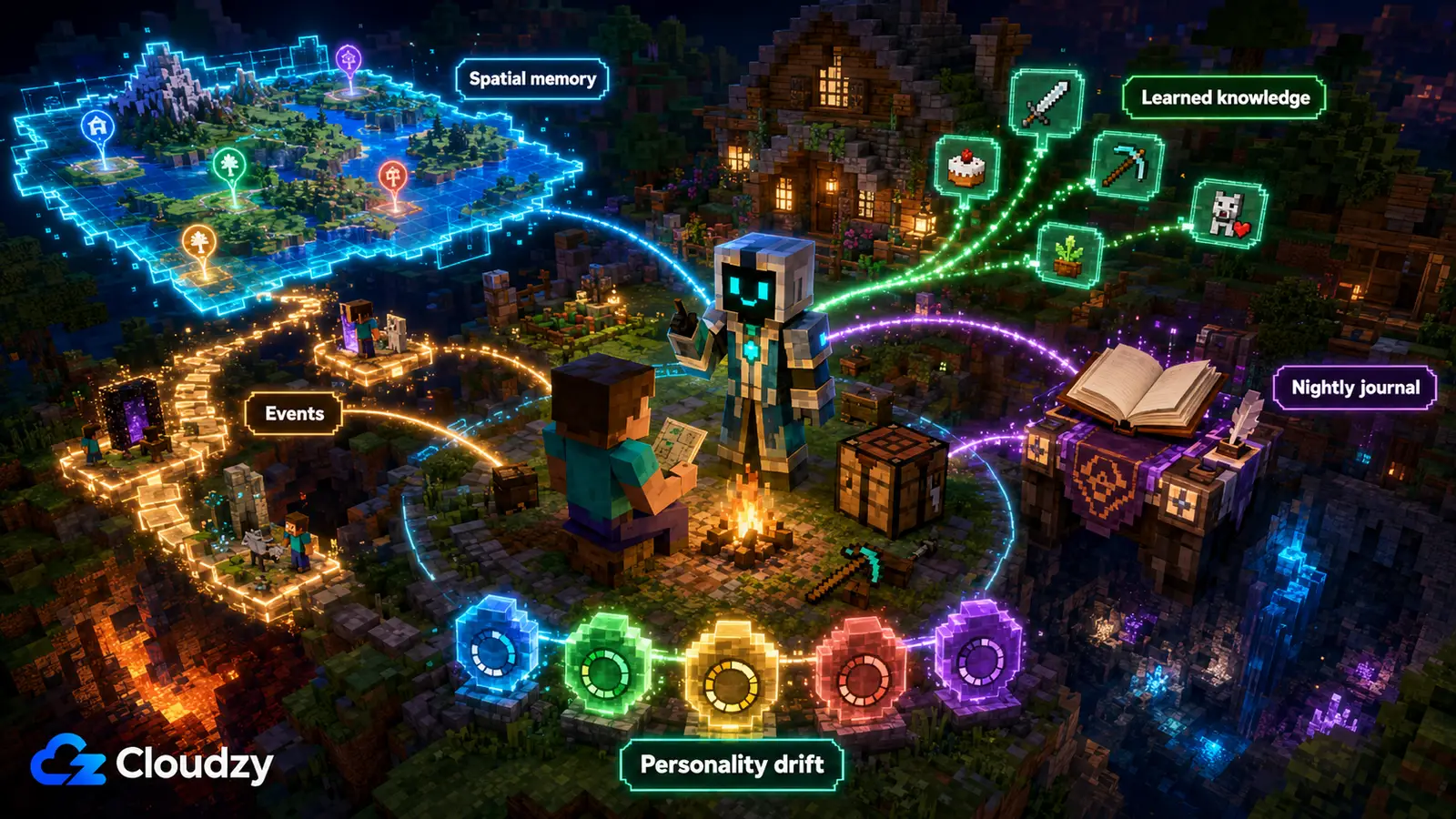
Start with the journal, because it's the part that got under my skin. Each in-game night, the companion writes an entry about what it witnessed that day, in its own words, in its own voice. Not a log file. A diary. It is keeping a record of you in a form that feels personal, even though the record is generated and stored by a service.
Underneath the journal are the memory stores VoxelMind names in its own privacy policy: spatial memory for locations, event data for actions, and learned knowledge generated during play. Together, those records let the companion connect the present moment to things that happened earlier instead of responding as if every session were the first. That durable state also separates VoxelMind from engine-replacing world models, where persistent, inspectable memory remains a core technical problem; our guide to games without a game engine explains why.
On top of that runs a personality system based on the OCEAN traits: openness, conscientiousness, extraversion, agreeableness, and neuroticism. VoxelMind describes those traits as drifting with experience. Two companions that begin alike can therefore diverge as their histories diverge, though the public material does not spell out a precise formula linking each player action to each trait.
Here's the part that everything after this rests on: the companion's durable state is not stored in your Minecraft save. VoxelMind says the mod keeps only authentication tokens locally, while bot memories, events, and learned knowledge are stored through its backend services. Its database and backend hosting are based in Germany, but selected game state and stored memories are also sent to Google, Anthropic, and OpenRouter for AI processing, with data transfers to the United States covered by contractual safeguards. That's not automatically a criticism. It's the architecture, and it changes who controls recall, retention, processing, and deletion.
Cancellation Is Not Deletion, But Deletion Exists
There is a memory-deletion control. It just isn't the same thing as cancelling a subscription.
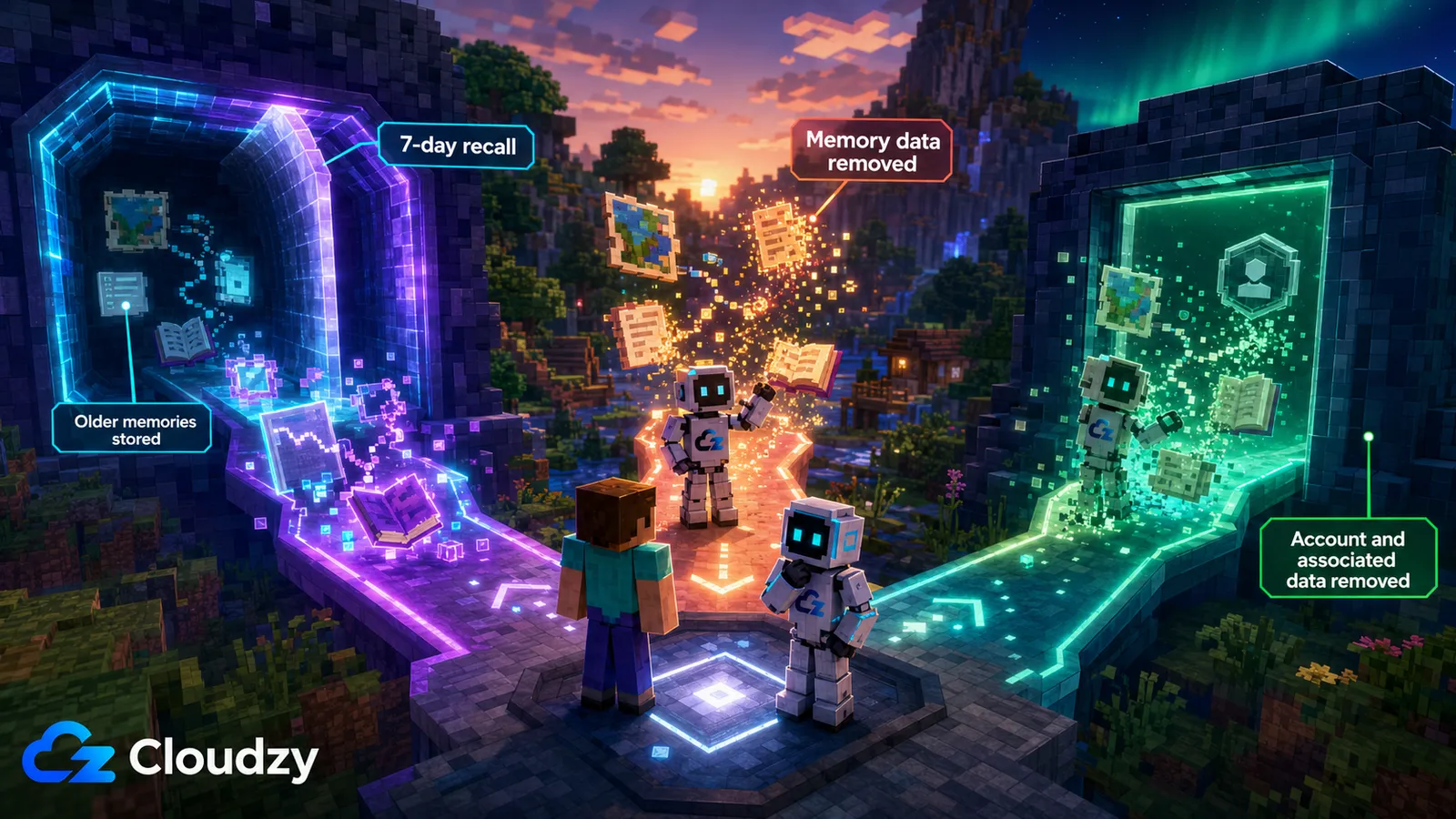
I went looking for the clean version of the thing people mean when they say "make it forget me." VoxelMind documents two controls in its dashboard settings. "Delete Bot Data" removes the bot's memories, events, and knowledge while leaving the account intact. "Delete Account" permanently removes the account and all associated data, including bots and authentication records. The retention section says account data is deleted within 30 days, although it does not publish a separate deletion timeline for every associated data category.
Cancelling does something else. VoxelMind markets its paid tiers as providing unbounded, permanent recall. Cancel, and the companion falls back to the free tier, where it recalls a rolling 7-day window. Older memories stop surfacing. The companion starts acting as if the distant past has gone soft, referencing only recent material and letting the ridge and the ravine slide out of reach.
VoxelMind's pricing page says it plainly: "All memories stay in the database, nothing is deleted." In the context of cancellation, the free tier does not erase the stored history; it changes what the companion retrieves.
That distinction matters. Cancellation can look like forgetting from inside the game, but VoxelMind describes it as a retrieval limit. The separate bot-data control is its documented eraser, and account deletion is broader still. One caveat remains: the pricing page says nothing is deleted when recall narrows, while the privacy policy says events older than three hours are automatically "decayed." The public documents do not explain whether decay means deletion, compression, summarization, or a change in retrieval weight, so it would be unsafe to claim that every raw event record remains intact forever.
I didn't build a paid companion over weeks, cancel it, restore it, and then delete its data to audit every stage. I want to be straight about that. What I'm doing here is reading the mechanics off VoxelMind's current pricing, terms, and privacy pages and following where they point. They clearly distinguish cancellation from deletion, but they do not give us a forensic view of backups, database replicas, event decay, or every processor's deletion timeline.
The Memory Was Never Symmetrical
Go back to the greeting. You and the companion "remember each other." That's the whole appeal. But only one of you wrote it down.
Your side of that shared history is a normal human memory: lossy, decaying, reconstructed on the fly, and yours. The companion's side is a set of queryable records controlled by a company and processed through cloud infrastructure. VoxelMind's policy offers dashboard deletion controls and lists GDPR rights, which matters, but users still depend on the provider and its processors to implement those promises. Two things called "memory," doing different jobs. The word papers over the difference, and the deletion question is what tears the paper.
A 2025 arXiv preprint by Rasam Dorri and Rami Zwick, Memory Power Asymmetry in Human-AI Relationships: Preserving Mutual Forgetting in the Digital Age, names the broader issue directly. Humans forget; AI-enabled firms can retain and selectively retrieve far more of a shared history. The authors argue for safeguards such as forgetting by design, contextual containment, and symmetric access to records. I read their frame as the general version of what VoxelMind makes specific and playable, not as a verdict on this one product.
I want to be careful not to swing this into a doom take, because it isn't one. A companion that keeps a persistent journal of your Minecraft world is not sinister, and the fact that its memory lives on someone else's infrastructure doesn't make the afternoons with it fake. What it makes them is a different kind of thing than the word "remember" quietly promised. When a friend remembers you, the memory is theirs and it fades. When VoxelMind remembers you, recall is a product feature, retention is a service policy, and forgetting can mean either a paywall, a delete command, or the end of the account.
So the deletion question is still the tell, just not for the reason I first expected. The product documents an eraser. But before you reach it, you have to separate three states that feel similar from inside the game: the companion cannot retrieve an old memory, the user has invoked a control that the policy says deletes the bot's stored data, or the entire account has been removed. The emotional experience may be "it forgot me" in all three cases. Architecturally, they are nothing alike. That gap between felt memory and managed data is the stranger, more honest description of what this companion is doing.
Frequently Asked Questions
Does VoxelMind run the AI locally or in the cloud?
Mostly in the cloud. VoxelMind says its backend, database, and "Brain server" are hosted in Germany, not on your computer, and the mod stores nothing locally beyond authentication tokens. However, active-agent data and stored memories can also be sent through OpenRouter to Google's Gemini and Anthropic's Claude services for AI processing, which can involve transfers to the United States. The companion's durable memory is therefore server-side rather than part of your Minecraft save.
What happens to a VoxelMind companion's memory if you cancel your subscription?
The companion falls back from what VoxelMind markets as unbounded recall to the free tier's rolling 7-day window. Older memories stop surfacing, but VoxelMind says they remain stored and become available again if the paid plan is restored. Cancellation limits retrieval according to the pricing page and terms; it is not the same action as deleting bot data.
Can you fully erase what a VoxelMind companion knows about you?
According to VoxelMind's current privacy policy, yes. The dashboard's "Delete Bot Data" option is described as removing all bot memories, events, and knowledge while keeping the account. "Delete Account" is described as removing the account and all associated data, including bots, bot data, and authentication records. The policy says account data is deleted within 30 days. These are the provider's documented deletion commitments, not an independently audited guarantee of its backend behavior.

Discussion
Comments
Sign in to join the discussion.