
On July 14, 2026, thousands of listeners opened Spotify and got silence. During the outage, Downdetector reports surged from about 2,000 to more than 8,000 within roughly 45 minutes, then fell sharply as the issue was resolved in under an hour. Spotify's public status page recorded no incident, and its Spotify Status account posted no update; a moderator later marked the issue as fixed on Spotify Community.
If you are here looking for the best Spotify alternatives, the outage is only the trigger. Behind it is a longer pattern: recurring downtime and three U.S. price increases since July 2023. Spotify still offers more than 100 million tracks, lossless playback, and mature discovery tools, so for many people it remains the right default. This guide is for the people it has stopped serving well.
The alternatives below are sorted by the specific thing that pushed you here, not ranked as interchangeable products. One of them, self-hosting, removes Spotify from the availability chain, but it also makes you responsible for the server.
TL;DR
- The right pick depends on the frustration: Apple Music for the easiest mainstream switch, Tidal or Qobuz for hi-res audio, YouTube Music for a free ad-supported option, and self-hosted Navidrome for a library you control.
- Spotify's user-visible outages recur, and U.S. Premium Individual rose from $9.99 to $12.99 between July 2023 and early 2026.
- Self-hosting removes dependence on a streaming provider's central service; it does not eliminate outages. Your server, hosting provider, network, and backups become your responsibility.
- Self-hosting is a control decision, not a guaranteed savings decision. Spotify's encrypted offline downloads cannot be imported into Navidrome, so you need music files you are legally allowed to use.
Is Spotify Down Right Now, or Is It Just You?
When Spotify stops playing, check a third-party tracker before troubleshooting your own setup. Downdetector and StatusGator aggregate user reports in real time; a broad spike is stronger evidence of a service problem than one failed device. Cross-check Spotify's own status page too, but do not treat it as the only source: StatusGator currently gives that page an F rating, which under its methodology means incidents are acknowledged four or more hours late on average. On July 14, Spotify's page still showed no incident during the report spike.
That delay mattered on July 14: users reported failures within minutes while the official page remained green. For a live incident, compare the crowd signal with Spotify's own channel instead of trusting either one alone.
If you just want music in the next five minutes, start with the free options. YouTube and ad-supported YouTube Music work in a browser without a paid subscription. Eligible new subscribers can also start trials of Apple Music, Amazon Music Unlimited, Tidal, or Qobuz. These are temporary workarounds, but they get sound back while you decide whether to switch.
Spotify's Reliability and Price Record
The frustration is a record, not a mood. StatusGator has monitored Spotify since August 2020 and says it has logged more than 1,091 user-affecting incidents in almost six years. That figure includes minor warnings and crowdsourced reports, not just major global outages. Five larger incidents made news in the last 15 months:
- April 16, 2025: about 5 hours 25 minutes; more than 48,000 U.S. reports at the peak
- June 12, 2025: a Google Cloud outage disrupted Spotify; more than 44,000 U.S. reports at the peak
- December 15, 2025: nearly 36,000 U.S. reports and more than 10,300 in the U.K. at the peak
- May 12, 2026: about 4 hours 48 minutes; more than 14,000 reports at the peak
- July 14, 2026: more than 8,000 reports during the spike; reports fell sharply within about an hour
Read that list carefully: many incidents resolve within a few hours, but larger outages can last around five hours. This is not a catastrophic-reliability story. It is a persistent-annoyance story, and the two call for different responses.
The price has been less ambiguous. U.S. Premium Individual rose from $9.99 to $10.99 in July 2023, to $11.99 in June 2024, and to $12.99 after Spotify's January 2026 announcement. That is three increases in about two and a half years, all in the same direction, alongside recurring user-visible outages.
Section takeaway: Spotify's outages are usually temporary, but they recur, and the U.S. Individual price has risen three times since 2023. Neither fact is a crisis on its own; together they are why people start looking.
Streaming Alternatives, Sorted by What's Bugging You
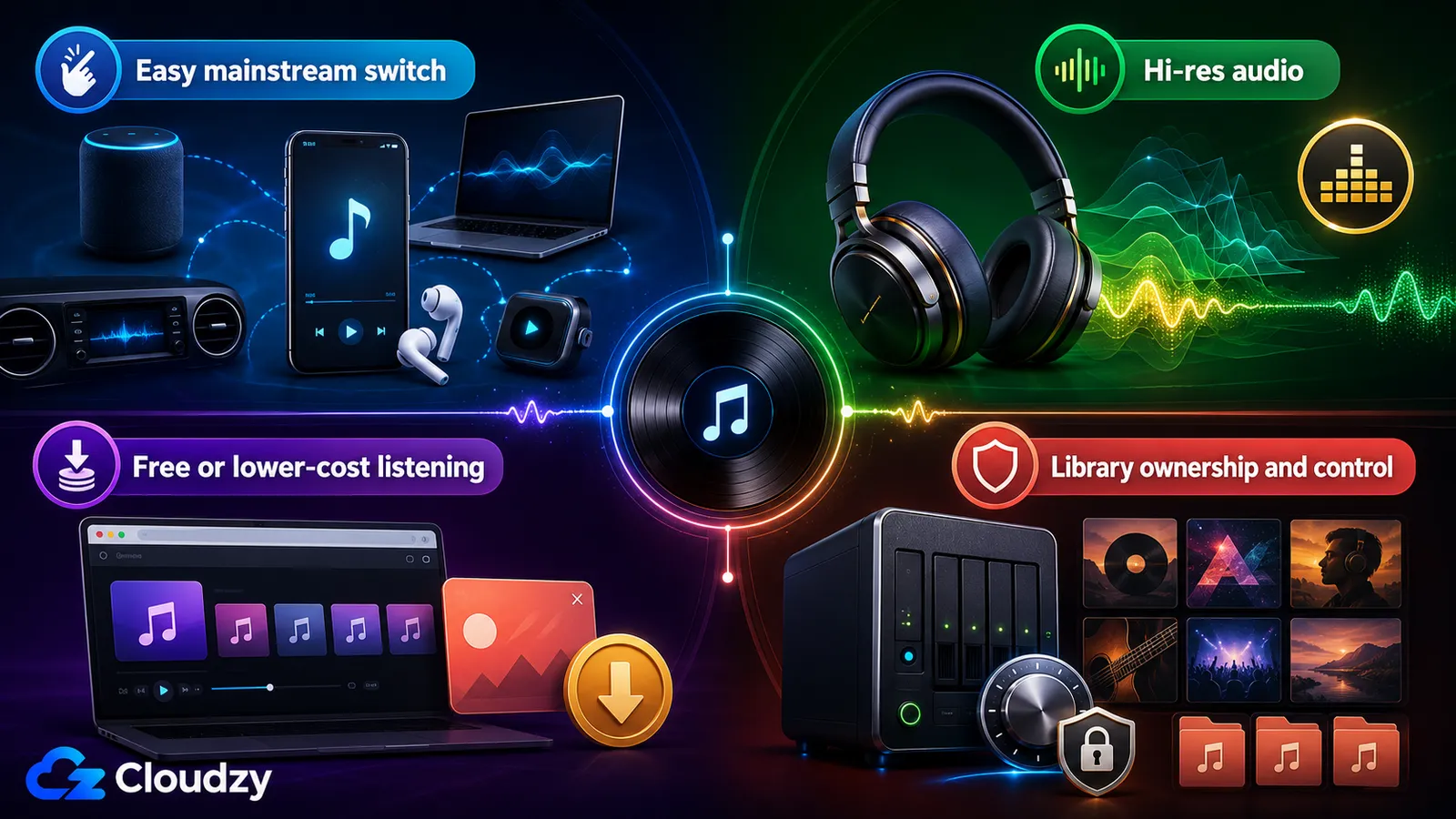
Start with the frustration, then pick the tool. Here is the mapping.
| What's frustrating you | Best pick | Why | Main limitation |
|---|---|---|---|
| I want the easiest mainstream switch | Apple Music | 100M+ tracks, lossless and hi-res lossless, Dolby Atmos, and apps across major platforms | No permanent free tier |
| I want the strongest hi-res options | Tidal or Qobuz | Both stream hi-res lossless; Tidal also offers Dolby Atmos, while Qobuz emphasizes editorial depth | Discovery feels less central than on Spotify |
| I want a free tier or a lower price | YouTube Music (free, with ads) or Amazon Music Unlimited for Prime members | YouTube Music has an ad-supported tier; Prime members get a lower Unlimited price | Background playback requires YouTube Music Premium; Amazon Music Unlimited remains a separate subscription |
| I want to own my library and control where it runs | Navidrome (self-hosted) | Runs on infrastructure you choose and plays your own files | You manage storage, backups, security, and uptime; no bundled catalog |
The last row is a different kind of answer, and it gets its own section below. The first three are all managed streaming services: you are swapping one subscription for another, and the choice comes down to which frustration you are solving.
The prices are close together. The U.S. figures below are current as of July 15, 2026; check each service's own page before subscribing, because regional prices and promotions change.
| Service | Individual monthly | Notable |
|---|---|---|
| Apple Music | $11.99 | 100M+ tracks; lossless, hi-res lossless, Dolby Atmos |
| Amazon Music Unlimited | $12.99 ($11.99 for Prime members) | 100M tracks; HD and Ultra HD lossless |
| Tidal | $10.99 | 180M+ tracks; lossless, hi-res FLAC, Dolby Atmos |
| YouTube Music | $11.99 (YouTube Premium bundle: $15.99) | Ad-supported free tier; Premium adds background playback and downloads |
| Qobuz | $12.99 ($10.83/month with annual billing) | 100M+ tracks; lossless and hi-res FLAC up to 24-bit/192kHz |
Quick verdict: For most people leaving Spotify for reasons other than price, Apple Music is the softest landing: the same basic subscription model, broad device support, and hi-res lossless plus Dolby Atmos. If audio quality is the main complaint, Qobuz is the purist pick and Tidal is the broader all-rounder. If the bill is the problem, YouTube Music is the only permanent, no-cost option in this table, but background playback and offline downloads require YouTube Music Premium.
One thing neither table can promise is uptime. Switching from one managed streaming service to another changes who runs the servers; it does not remove your dependence on a provider's infrastructure. Self-hosting changes that tradeoff, which is why the next option deserves separate treatment.
Owning Your Music: Self-Hosting with Navidrome
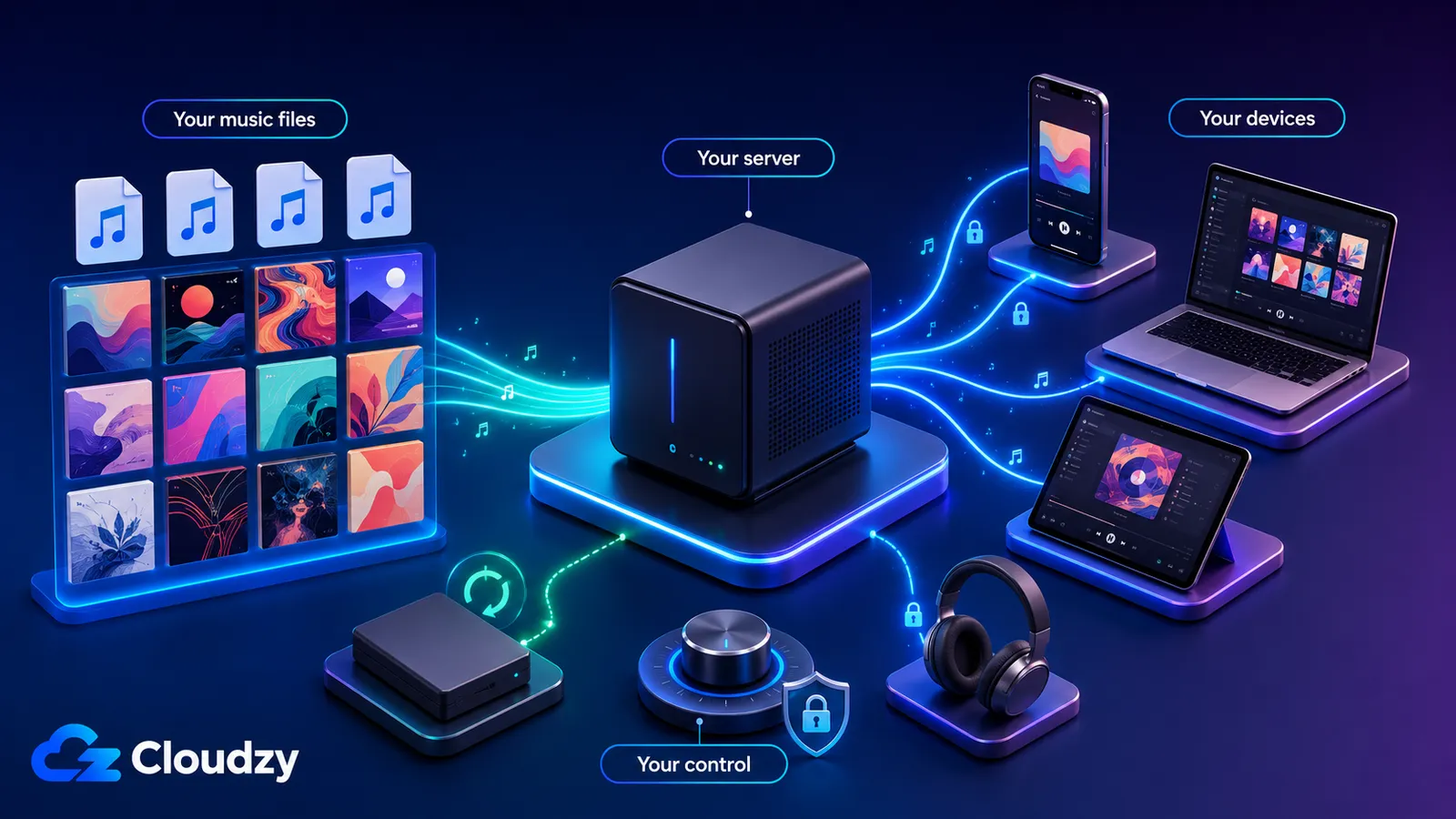
Navidrome is a lightweight, open-source music server written mainly in Go. Point it at a folder of music files, and it indexes and streams them through a web interface or compatible apps. Navidrome is free under the GPL-3.0 license. As of July 15, 2026, its GitHub repository has about 22.3K stars and the latest stable release is v0.63.2, published July 11, 2026 -- strong signs that the project is actively maintained.
Two things Navidrome does not do, stated plainly because they decide whether it fits you:
- It has no bundled catalog. Spotify offers access to more than 100 million tracks; Navidrome plays the files you supply, which you must acquire and use legally.
- It does not reproduce Spotify's global discovery feed. Smart playlists, compatible clients, and integrations can add recommendations, but Navidrome still cannot stream a track that is not in your library.
What you get in exchange is control. Navidrome supports the Subsonic API and OpenSubsonic extensions. Its official directory currently lists 80 apps and players, including Symfonium on Android, Feishin on desktop, and Amperfy on Apple devices. There is no central Navidrome streaming service whose outage takes every user offline. Your own instance can still fail if the server, hosting provider, network, DNS, or storage fails.
The cost caveat: Self-hosting is a control decision, not a guaranteed savings decision. You run the server, handle security and backups, and become your own IT support. A neglected instance can have more downtime than a managed streaming service. Navidrome is free; the maintenance is not.
Navidrome's resource usage is low: the official Docker image cites less than 50MB of RAM for a 300GB, roughly 29,000-song library. For a small personal instance, a 1GB VPS gives the operating system and application practical headroom; active transcoding and multiple listeners may need more CPU and memory. Storage is the real planning variable. Check the size of your library, allow room for artwork, cache, backups, and growth, and do not assume a 25GB disk is enough unless the collection is small or stored elsewhere.
If you do not have a spare always-on machine at home, a small Linux VPS is a low-friction place to run it, and this is where we come in. Cloudzy's Linux VPS lineup includes a one-click Navidrome marketplace image, so you can deploy the application without building the stack by hand. That removes Spotify from the availability chain; your music still depends on the VPS, its network, and the backups you maintain.
Setting Navidrome up end to end, from file tagging and storage sizing to backups and your first mobile client, is a separate job worth its own walkthrough. If you want one server for movies, live TV, photos, and music, Jellyfin covers a broader media library and is also available as a one-click Cloudzy app.
What Actually Transfers When You Switch
Here is the distinction that trips people up: a streaming-to-streaming transfer can copy library and playlist metadata by matching tracks in the destination catalog, but it does not move Spotify's downloaded audio. Spotify stores offline downloads in encrypted form and licenses its content rather than selling or transferring it to you. Those downloads cannot be imported into Navidrome.
Apple Music and YouTube Music expose transfer flows in their apps or websites, but both may rely on third-party services. Tidal and other platforms also use partners such as TuneMyMusic or Soundiiz. Matches are not perfect, so some tracks may need review. Navidrome is different: a playlist file can preserve the track list, but the server can play only music files you legally possess or are authorized to use.
Set that expectation before you start. Moving from Spotify to another streaming service can be mostly automated. Moving from Spotify to Navidrome cannot: you must supply the audio files and rebuild any unmatched playlist entries around those files.
You Don't Have to Pick Just One
The most useful answer for a lot of readers is not a single winner. Keep a streaming service for what streaming is good at, and run Navidrome for what ownership is good at.
Streaming still wins on breadth and discovery: the album you want to hear once, or the algorithm that surfaces something new on a Tuesday. Navidrome wins on ownership and control: your curated files cannot disappear because a label changes its streaming license. Availability still depends on your server, storage, and connection. These are complementary tools. Streaming is your discovery layer; the server is your vault.
Own the core, stream the discovery. For anyone tired of watching songs vanish from playlists but unwilling to give up finding new music, that split is the pragmatic answer, and it asks less of you than fully committing to either extreme.
Frequently Asked Questions
What Is the Best Spotify Alternative?
It depends on why you are leaving. For the easiest mainstream switch, Apple Music. For hi-res audio, Tidal or Qobuz. For a permanent free tier, YouTube Music. Amazon Music Unlimited can cost less if you already have Prime. To own your library and control where it runs, use a self-hosted server such as Navidrome.
What Do I Do When Spotify Is Down?
Check a third-party tracker such as Downdetector or StatusGator, then compare it with Spotify's status page and test another device or connection. If reports are spiking, wait or use YouTube Music's free tier, YouTube in a browser, or a trial for another service.
What Happens to My Playlists When I Switch?
Apple Music and YouTube Music can import library or playlist data through transfer tools, and Tidal and Qobuz support partner-based transfers. These services match tracks in their own catalogs, so some items may not transfer cleanly. Spotify's encrypted offline audio does not transfer to Navidrome; you must supply your own legal files.
How Much Does Self-Hosted Music Cost?
Navidrome itself is free. The real cost is an always-on machine or VPS, enough storage for your library and backups, and the time to secure and maintain it. Self-hosting may be inexpensive, but it is mainly a control decision -- not a guaranteed way to spend less than a streaming subscription.


Discussion
Comments
Sign in to join the discussion.