
A workflow that fires 100 times a day and completes five action steps consumes 15,000 Zapier tasks per month. Zapier counts each successful action, while triggers and certain built-in steps do not count. At that volume, the selected task tier matters. The same workflow can run on self-hosted n8n without a per-execution software fee, but the VPS resources and the time required to operate it are still real costs.
But the math is where many "Zapier alternative" articles stop, and where the real questions begin. Which tool fits which job? What does the n8n Sustainable Use License actually permit? How much time will you spend keeping the deployment healthy? This guide compares five self-hosted Zapier alternatives: n8n, Activepieces, Automatisch, Node-RED, and Huginn. It focuses on current pricing, licensing, deployment needs, and the operational trade-offs that easy cost comparisons leave out. Cloudzy sells the infrastructure, not any of these workflow engines, so there is no preferred software vendor here.
The Short Version
n8n remains the strongest default for general SaaS and API automation because it has the broadest catalog and the most mature self-hosting path in this group. Its Community Edition is source-available under the Sustainable Use License, which permits internal business use but restricts selling access to n8n or using it as the value-bearing engine of a commercial product. Activepieces has a more Zapier-like interface and an MIT-licensed core, although its enterprise and embedding features use a commercial license. Node-RED is the specialist choice for IoT and event-driven hardware. Automatisch and Huginn are narrower options. There is no honest universal task threshold where self-hosting wins; the answer depends on your action count, required features, VPS size, and the value of your administration time.
The Real Cost Crossover: When Self-Hosting Beats Zapier
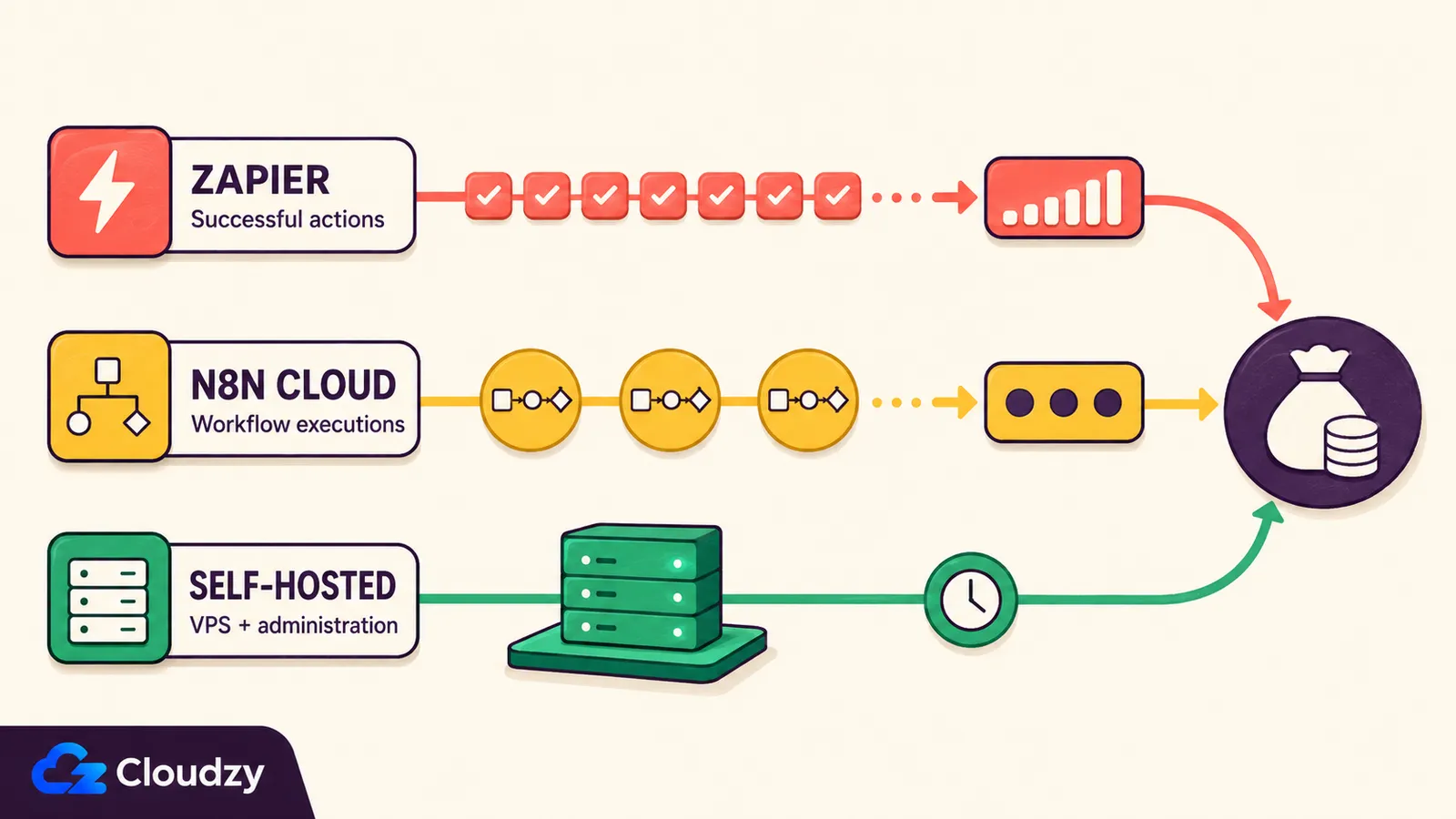
Zapier Professional currently starts at $19.99 per month, while Team starts at $69 per month. The actual bill changes with the task tier and billing cadence, so a live quote is more reliable than a fixed example from an older pricing table. n8n Cloud Starter is currently EUR 20 per month when billed annually and includes 2,500 workflow executions, unlimited steps, unlimited active workflows, and five concurrent executions. Self-hosted n8n Community Edition has no per-execution license fee. On Cloudzy, the regular list price is $14.95 per month for 2 GB and $28.95 for 4 GB; temporary sale prices may be lower.
That makes the raw infrastructure comparison simple but not universal. A small VPS can cost less than Zapier Professional before you reach a specific task count, while Zapier Free or a low-volume Professional plan may still deliver better value because the platform handles updates, backups, and service reliability. For a useful comparison, count successful Zapier actions, not just workflow runs, and price the exact task tier you would need.
Self-hosting is not free; it is differently priced. Model administration time explicitly instead of hiding it. A useful budget uses low, expected, and high cases such as 2, 5, and 10 hours per month. At a loaded rate of $75 per hour, those cases add $150, $375, and $750 to the monthly cost. Your real number may be lower once the stack is stable, but updates, backup tests, monitoring, credential failures, and recovery work do not disappear from the cost model.
Self-hosting often wins on raw infrastructure cost once you need a paid automation tier. The all-in winner depends on operational time, reliability requirements, and how quickly task usage grows.
How These Five Tools Actually Stack Up
n8n: The Default Pick for Most Teams
n8n's repository describes 400+ direct integrations, while its public directory currently lists nearly 2,000 entries when triggers, core nodes, AI nodes, and related components are counted separately. That distinction matters when comparing it with tools that count connected services instead of individual nodes. Docker-first installation, queue mode, and JavaScript or Python code nodes make n8n the most flexible general-purpose option in this group.
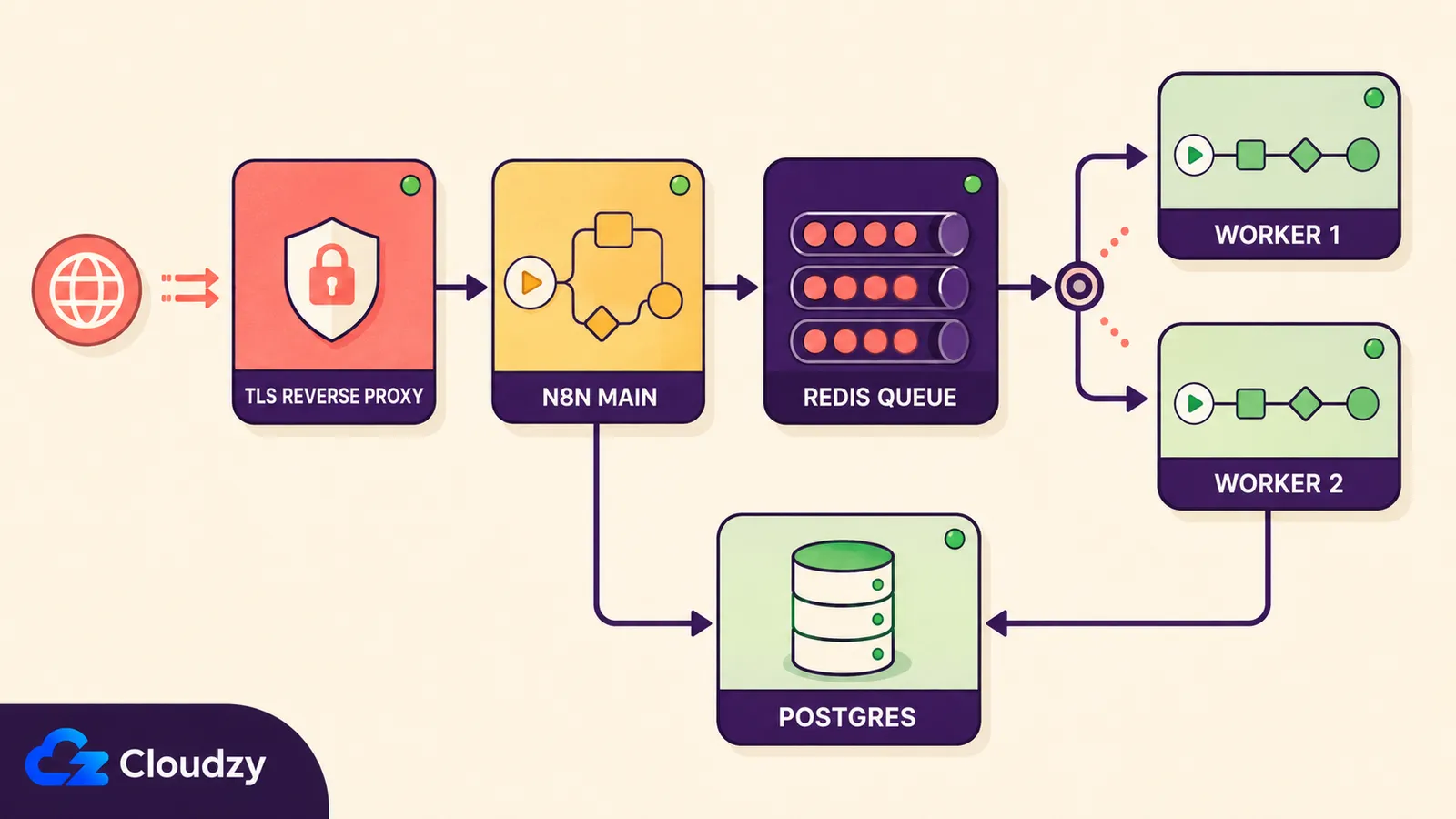
The single-container Docker quickstart is fine for evaluation and small workloads. For a more durable deployment, use Postgres instead of relying on the default SQLite database, place n8n behind a reverse proxy for HTTPS, and configure backups. Redis becomes necessary when you enable queue mode and add workers; it is not a requirement for every production installation. The right architecture depends on throughput and recovery goals, not the label "production."
The license is the part most teams get wrong. n8n uses the Sustainable Use License, which n8n describes as fair-code rather than OSI-approved open source. Internal business use is allowed, as are consulting and support services built around a client's n8n deployment. The license does not allow white-labeling n8n and charging customers for it, hosting n8n and charging people for access, or building a commercial product whose value substantially derives from n8n without a separate agreement. If customer-facing embedding is on the roadmap, review n8n's Embed licensing instead of relying on a rule of thumb.
The Community Edition also excludes projects, SSO through SAML or LDAP, workflow and credential sharing, and Git-based version control. Project roles and granular RBAC are not available in Community Edition. These are capability boundaries, not a reliable team-size threshold; even a small team may need them if users must be isolated from one another.
Our Take: n8n is the best default in this group for technically comfortable teams that want broad integrations and deployment flexibility. Check the license early if customers will interact with the product.
Pro Tip: Move to queue mode when measured concurrency, latency, or worker isolation requires it. Do not use an arbitrary executions-per-minute threshold; load-test your own workflows because node behavior and external API delays dominate capacity.
n8n is the default for general SaaS and API automation, but customer-facing resale or embedding requires a careful license check.
Activepieces: The Easier UI, MIT License
Activepieces has an MIT-licensed core and a trigger/action interface that feels closer to Zapier than n8n's node graph. Enterprise and cloud-only code is commercially licensed, so "MIT licensed" describes the core Community Edition rather than every feature in the repository. The permissive core is useful when you want to customize or build around the software, but teams that need packaged embedding, SSO, audit logs, or custom RBAC should check the commercial edition.
The repository lists integrations for more than 200 services. Activepieces also exposes automation capabilities through MCP, but MCP server counts are not directly comparable with n8n node counts or Zapier app counts. Use the services your team actually needs as the load-bearing comparison, then test authentication, triggers, and missing actions before migrating.
The UX is closer to Zapier's trigger/action format than n8n's node-graph view, which can reduce migration friction for non-technical operators. The current upstream hardware guide allocates 1 GB each to PostgreSQL and Redis, 4 GB to the app, and 4 GB per worker replica. A one-worker stack therefore totals about 10 GB before operating-system overhead, while the default Docker Compose setup starts five worker replicas. A lightweight pilot can run smaller, but 16 GB is the safer single-server starting point for the upstream component guidance; use more capacity or separate services for the default worker count.
Pick Activepieces if you want a Zapier-like UX or a permissively licensed core. Verify the commercial license if you need its packaged enterprise or embedding features.
Automatisch: The Simple-Stack Option
Automatisch Community Edition uses AGPL-3.0 and offers a smaller catalog centered on common business apps. It is the simple-stack option when the exact integrations you need are already supported and you prefer its straightforward trigger/action model.
The integration library is the binding constraint. Audit every required trigger and action before choosing it for a migration. The AGPL does not prohibit commercial network use in the same way as n8n's Sustainable Use License; instead, if you modify the AGPL-covered program and let users interact with it over a network, you must offer those users the corresponding source code. Treat embedded SaaS use as a legal review item, especially because the repository also contains commercially licensed Enterprise files.
Automatisch is right for small teams running a handful of mainstream integrations and wrong for anything beyond that.
Node-RED: Different Tool, Different Job
Node-RED is not a direct Zapier replacement. It is an event-driven flow-programming environment built for IoT, MQTT, and hardware integrations, and it is often miscategorized in Zapier-alternative lists.
The right way to think about Node-RED: if your trigger is an MQTT topic, a Modbus register, a Home Assistant state change, a serial port, or a GPIO pin on a Raspberry Pi, Node-RED is exactly the tool. Its official Flow Library currently lists more than 6,100 community node packages, but that number is not equivalent to 6,100 polished SaaS connectors. For Slack, Google Sheets, Stripe, or HubSpot automation, n8n or Activepieces usually provides a more natural operator experience.
Pro Tip: If your trigger is an MQTT topic, a GPIO pin, or anything event-driven from physical hardware, stop reading and use Node-RED. If your trigger is "a new Google Sheet row," keep reading.
Node-RED is the right answer for IoT and hardware-driven automation, and the wrong answer for SaaS workflow replacement.
Huginn: Honest Mention, Not a Recommendation
Huginn's latest tagged release remains v2022.08.18 from August 2022. The repository still receives commits, but the long gap between tagged releases is a maintenance signal worth respecting. That does not make Huginn unusable; it means teams should test the current container, dependencies, and upgrade path before treating it as a low-maintenance choice.
Huginn is genuinely good software for a specific niche: scheduled scraping, alerting chains, and agent-style monitoring. The agent paradigm is fundamentally different from Zapier's trigger-action model; Huginn agents poll, react, and chain like email filters with timers wired into them. If you're migrating Zapier workflows, you'll be re-architecting, not porting. Add Ruby and Rails operations on top of that, and the all-in cost of running Huginn rises above the equivalent n8n deployment for most teams. Recommend it if you specifically want the agent paradigm, you're comfortable with Ruby/Rails operations, and you don't need recent integrations. Otherwise, look elsewhere.
Huginn is a niche tool with a strong fan base and a stalled release cadence; pick it deliberately or pick something else.
Comparison Table
| Tool | License | Integrations | Best For | Starting VPS | Main Caveat |
|---|---|---|---|---|---|
| n8n | SUL, source-available | 400+ direct; ~1,950 directory entries | General SaaS and API automation | 2 GB pilot; 4 GB+ practical | Resale and value-bearing embedding restricted; Community lacks sharing, SSO, Git, and RBAC |
| Activepieces | MIT core; commercial EE | 200+ services | Zapier-like UX and customizable core | 2 GB pilot; 16 GB+ reference | Enterprise and embedding features are commercial; production stack needs more RAM |
| Automatisch | AGPL-3.0 CE; commercial EE | Smaller catalog | Mainstream trigger/action workflows | 1 GB light use | Audit app coverage; AGPL source obligations apply to modified network use |
| Node-RED | Apache-2.0 | 6,100+ community node packages | IoT, MQTT, and hardware events | 1 GB light use | Package count is not equivalent to polished SaaS connectors |
| Huginn | MIT | Built-in agents | Monitoring, scraping, and alert chains | 2 GB | Latest tagged release is from August 2022; Ruby/Rails operations |
n8n is the broadest general-purpose choice; Activepieces offers a simpler interface and permissive core; Node-RED specializes in event-driven and hardware automation; Automatisch and Huginn fit narrower requirements.
The n8n Sustainable Use License: What's Actually Allowed
The Sustainable Use License allows n8n to be used for internal business purposes. That includes a company using n8n to automate its own operations, regardless of company size or revenue. It also permits consulting and support work around client deployments. These permissions are broad enough for most internal automation projects, but they do not turn the software into an unrestricted open-source component for any commercial product.
Allowed examples include synchronizing your company's own data, building internal workflows, modifying n8n for internal use, and helping a client configure or operate its own instance. The safest reading is to anchor the use case to the official examples, not to whether the customer happens to know that n8n is involved.
The restricted cases are customer-facing monetization of n8n itself: white-labeling it and charging customers, hosting it and charging for access, or using it as a substantial part of a commercial product's value. n8n offers separate Embed agreements for product integration. If the boundary is commercially important, get written guidance from n8n or qualified counsel rather than relying on an article summary.
Two details matter. First, n8n calls the model fair-code, and it is more accurate to describe Community Edition as source-available than as OSI-approved open source. Second, licenses and commercial plans can change. Re-check the current license before launching a customer-facing service or product. Activepieces' MIT core and Automatisch's AGPL Community Edition offer different freedoms and obligations; neither should be summarized as simply "more open" without naming the trade-off.
Internal business use of n8n is allowed; selling access, white-labeling it, or embedding it as a substantial commercial product component requires different terms.
VPS Sizing and the Real Operational Cost
For a small n8n pilot, Cloudzy's 2 GB plan is the catalog starting point at a regular $14.95 per month. The 4 GB plan at $28.95 provides more practical headroom for Postgres, a reverse proxy, and moderate workloads; queue mode adds Redis and workers, so load-test before calling 4 GB a production guarantee. Cloudzy's marketplace lists 1 GB for light Automatisch and Node-RED deployments, and 2 GB for Huginn, n8n, and Activepieces. Activepieces' upstream production reference architecture is substantially larger: even one worker brings the component guidance to about 10 GB before operating-system overhead, so 16 GB is the safer single-server starting point for that reference stack.
Cloudzy's marketplace lists one-click images for n8n, Activepieces, Automatisch, Huginn, and Node-RED. The n8n hosting page provides a direct deployment path on Ubuntu. These images remove much of the initial installation work, but you still own application updates, backups, workflow testing, credentials, and recovery.
The ops tax is a line many "Zapier vs self-hosted" comparisons skip. n8n releases frequently, so updates need a tested schedule. Caddy or Traefik can automate TLS renewal, but database backups, workflow exports, restore tests, monitoring, and alerting still need owners. Upstream APIs also change authentication and response formats, which can break a workflow regardless of where the engine runs. Use observed monthly administration time in the cost model and keep a high-case budget for upgrades or incident recovery.
Budget for the VPS, routine administration, and occasional recovery work. A three-case time estimate is more honest than pretending the VPS invoice is the entire cost.
Picking the One That Fits
For technical teams, start with n8n after reviewing its customer-facing license limits. Choose Activepieces for a Zapier-like interface, Node-RED for hardware, Automatisch when its catalog fits, and Huginn for deliberate monitoring or scraping.
Avoid a fixed 750-task rule. Compare the live Zapier tier with the VPS, administration, backup and monitoring, and downtime. Low volume may favor Zapier; higher action counts favor self-hosting. Self-hosting is differently priced, not free.
Frequently Asked Questions
Is n8n Really Free to Self-Host?
Yes, for internal business use. n8n's Sustainable Use License also permits consulting and support around client deployments. It does not permit white-labeling n8n, charging for access to a hosted n8n service, or using n8n as a substantial part of a commercial product without separate terms. Community Edition lacks projects, SSO, sharing, Git-based version control, and project RBAC.
What Is the Cheapest Way to Run n8n on a VPS?
Cloudzy's 2 GB plan has a regular list price of $14.95 per month and is the marketplace starting point for n8n. The 4 GB plan at $28.95 adds headroom for Postgres. Queue mode adds Redis and workers, so size from measured memory and concurrency rather than treating 4 GB as a universal production minimum.
Activepieces vs n8n: Which Should I Pick?
Pick Activepieces for a Zapier-like trigger/action interface or an MIT-licensed core; check its commercial license for packaged enterprise or embedding features. Pick n8n for the broader ecosystem, flexible node graphs, and mature scaling path. Compare required services and actions, not incompatible headline integration counts.
Can I Migrate My Zapier Workflows Directly to n8n?
There is no official Zapier-to-n8n importer. n8n can import its own workflow JSON, but Zapier workflows usually need mapping and rebuilding, credential reconnection, and full testing. Third-party converters can help, but they do not replace validation. Migrate the highest-cost workflows first.
Is Node-RED a Good Zapier Alternative?
Only if your triggers are IoT-, MQTT-, or hardware-driven. Node-RED's event-driven model fits physical systems. For SaaS-app automation, n8n or Activepieces usually provides a more natural trigger/action experience.


Discussion
Comments
Sign in to join the discussion.