


The best VPS in Europe depends on why you need a European server. A customer contract might require German hosting. A testing workflow might need an IP recognized as British. An application serving Dutch customers might need shorter, more consistent network routes. Those requirements can lead to different providers and locations.
Start by separating four goals: keeping infrastructure or data in a required jurisdiction, obtaining a country-specific IP address, hosting near customers, and connecting reliably to their networks. A provider can meet one goal without satisfying the others. Europe is a continent with several jurisdictions, and an EU location is a narrower choice.
In this guide, we explain our European VPS offering, consider five credible alternatives, and show how to check location, resources and costs before choosing. The aim is a shortlist that fits your application and obligations.
What Cloudzy offers for VPS hosting in Europe
Four locations with different jurisdictions
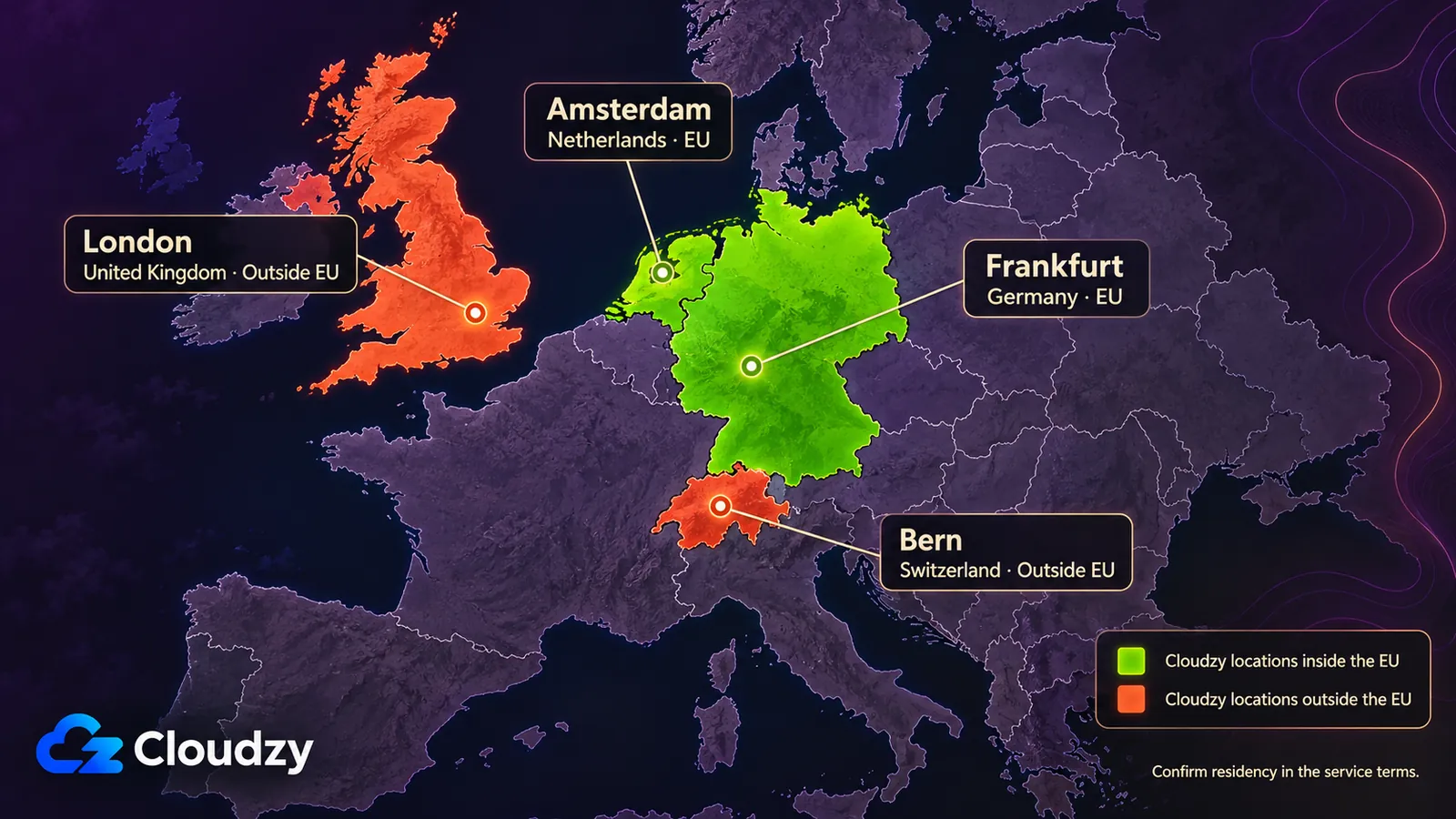
We offer four European locations, two inside the EU:
| Location | Jurisdiction | Practical starting point |
|---|---|---|
| Amsterdam, Netherlands | EU | Benelux and Northern European audiences; Dutch hosting requirements |
| Frankfurt, Germany | EU | German-speaking markets and German hosting requirements |
| London, United Kingdom | Outside the EU | British audiences and UK-specific requirements |
| Bern, Switzerland | Outside the EU | Swiss-specific hosting requirements |
Amsterdam and Frankfurt have substantial network interconnection ecosystems, making them sensible candidates for applications serving nearby markets. That context does not establish the route from a particular customer's ISP to your VPS.
Choose the required jurisdiction first. A UK server cannot satisfy an EU-only requirement, and Bern is not an EU location either.
Storage, CPU allocation and network capacity
Our regular VPS offering uses dedicated AMD EPYC vCPUs, with NVMe SSD storage and DDR5 memory described in its infrastructure documentation. NVMe is relevant to database activity, container-image downloads and other storage-intensive work, but the storage interface alone does not tell you the I/O performance your application will receive.
The separate Ryzen 9 High Performance VPS line comes with dedicated vCPUs with clock speeds of 4.2 GHz+. Consider that allocation for sustained processing, builds or CPU-heavy services where contention matters. A higher clock-speed headline also cannot predict every application's response time.
Regular configurations span from 512 MB up to 64 GB of memory. Size RAM, disk and CPU together: a small utility and a database-backed application need different starting allocations. The smallest configuration is not suitable for every deployment image.
Choose an OS or start with an application image
Our Linux VPS catalog includes familiar choices such as Ubuntu, Debian, AlmaLinux and Rocky Linux. Choose a supported version that matches your application's dependencies. For concrete deployment examples, our OS images list Ubuntu from 20.04 up to the latest version, with Debian options depending on the image.
For a containerized web application or staging stack, our one-click Docker VPS reduces initial installation work. Its required minimum is 1 GB RAM, with Ubuntu 26.04/24.04 LTS or Debian 13 options. Allow additional memory for the containers themselves.
For website administration through a panel, CloudPanel lists a 2 GB minimum and supports Ubuntu 26.04/24.04 LTS or Debian 12.
Windows VPS options include various Windows Server versions and Windows 10/11 Enterprise editions. They require at least 4 GB of RAM and can be deployed in under a minute.
After deployment, root SSH or Windows administrator RDP access lets you customize the server. Custom ISO installation is another option, with the upload region matching the deployment region. Confirm the required image is selectable in your chosen location. These are self-managed deployments.
Billing options and the cost of your configuration
Cloudzy offers hourly PAYG, monthly and yearly billing. Hourly billing can suit temporary environments or uncertain capacity needs; longer terms deserve comparison once requirements are stable. Resource tiers let you buy the capacity your workload needs without automatically committing to the largest server.
Resizing depends on billing type. Our hourly PAYG plans support easy resizing. We also offer a 14-day money-back guarantee, giving you more flexibility while you determine your long-term resource needs.
Current pricing includes the plan's transfer allocation, IPv4/IPv6, root access, and free monitoring. Excess transfer rate and additional IPv4 allocation are also available.
The common regular product family offers a familiar starting point across the four cities. Our servers suit buyers seeking those jurisdictions and control over deployment. Explore our European VPS locations and plans against your shortlist.
Other European VPS providers worth considering
Europe has several established hosting suppliers. Your required country, application architecture, budget and administration experience may make one of these providers a better fit. Compare the relevant product family and location together.
Hetzner
Hetzner Cloud offers European locations in Falkenstein and Nuremberg, Germany, and Helsinki, Finland. It is worth examining when resource value in Germany or Finland matters more than a broad country list. Hetzner, however, requires strict payment and identity verification before offering any of their services.
Developers can use its API, CLI, integrations and private networks to automate environments and keep components such as databases off the public network. That makes it relevant to repeatable application deployments as well as individual servers.
Regular Performance uses shared resources for low-to-medium CPU use, while General Purpose provides dedicated vCPUs for sustained workloads. Select the family around CPU duty cycle. A lower-priced shared configuration is a poor basis for assuming the same sustained allocation as a dedicated-vCPU plan.
UpCloud
UpCloud's European catalog spans ten data centers in nine countries, including Finland, Germany, the Netherlands, Spain and several Nordic markets, plus the UK. That breadth is useful when a business needs a country beyond the usual Frankfurt–Amsterdam choice.
Its Cloud Servers sit alongside programmable networking and automated backup options. Businesses assembling a larger environment can evaluate these services together instead of treating the VM as the whole purchase.
Use each location's available-products list when planning. A compute location does not establish that every adjacent service is available there, and backup retention affects cost. Also distinguish EU requirements from European coverage: Norway and the UK are outside the EU.
Scaleway
Scaleway combines virtual instances with Kubernetes, a container registry, databases and object storage. Its European cloud ecosystem is relevant to developers who want application components within one provider's tooling.
Consider Paris, Amsterdam and Warsaw, plus Milan where the required instance family is available. The official availability matrix lists BASIC3-X, STANDARD3-X, COMPUTE3-X and MEMORY3-X in Milan's three availability zones; PRO2 and POP2 are not listed as available there.
That makes Scaleway a candidate for an Italian deployment, subject to the actual configuration. Check the CPU family, availability zone and supporting services together. A regional label is too broad to establish that your intended architecture can run there, and European roots alone do not settle your contractual data requirements.
OVHcloud
OVHcloud has a broad infrastructure footprint and offers VPS, Public Cloud and dedicated servers as distinct products. Its European VPS country options include France, Germany, Poland and the UK. Businesses needing several infrastructure types may find that breadth useful.
The current VPS range includes anti-DDoS protection and daily backup, with public port rates varying by plan. Compare recovery coverage as closely as the server resources: the described backup excludes additional disks.
Choose against the VPS order's actual location and features. OVHcloud's wider infrastructure map is not a VPS inventory list. Local Zones also exclude Windows and several advanced options, so they may not suit the same deployment as a standard VPS location.
Contabo
Contabo is worth investigating when RAM and storage capacity dominate a limited budget. Contabo offers a European Union region and a separate UK location in Portsmouth. Confirm the physical country for the configuration you intend to order, particularly if you require Germany-only hosting. Check the selected location and billing term when comparing offers.
Their VPS documentation distinguishes Core, Performance and Storage families. The entry-level Core VPS lists 4 vCPUs, 8 GB RAM and 100 GB SSD. Performance uses newer EPYC generations and NVMe, but its vCPUs remain shared.
For a memory-heavy service, those allocations can justify a closer look. For continuous processing or intensive I/O, compare CPU allocation, storage type and port limits rather than choosing by capacity alone. Traffic is subject to fair-use terms, and an introductory long-term offer should not be treated as permanent pricing.
How to choose the right European VPS location
Start with residency and jurisdiction
Write the requirement precisely: Germany-only hosting, EU storage, UK infrastructure, or simply proximity to customers. Those are different filters. The provider's registered office and the selected server's physical location are also separate facts.
For a contractual country requirement, examine where the primary data, backups and replicas reside. Check the service entity, subprocessors, remote processing or support access, and the data-processing agreement. A server-region dropdown does not answer every one of those questions.
European hosting does not automatically deliver GDPR compliance. Conversely, EU/EEA rules do not impose a universal ban on processing outside the EU. The European Commission explains the safeguards for international transfers. Apply the requirement governing your data instead of using an EU badge as a complete purchasing decision.
Check how the assigned IP is recognized
A European IP address may matter for localized QA, an allowlisted endpoint or country-specific infrastructure. Distinguish the server's physical country, the address's allocation or registration information, and the country a particular service assigns to that address.
These can disagree. MaxMind's geolocation guidance explains accuracy limitations and differences between vendors; a registry country field is not definitive physical-location evidence either.
When recognition is essential, check the IP actually assigned against the destination service and an independent geolocation database. Investigate mismatches before depending on it. A provider's looking-glass IP is a sample endpoint, not a promise about your next assigned address. Country recognition also does not establish residential status, a clean IP history or acceptance by every service.
Put the application near its users
Distance influences latency, especially when a page or transaction requires several exchanges with the origin. However, the geographically nearest server may have a less direct or more congested route to your customers.
Consider an illustrative application serving Germany and the Netherlands. If its contract requires German physical hosting, Frankfurt belongs in the initial shortlist. If either country is acceptable, compare Frankfurt and Amsterdam from representative German and Dutch networks. The useful outcome is consistent application response for that audience.
Include dependencies in the decision. A web server close to visitors can still feel slow if every request waits on a distant database or API. For customers spread across countries, prioritize their actual distribution and the application's traffic pattern over the provider's city label.
Test the route and its consistency
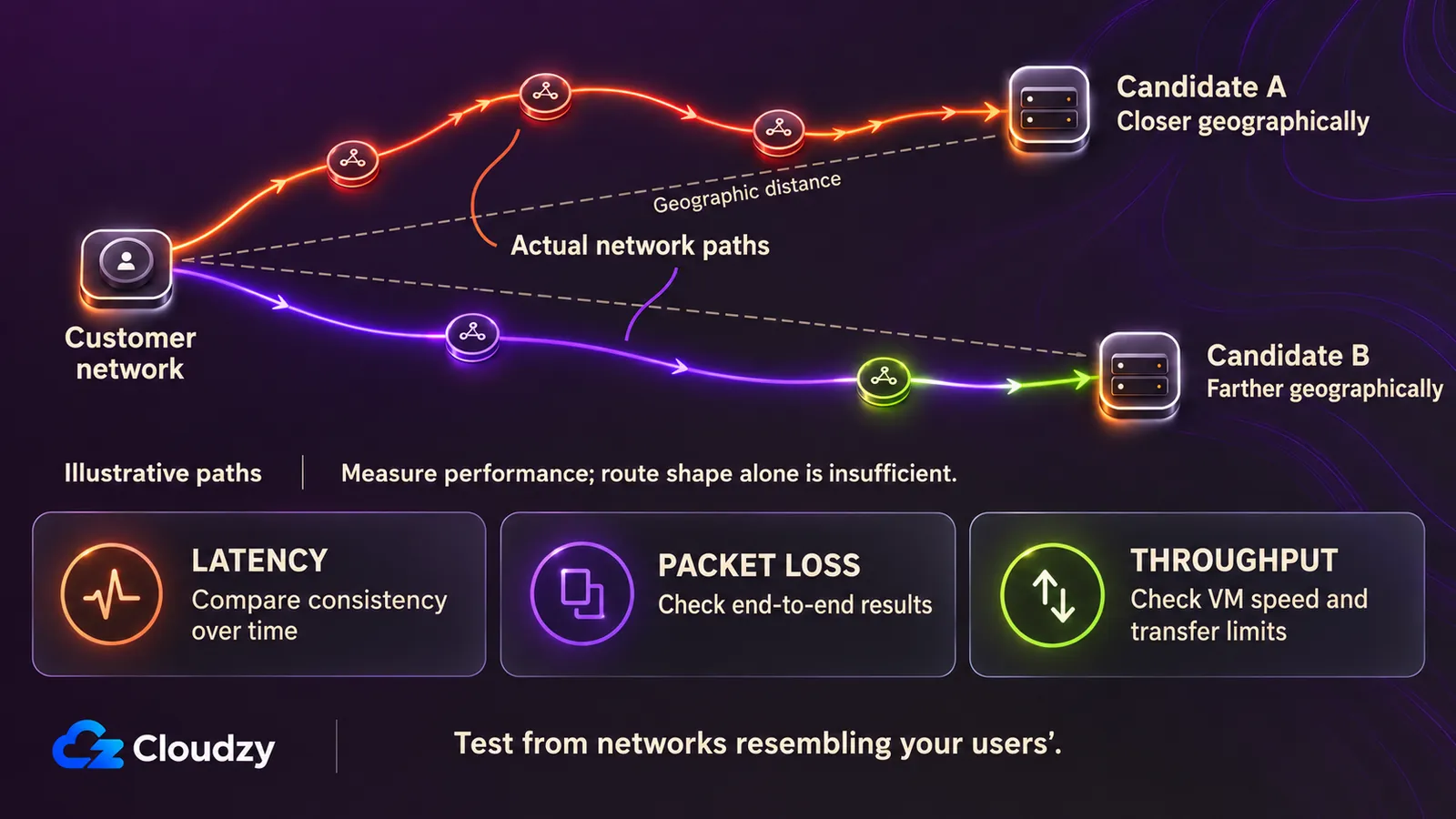
Routing, peering and transit determine how networks connect. Amsterdam's or Frankfurt's exchange ecosystem provides context, but does not prove that a particular VPS has an efficient path to every ISP. Look for consistent latency, end-to-end packet loss and sufficient throughput at relevant usage times.
Our network-testing directory links regional resources, including Amsterdam and Frankfurt. Use the relevant regional test address or file from networks resembling your audience's. Pinging the provider's main website may reach a web edge rather than that VPS region.
Check direction too: a browser looking-glass query may run from the server toward your destination. That is a different observation from a user's connection toward the server. Compare results over time, then relate throughput to the VM's speed cap and traffic allowance; a fast sample transfer does not increase either limit.
Six checks before buying a European VPS
Use the same questions for every shortlisted configuration. Record the answers for the product and location you would actually order.
- CPU allocation: Are vCPUs shared or dedicated? Check architecture, sustained-use restrictions and capacity. Match the allocation to your duty cycle; a larger core count alone does not establish suitability for continuous processing.
- Storage: Check disk type, usable capacity, I/O limits and additional volumes. NVMe branding does not specify application IOPS. Establish which disks your recovery option covers, especially if you separate the database or uploads.
- Network: Verify the per-instance speed cap, included transfer and excess-usage handling. Compare connectivity to customers' networks. Keep the host uplink, VM rate and monthly allowance separate when reading specifications.
- OS and deployment: Confirm the exact supported image and version, application RAM requirements, software licenses and custom ISO constraints. A one-click image can simplify installation while still requiring compatibility checks for your application.
- Recovery and support: Read SLA exclusions and credit rules, backup frequency, retention, location, exportability and restore scope. A snapshot alone does not establish an offsite backup policy. Check support's administration scope and contractual response commitments; availability is not measured uptime or guaranteed resolution speed.
- Total cost: Compare the selected region, OS and term on the same currency and tax basis. Include renewal, setup, additional IPs, storage, excess traffic, backups and paid licenses. Budget for the complete service you need beyond any introductory offer.
Which European VPS provider should you choose?
There is no universal winner. A required country can eliminate otherwise attractive plans immediately. An application using several managed services may benefit more from a complete regional ecosystem than from a cheaper standalone VM. Sustained CPU work calls for attention to allocation, while a small service may prioritize billing flexibility and straightforward deployment.
Cloudzy is a reasonable choice when Amsterdam, Frankfurt, London or Bern fits your requirements and you want a self-managed server with familiar OS choices, NVMe storage and several billing options.
Start with the country, narrow the product family, then compare connectivity and the full cost of running your application. Explore our European VPS plans and choose the region and configuration that meet those requirements, alongside any alternatives that fit your use case.
Frequently asked questions
Can I move my VPS to another European region later?
Our migration guide describes redeployment or support-assisted relocation, with a new IP and possible support fees. Back up first, arrange DNS and allowlist changes, and validate the replacement before retiring the original. Plan a cutover; do not assume the move preserves your address or avoids downtime.
Is an IPv6-only VPS suitable for a public website?
Not by itself for IPv4-only visitors. The IPv4/IPv6 translation framework describes the interoperability problem. Use dual-stack hosting or verify an IPv4-facing proxy can reach your IPv6 origin. Check outbound IPv4-only dependencies separately; a web proxy does not automatically solve those connections.
Can a CDN move some of my data outside Europe?
Yes. A European origin does not determine every CDN cache or processing location. Check cache geography, request processing and logging separately. Cloudflare, for example, documents regional cache controls with product-specific compatibility limits. Do not assume every CDN plan provides equivalent controls.
Who handles security updates on an unmanaged VPS?
You normally patch the guest OS, applications and dependencies, configure access, and maintain recoverable backups. Our services are unmanaged by default; infrastructure support does not administer your software stack. Budget for that work or choose written management coverage that includes it.


Discussion
Comments
Sign in to join the discussion.