
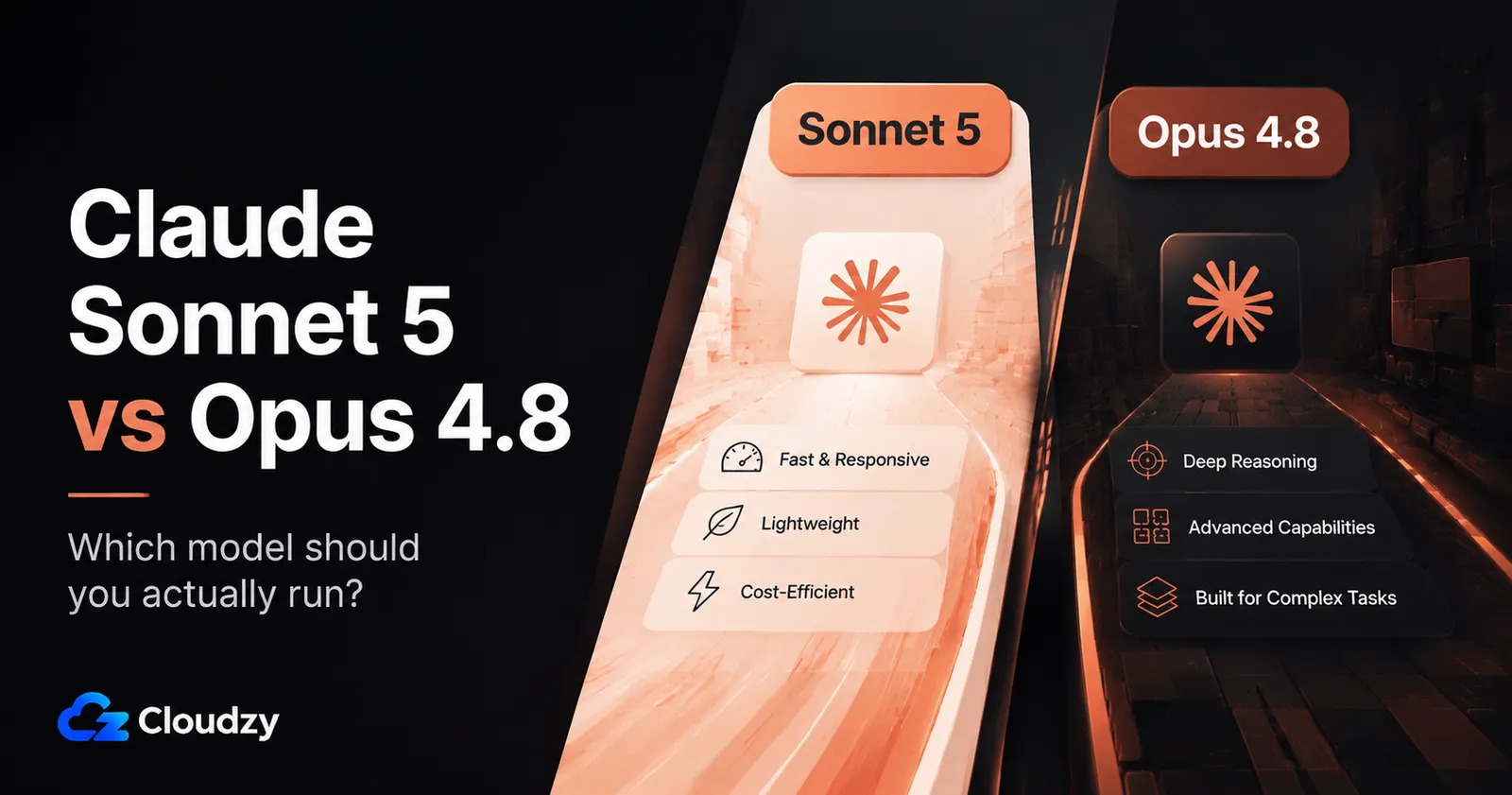
Anthropic shipped Claude Sonnet 5 with standard pricing at roughly 60% of Opus 4.8's per-token rate, plus an even lower $2/$10 launch promo through August 31, 2026. It also made Sonnet 5 the default model for Free and Pro users on launch day. The instinct (and I had it too, for about an hour) is to swap your default over to Sonnet 5 everywhere and pocket the difference.
Then you run an actual agent loop and the arithmetic gets more interesting. The per-token rate is the sticker price. It is not the bill. Two things move between the price sheet and your invoice, and both of them cut against the "just cheaper" headline hard enough to change what you should actually do.
So the real question isn't "which model exists", you already know both do. It's which one you point your agent at by default, and when it's worth paying up for Opus. Here's the decision rule, plus the two cost mechanics the benchmark recaps left on the floor.
The Short Version
Default to Sonnet 5 for most agentic coding and everyday API work. It's cheaper and holds its own on the benchmarks that split between the two models. Reserve Opus 4.8 for your hardest reasoning and coding tasks, and for extra-high-effort runs where Sonnet 5 can lose its cost advantage. Two things the price sheet hides: Sonnet 5's newer tokenizer eats about 30% more tokens for the same text, and at extra-high effort settings the cost math can flip. One date to mark: Sonnet 5's intro pricing ($2/$10 per million tokens) ends August 31, 2026, after which it's $3/$15. Model the standard rate now if you're standardizing on cost.
The one-liner: Sonnet 5 is your new default for most agentic coding. Opus 4.8 isn't dead, it's just not your default anymore.
The Price Gap Everyone's Quoting (and What It Leaves Out)
Sonnet 5 runs $3 per million input tokens and $15 per million output tokens at standard pricing, with an introductory rate of $2/$10 through August 31, 2026. Opus 4.8 sits at $5/$25. Both carry a 1M-token context window at standard pricing, and Anthropic made Sonnet 5 the default model for Free and Pro users at launch. Those numbers come straight from Anthropic's Sonnet 5 announcement (https://www.anthropic.com/news/claude-sonnet-5) and the Claude platform pricing docs (https://platform.claude.com/docs/en/about-claude/pricing); this is the part of the comparison where the facts are clean.
Line them up and Sonnet 5 looks like a straightforward markdown: same context window, roughly 40% off per token, and it's the default tier now. If your mental model of cost is "rate times tokens, and the rate just dropped," you're done. Switch and save.
The catch is that the token count isn't a constant. It moves with the model, and Anthropic changed it. That's where the sticker price and the bill come apart.
The Tokenizer Changed. So Did the Bill.
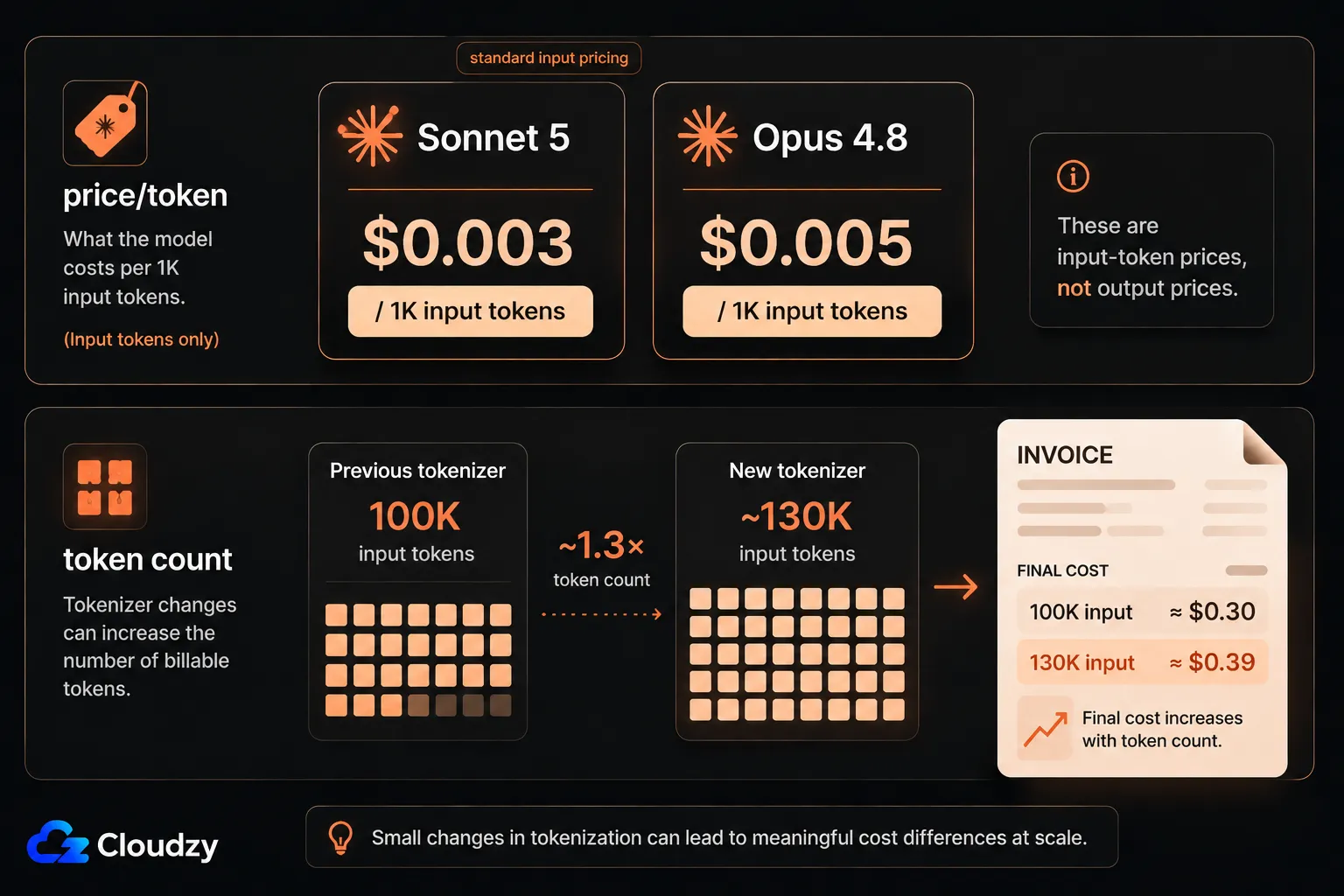
Sonnet 5 uses the newer Anthropic tokenizer (the same one shipped with Opus 4.7 and later), and per Anthropic's own framing it runs about 30% more tokens for equivalent text than older Sonnet versions did. That is not a rounding detail. Your bill is rate multiplied by tokens, and Anthropic just quietly moved the second number up while you were looking at the first.
Walk it through. If you're comparing Sonnet 5's intro rate against what you were paying on an older Sonnet, a lower per-token price applied to ~30% more tokens narrows the real gap well below what the headline rate suggests. Same prompt, same output text, more billable units underneath. The discount is real, but it's smaller than the number on the pricing page implies, because the pricing page prices a token and your workload is measured in words.
This mostly matters for two kinds of reader. If you're migrating from an older Sonnet, budget for the token inflation, not just the rate change. If you're weighing Sonnet 5 against Opus 4.8 head to head, it's less of a factor, since they share the newer tokenizer, so you're comparing like tokens to like tokens, and the per-token gap is closer to the truth. The trap is assuming your historical cost-per-task carries over. It doesn't; the unit under it changed.
Where Sonnet 5 Stops Being Cheaper
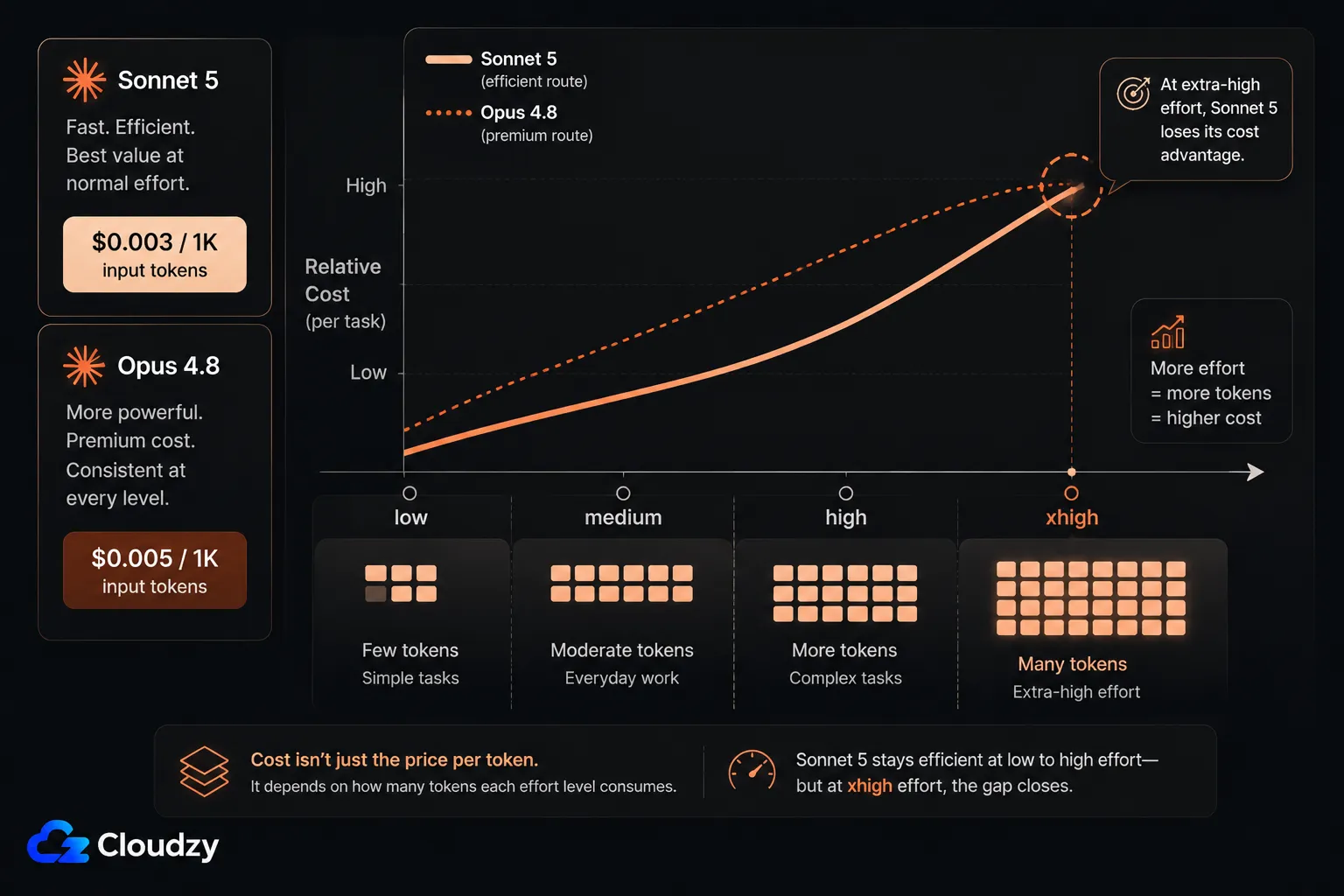
Turn the effort setting up and the cost advantage can invert. Practitioners running Sonnet 5 at extra-high ("xhigh") effort settings have reported that it can cost more than Opus 4.8 for similar quality, because a cheaper model that thinks harder and longer on a task can burn enough extra tokens to erase the per-token discount. This one traces to community reporting: a Hacker News thread on the launch (https://news.ycombinator.com/item?id=48736605) and a widely reported benchmark comparison (https://www.marktechpost.com/2026/06/30/anthropic-claude-sonnet-5-vs-sonnet-4-6-vs-opus-4-8-agentic-coding-benchmarks-api-pricing-and-cost-performance-tradeoffs-compared/). It's not an Anthropic-confirmed figure, so treat it as a reported pattern rather than a published threshold. I'm not going to hand you a precise crossover point, because I don't have one that's verified.
The shape of it is what matters, and the shape is clean: on ordinary runs, where the effort setting is modest and the task is bounded, Sonnet 5 is genuinely cheaper. On the heaviest runs (deep reasoning, high effort, long agent loops chewing on a large or messy codebase), the discount thins out and can disappear. A cheap model that has to work twice as hard isn't cheap.
Section takeaway: the discount is real for ordinary runs and evaporates for the heaviest ones, and that boundary is exactly where your default should switch.
The Benchmarks: What's Verified and What's Widely Reported
Start with the clean correction, because this is where the launch recaps get easy to misread. The 34.6% / 46.8% Humanity's Last Exam numbers and the 78.5% OSWorld-Verified number are not Sonnet 5 scores; Anthropic identifies them as revised Sonnet 4.6 baselines. For Sonnet 5, the launch/system-card table is reported as 43.2% / 57.4% on Humanity's Last Exam, 81.2% on OSWorld-Verified, 63.2% on SWE-bench Pro, and 1,618 on GDPval-AA v2. Opus 4.8 still leads on several harder-reasoning and coding measures, including SWE-bench Pro, OSWorld-Verified, HLE without tools, and USAMO 2026; Sonnet 5's cleanest head-to-head edge is knowledge work, where it slightly beats Opus 4.8 on GDPval-AA v2. That still does not crown a universal winner. It just reinforces the actual buying rule: default to Sonnet 5 for routine agentic work, and escalate to Opus when the task needs the higher ceiling.
Everything else in the head-to-head comes from third-party aggregation, and I'm going to keep that line bright. The cleanest safe read is narrower: Opus 4.8 still leads on the hardest coding, reasoning, and computer-use numbers, while Sonnet 5 narrows the gap and slightly edges Opus on GDPval-AA v2 knowledge work. Terminal-Bench 2.1 is worth treating as harness-dependent rather than a simple win column, because launch recaps report different Opus comparisons depending on the setup.
I'm attributing those rather than asserting them because the full system card ran past what I could verify directly, and a benchmark delta stated as fact when it's actually one aggregator's table is exactly the kind of thing that ages badly.
| Claude Sonnet 5 | Claude Opus 4.8 | Source | |
|---|---|---|---|
| Input / output price (standard) | $3 / $15 per Mtok | $5 / $25 per Mtok | Primary (Anthropic) |
| Intro price (through Aug 31, 2026) | $2 / $10 per Mtok | N/A | Primary (Anthropic) |
| Context window | 1M tokens | 1M tokens | Primary (Anthropic) |
| Default for Free / Pro | Yes | No | Primary (Anthropic) |
| Humanity's Last Exam (no tools / with tools) | 43.2% / 57.4% | 49.8% / 57.9% | Anthropic system card / launch recaps |
| OSWorld-Verified | 81.2% | 83.4% | Anthropic system card / launch recaps |
| SWE-bench Pro | 63.2% | 69.2% | Anthropic / launch recaps |
| GDPval-AA v2 | 1,618 | 1,615 | Anthropic launch/system-card recaps |
| USAMO 2026 | 79.5% | 96.7% | As widely reported |
The honest read of that table is that the benchmarks don't crown a winner. They trade wins. Which is precisely why the leaderboard shouldn't be your deciding factor. When two models split the benchmarks, the tiebreaker isn't "who scored higher on the one test you care about." It's cost per task on your actual workload, which is the number a leaderboard can't give you.
Is the Hype Matching Reality?
The launch reaction has been loud in both directions, and neither pole is quite right. On one side there's real backlash: a widely circulated post (https://www.bleepo.co/article/claude-sonnet-5-useless-flop-backlash-benchmarks) called Sonnet 5 a "useless flop," and some practitioners in the launch discussion noted the familiar failure mode of agent-optimized models: over-engineering trivial tasks, like turning a tiny Python request into something closer to a whole library. Some commenters also flagged presentation choices in the launch charts. Take those as individual reactions in a live thread, not a verdict.
On the other side, the positive signal is concrete and attributed. Zapier engineer Daniel Shepard, quoted in TechCrunch's launch coverage (https://techcrunch.com/2026/06/30/anthropic-launches-claude-sonnet-5-as-a-cheaper-way-to-run-agents/), said Sonnet 5 completed a complex two-part Salesforce-and-email task end-to-end that used to stall halfway, and called it "a no-brainer for day-to-day automation." That's a practitioner running it in production, not a benchmark row.
My read: this is the normal shape of a model launch, not a signal that Sonnet 5 is either a triumph or a dud. A cheaper agent model that occasionally over-thinks a small task is a manageable tradeoff, not a disqualifying flaw. You scope the effort setting to the job and move on. The people calling it a flop and the people calling it a leap are both extrapolating from a few days of a specific workload. The measured position is that Sonnet 5 is a solid, cheaper default with a known rough edge on high effort, and that's enough to decide on.
The Decision Rule (and the September Cliff)
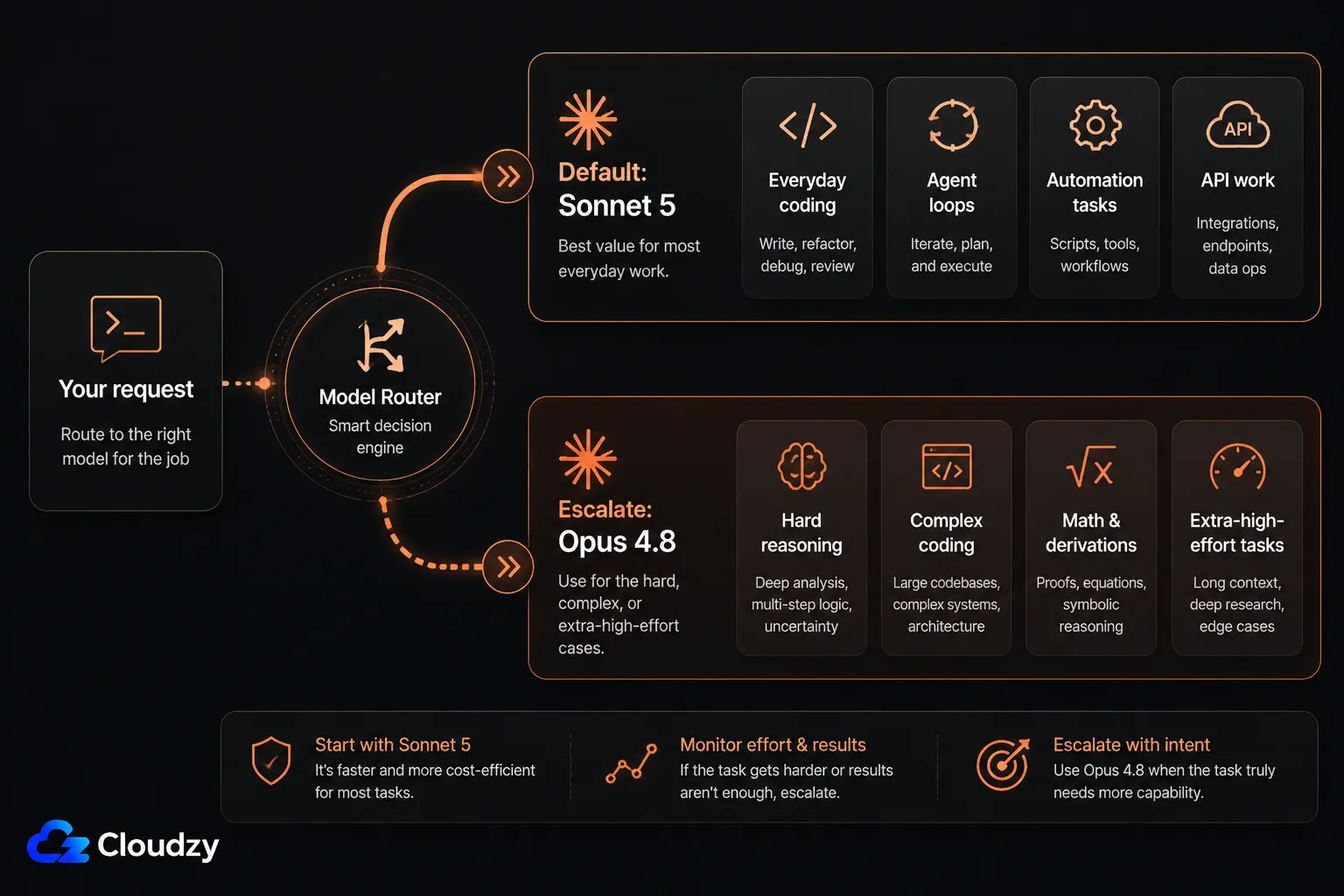
Here's the rule I'd apply starting today. Default to Sonnet 5 for most agentic coding and day-to-day API work, since it's cheaper on ordinary runs, it's the default tier, and it holds its own where the benchmarks split. Reserve Opus 4.8 for the hardest reasoning and coding tasks, and for extra-high-effort runs where Sonnet 5's discount can disappear; at that point Opus may be the better value, not the indulgence. That's not "Opus is obsolete." It's "Opus stops being your default and becomes your specialist."
Then the part that's easy to miss because it's a date, not a benchmark: Sonnet 5's intro pricing ends August 31, 2026. If you're standardizing on Sonnet 5 for cost reasons, model the standard $3/$15 rate now (not the $2/$10 intro rate) and budget for September. Building a cost case on a price that expires in weeks is how you get an unpleasant surprise in Q3. Run the numbers on what you'll actually pay, not on the launch promo.
One more distinction, because it changes the weighting. If you're running a self-hosted or local agent harness (Aider, OpenCode, Continue.dev) rather than calling the API directly through a hosted product, your cost exposure and your effort-setting control look different than an API-only user's, and the crossover math is worth re-running against your own harness's token behavior. See our OpenCode vs. Claude Code comparison if you're picking a harness.
The models will keep leapfrogging each other; the next release will reset the table. But the discipline outlasts the version numbers: don't buy the sticker price, run the cost per task on the effort setting you actually use, and switch your default at the boundary where the discount runs out.
Frequently Asked Questions
Should I switch my default from Opus 4.8 to Sonnet 5?
For most agentic coding and everyday API work, yes. Sonnet 5 is cheaper on ordinary runs, it's the default tier for Free and Pro, and it holds its own where the benchmarks split. Keep Opus 4.8 for your hardest reasoning and coding tasks and for extra-high-effort runs, where Sonnet 5 can lose its cost advantage.
How much cheaper is Sonnet 5 than Opus 4.8?
At standard pricing, Sonnet 5 is $3 per million input tokens and $15 per million output tokens, versus Opus 4.8 at $5/$25, roughly 40% less per token. Through August 31, 2026, Sonnet 5 runs a lower intro rate of $2/$10. The real gap is narrower than the rate suggests if you're coming from an older Sonnet, because Sonnet 5's newer tokenizer uses about 30% more tokens for the same text.
When does Sonnet 5 intro pricing end?
Sonnet 5's introductory pricing of $2 per million input tokens and $10 per million output tokens runs through August 31, 2026. After that, standard pricing is $3/$15. If you're standardizing on Sonnet 5 for cost reasons, model the standard rate now and budget for the increase in September.
Is Opus 4.8 still worth the extra cost?
Yes, for specific jobs. The launch/system-card numbers show Opus 4.8 still ahead on SWE-bench Pro, OSWorld-Verified, Humanity's Last Exam without tools, and USAMO 2026, while Sonnet 5 is close on tool-augmented HLE and slightly ahead on GDPval-AA v2. So Opus is not obsolete; it becomes the specialist for the hardest reasoning, math, and coding tasks, and for extra-high-effort agent runs where Sonnet 5 can lose its cost advantage.




Discussion
Comments
Sign in to join the discussion.