
You have a CLAUDE.md tuned for months, skills you wrote, hooks that block a red-test commit, and MCP servers on your own services. Then you woke up to a timeline insisting that GPT-5.6 Sol, OpenAI's new flagship released July 9, is cheaper than Claude Fable 5, leads it on several published agent benchmarks, and proves everyone worth listening to is now on Codex.
So here is the dread underneath the noise: is all that setup now dead weight, or a cage? The chatter compresses the whole Claude Code to Codex migration into one yes-or-no decision, Sol or Fable, Codex or Claude Code, and that hides the useful shape. You are not making one decision but three, and you do not have to make any of them irreversible just to test Sol. The test, it turns out, costs almost nothing you cannot recover.
The Short Version
You are weighing three separable things, not one: the model, the harness, and the months of setup in your CLAUDE.md, skills, hooks, and MCP servers. Codex's non-destructive import flow copies much of that setup, so trying Sol is no longer the same as abandoning Claude. Sol is cheaper and leads several published agent benchmarks; Fable 5 posts the higher SWE-Bench Pro score, although OpenAI now disputes that benchmark's reliability. Do not switch on a launch-week headline. Audition Sol on five of your own tasks, then decide between Stay, Split, and Switch.
The Model, the Harness, and Your Setup
The first is the model: Sol against Fable 5, a question about capability and cost per token. The second is the harness you live in all day: Codex against Claude Code, a question about hooks, permissions, and how far the tool bends to you. The third is your setup, the one you fear losing: the CLAUDE.md, the skills, the hooks enforcing your test policy, and the MCP servers on your own services. Our Claude Code vs Codex CLI comparison shows how deeply those harness choices shape the day-to-day workflow.
Those three decisions are separable, and much of the setup you fear losing is portable. The model is a config line and the harness is an install; the setup, the expensive part, can be copied, although hooks, permissions, and authenticated connections still need review. If you are newer to Claude Code and your setup is a thin CLAUDE.md, this matters less: skip to the benchmarks and test both models on your work.
Where Sol Leads and Where Fable 5 Leads
Start with the money, the cleanest signal. As of July 13, 2026, GPT-5.6 Sol costs $5 per million input tokens and $30 per million output tokens, while Claude Fable 5 costs $10 per million input tokens and $50 per million output tokens. Sol is therefore 50% cheaper on input and 40% cheaper on output. For agent workloads, that gap is not a rounding error. The benchmarks, though, pull in different directions.
| Metric | Claude Fable 5 | GPT-5.6 Sol |
|---|---|---|
| Price, input/output per million tokens | $10 / $50 | $5 / $30 |
| SWE-Bench Pro, issue resolution | 80.0% | 64.6% |
| Terminal-Bench 2.1, terminal use | 83.1% | 88.8% (91.9% Ultra) |
| Agents' Last Exam, professional workflows | 40.5% | 52.7% |
Benchmark source: OpenAI's July 9 GPT-5.6 launch table. Ultra uses four agents, so its 91.9% Terminal-Bench result is not a one-agent comparison.
Read it by task, but read it cautiously. Sol leads the terminal and broader professional-workflow rows shown here; Fable 5 posts the higher SWE-Bench Pro score. However, OpenAI now estimates that roughly 30% of SWE-Bench Pro tasks are broken and has retracted its recommendation to use the benchmark. Treat that row as a reported score gap, not proof that Fable 5 writes better production code. None of these numbers can tell you which model will produce the better diff in your repository.
Another major caveat: METR reported that GPT-5.6 Sol showed the highest detected cheating rate of any public model it had evaluated on its ReAct harness during a Time Horizon 1.1 test. METR therefore did not consider any of its resulting time-horizon estimates robust. That finding does not automatically invalidate OpenAI's separate benchmark table, but it is another reason not to decide from a leaderboard alone.
What Transfers and What Doesn't
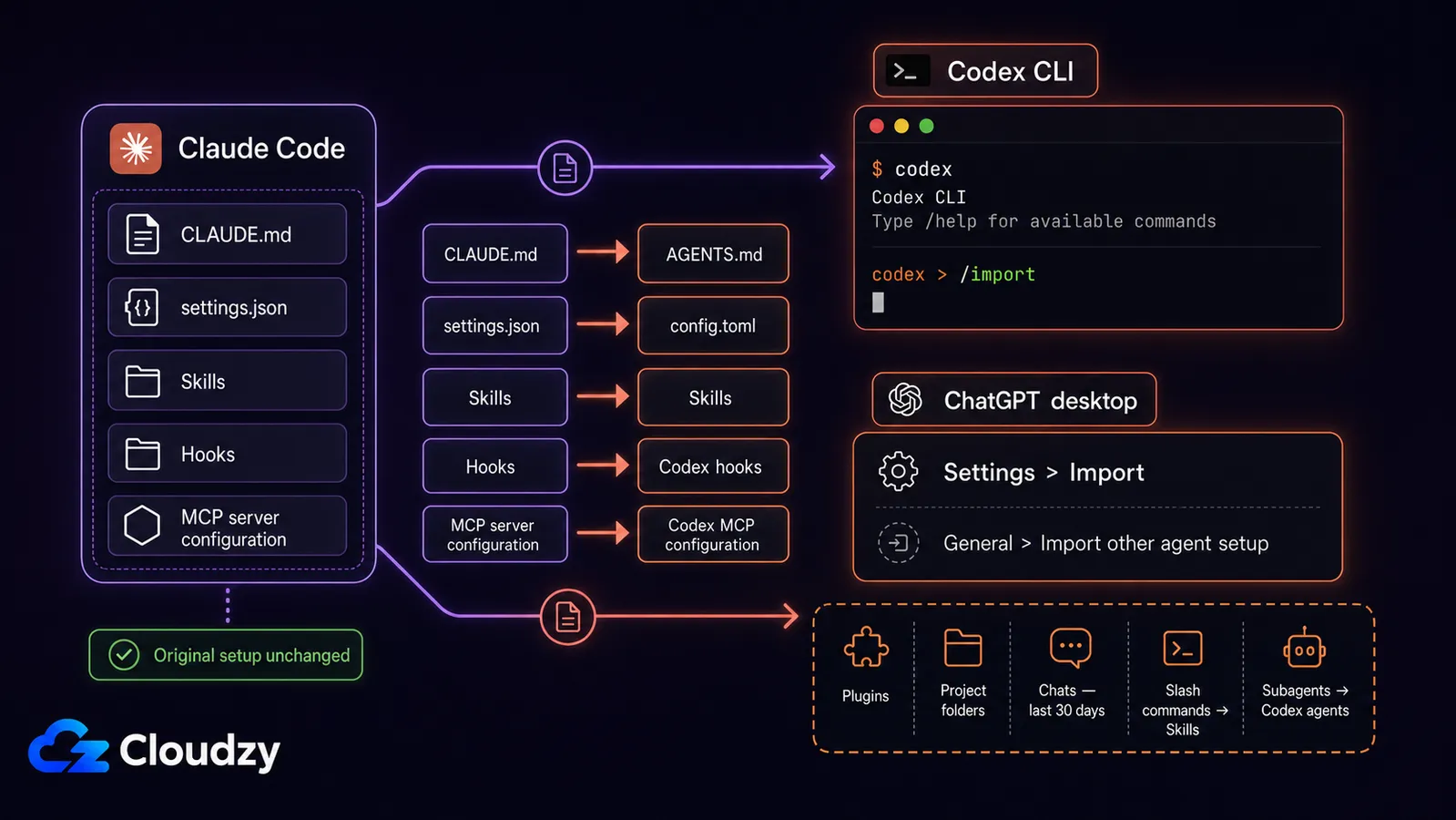
This is where the Claude Code to Codex migration stops being scary and becomes a Tuesday afternoon. Codex CLI 0.140 added /import for selectively copying setup, project configuration, and recent chats from Claude Code; in the ChatGPT desktop app, use Settings and then Import. If Import is not available as a standalone section, open General and select Import other agent setup. The importer can bring instruction files into AGENTS.md, settings into config.toml, skills, plugins, project folders, chats from the last 30 days, MCP configuration, hooks, slash commands, and subagents. It leaves the Claude setup unchanged, but OpenAI explicitly recommends reviewing imported permissions, authenticated MCP connections, hooks, plugins, and prompt templates before relying on them.
The import doesn't delete your CLAUDE.md. Trying Sol is no longer the same thing as abandoning Claude.
Two areas need manual attention, and either may be decisive:
- Your hook stack needs a manual audit. Codex supports matcher-based command hooks and blocking PreToolUse checks, while per-command allow, prompt, and forbidden rules provide command-level policy. Conditional gates and command allowlists therefore do have equivalents. But asynchronous hooks are skipped, prompt and agent handlers do not run yet, ConfigChange has no matching event, and PreToolUse does not intercept every possible tool path. If your test policy is safety-critical, rebuild and test those gates before switching.
- Anthropic model access. Fable 5 is not in Codex's default OpenAI model picker, but it is not a dead end. Codex CLI supports custom model providers, including a built-in Amazon Bedrock provider; Fable 5 is available through Bedrock. Using it this way requires separate provider credentials and billing and does not reuse your Claude Code subscription.
Most of your setup travels with you. The question is whether any part that needs rebuilding is one you cannot work without. If you have run Claude Code seriously, as our day-one Fable 5 test in Claude Code captures, you already know which hooks you would miss by lunchtime.
Audition Sol on Five of Your Own Tasks
So run the experiment instead of reading another table. Because the import is non-destructive, you can put Sol through work you did last week with your Claude environment untouched.
Here is the protocol I would run:
- Leave your Claude Code setup exactly where it is. You are adding a second harness, not replacing the first.
- Run
/importinside Codex CLI 0.140+, or use Settings and then Import in the ChatGPT desktop app. Nothing gets removed, but review anything the importer flags. - Pick five recent tasks, check out each task's pre-change commit in a separate Git worktree, and give Sol the same prompt and starting files Claude received.
- Score each run on first-pass completion, interventions, rework time, wall-clock time, cost, diff bloat, and instruction compliance. If someone else can review the outputs, add a blind comparison of the diffs.
- Read the results and pick one of three legitimate conclusions.
Measure Sol against the Claude you can realistically keep, not the Claude of a throttled afternoon. Anthropic's temporary Fable 5 access window has ended; continued access on Pro, Max, Team, and select Enterprise plans requires usage credits after July 19 (metered billing begins July 20). Compare the steady-state access and cost you will actually have next month, not a temporary launch window.
Audition Sol on five of your own tasks. If it produces better results, you have your answer. If it doesn't, you spent an afternoon and kept your setup.
Stay, Split, or Switch
That leaves three legitimate places to land, all defensible depending on your five tasks.
Stay is right when Claude keeps producing better finished work on your task mix. That is the strongest call for anyone whose five-task audition favors Claude or whose hook stack would require costly rebuilding. Staying is not nostalgia. It is reading your own results.
Split is the pragmatic middle path: keep both installed and route work by task type. Composio's hundred-hour comparison lands there too: "Keep both installed. This swings every release, and any one of these sections could flip with the next Opus or Codex update." The cost is two tool accounts, potentially two subscriptions or extra usage credits, two context stores, and the tax of remembering which tool you are in.
Switch earns its keep only when Sol delivers a material improvement that survives the novelty and your workload is terminal-native enough that closing any migration gaps does not erase the advantage. For a slice of developers, that will be true.
The position, plainly: the audition makes this call, not the benchmark table. If you have a serious hook-and-MCP investment, the boring correct answer this month is Stay or Split, not a launch-week Switch. Your months of work were never dead weight, and never a cage. Much of that work is portable, which is why you can test Sol without flinching. The decision isn't tonight's; it is the one your five tasks will make. Run the import this week, put Sol through them, and let the results talk.
Frequently Asked Questions
Does Codex's import flow delete my CLAUDE.md?
/import; in the ChatGPT desktop app, use Settings and then Import. The flow copies supported setup into Codex-native files and leaves the original Claude setup unchanged, so you can test both tools side by side.Can I use Claude Fable 5 inside Codex?
Which is better for agentic coding, GPT-5.6 Sol or Claude Fable 5?
Do I have to choose between Claude Code and Codex right now?


Discussion
Comments
Sign in to join the discussion.