

Render started as a marketplace for 3D rendering jobs. Livepeer started as video transcoding, Bittensor as an incentive scheme for machine learning models, NEAR as a sharded layer-1 for dApps, and the Artificial Superintelligence Alliance as a federation of autonomous-agent projects. Five different businesses sit behind the best AI crypto projects.
All five now overlap around AI infrastructure, but they do not sell the same thing. Render and CUDOS/ASI put compute supply on a marketplace, Livepeer runs video and AI workloads, Bittensor rewards subnet-defined digital commodities, and NEAR now combines intent settlement with confidential AI inference and a GPU marketplace. The convergence is real; the business models are not.
What is worth checking is what each network sells, what its token does inside the protocol, and what a machine must look like to join. None of those swings 90% in eighteen months the way a token price does.
TL;DR
- Five networks, five different origins, and five different ways of turning AI infrastructure into a networked market. Render and ASI expose compute supply, Livepeer routes video and AI jobs, Bittensor pays subnet participants for task-specific output, and NEAR spans settlement plus confidential AI inference.
- The category is small and thinly spread. CoinGecko's AI section sat 34th at $16.01 billion across 1,444 coins on August 27, 2026.
- What a token does inside its protocol is checkable: RENDER is burned against completed work, NEAR prices chain computation and storage and can be staked for AI credits, LPT and FET help secure ranked operator sets, and TAO and Alpha shape Bittensor validator influence and subnet economics.
- The participation floors are not interchangeable: NEAR's validator path is stake-gated, Render's Dispersed subnet has a published hardware spec, and Livepeer's Cascade real-time AI pipeline recommends 24 GB of VRAM.
- My read on Livepeer's economics: an orchestrator's income splits between customer fees and protocol-minted LPT rewards, and the reward half runs on a governance-controlled dial. On rented hardware you pay for the compute whether or not a job arrives.
- The two roles with a plausible entry point are a Livepeer orchestrator and a Render Dispersed node. A Bittensor subnet miner is a serious commitment.
What Changed in Decentralized AI Compute
Livepeer published its 2.0 direction on July 29, 2026, but the protocol changes are not live yet. The current roadmap still lists the 2.0 upgrades as in progress: they need to be specified, simulated, supported by the community, developed, audited, and brought to an upgrade vote. The proposed design broadens the supply side beyond today's orchestrator model. Livepeer's own 2.0 announcement says the unit of supply is no longer a GPU, it is compute, with CPU-only nodes, API-specialist nodes, and operators competing on breadth and quality of service instead of just silicon.
Render's own documentation describes the Dispersed subnet, previously called the Render Compute Network, as a "dedicated AI workloads subnet," with its hardware requirements set by governance proposal RNP-019.
ASI:Cloud, "a permissionless GPU Cloud and AI inference platform," launched in September 2025 under the Artificial Superintelligence Alliance. NEAR shipped Intents, a settlement protocol of its own. NEAR's Intents documentation names AI agents as originators of the requests that solvers compete to fill. And Bittensor now prices each subnet through its own Alpha token, traded against TAO in that subnet's liquidity pool.
Five changes, five different starting points, one broad direction. The market has not tracked it. CoinGecko's "Artificial Intelligence (AI)" category ranked 34th by market cap on August 27, 2026, at $16.01 billion spread across 1,444 coins. That is a small pool divided a great many ways, and it is the context for every market-cap figure below.
How to Evaluate the Best AI Crypto Projects
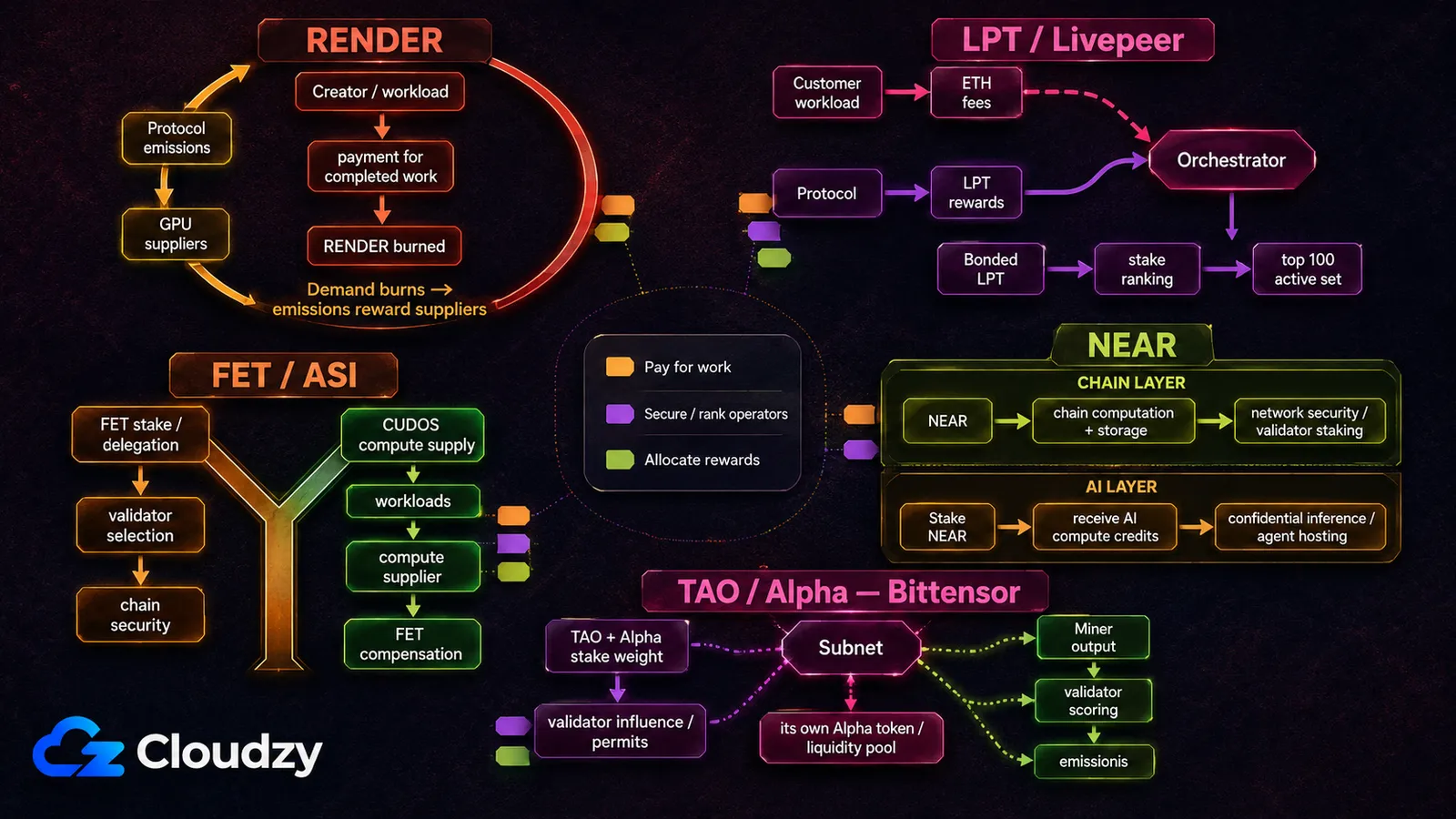
Start at the fee line, not the market cap, and expect patchy data. A network can carry a nine-figure valuation without publishing a clean customer-fee series you can compare against the others. Of the five below, Render's burn is the cleanest public proxy for paid work, and that scarcity of comparable fee data is itself a finding.
Then ask what the token does when nobody is trading it. There are three jobs available: it pays for work, it secures the network by being staked, or it allocates work by ranking who gets to do it. A token with none of them is priced entirely on the expectation that somebody else will want it, which is a market, but it is not a mechanism.
Third, find the operator role and read its entry requirements, because that is where the network tells you who it is built for. Some publish a hardware spec you can price out in an afternoon. Others publish a stake ranking, so the entry cost is whatever your competitors will put up.
Fourth, check how much of that is a governance parameter. Bittensor's network documentation puts TAO weight at 0.18 on mainnet and marks it governance-set, so the ranking that decides who validates can be re-weighted by a vote. That is not a criticism, because every protocol worth running has dials and the ones that hide them are worse. It means the answer you get today has a shelf life, and you should know which of your numbers a vote can move.
The Networks, and What Each One Does Now
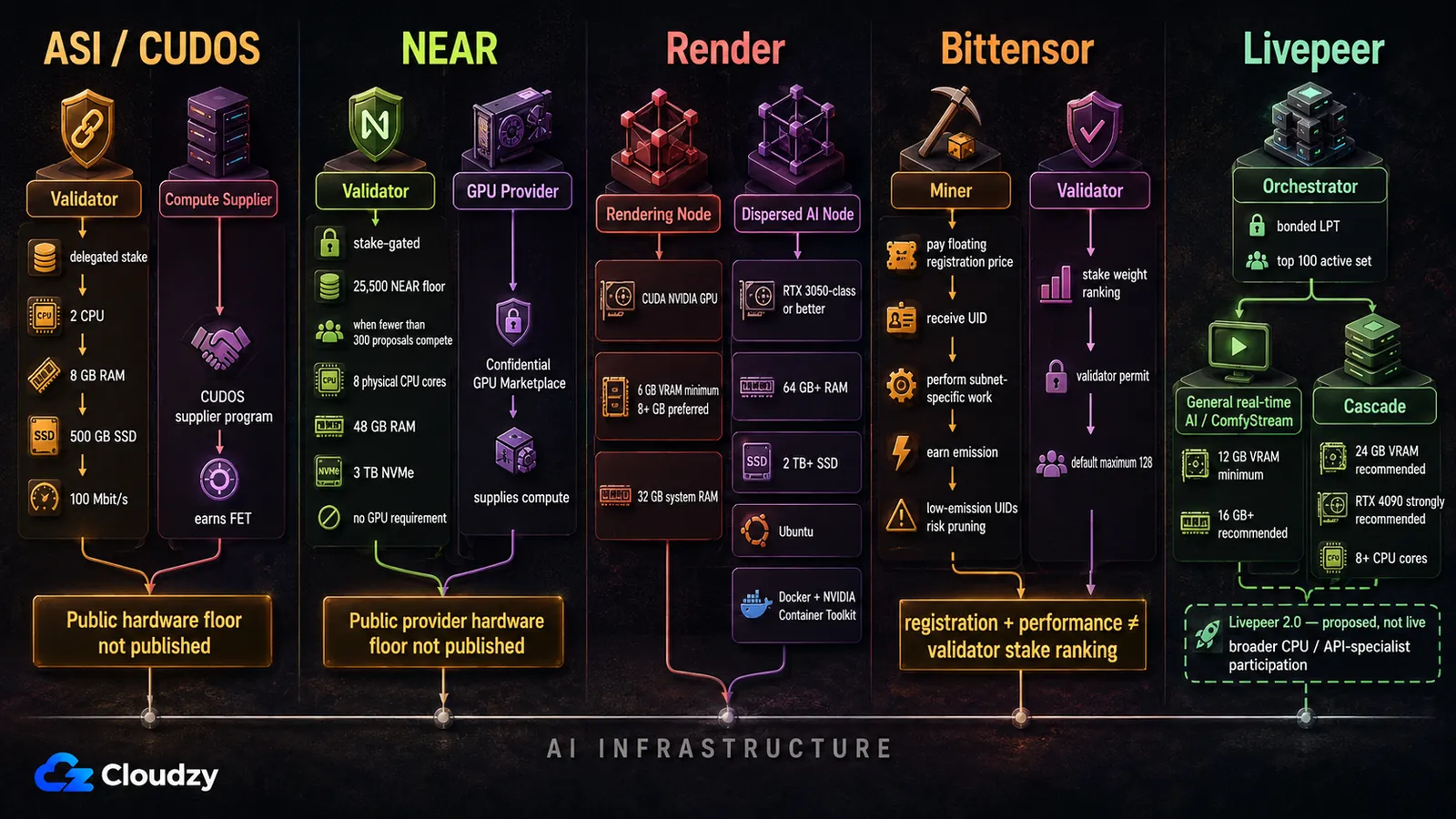
Each network below gets the same treatment, in the same order. Every price and market-cap figure was read from CoinGecko on August 27, 2026.
Artificial Superintelligence Alliance (ASI)
The alliance's own site lists three members: Fetch.ai, SingularityNET and CUDOS. CUDOS is the compute member, and its GPU marketplace sits underneath ASI:Cloud.
FET is the single token across the group. On the ledger side, it secures the proof-of-stake validator set; on the compute side, CUDOS's supplier program pays contributors in FET. The ASI ledger's validator documentation is direct about how the set is chosen: "the top validator candidates with the most stake become active validators within the network."
The change worth knowing is a departure. The Ocean Protocol Foundation withdrew on October 9, 2025, pulling its designated directors and resigning its membership effective immediately, which frees OCEAN to de-peg from FET and list separately. I would want to see how treasury and governance settle before treating the three remaining members as one entity.
Participation is clear on the validator side and less clear on the compute side. On the ledger side, you can run a validator. The published hardware floor is modest: two Intel or AMD CPUs carrying the SSE4.1, SSE4.2 and AVX flags, 8 GB of RAM, a 500 GB SSD, and an always-on 100 Mbit/s connection.
The CUDOS Compute Supplier Program pays contributors in FET, but its current public page does not publish supplier hardware or onboarding requirements. That makes the validator role priceable from public documentation and the compute-supplier role harder to price the same way.
CoinGecko listed FET at $0.1644 with a $371.6 million market cap on August 27, 2026, ranked #117.
NEAR Protocol (NEAR)
NEAR now sells both settlement and AI infrastructure. Intents is the settlement layer: a user or agent broadcasts what it wants, solvers compete to fill it, and the accepted result settles through NEAR. Separately, NEAR AI Cloud runs confidential model inference, and its Confidential GPU Marketplace connects AI workloads with GPU providers.
That AI-side expansion also gives NEAR another token use. Since July 2026, NEAR AI has let users stake NEAR to receive compute credits for confidential inference or agent hosting while retaining ownership of the underlying stake. The provider side is harder to price. NEAR AI's launch announcement says providers can monetize idle GPUs, but the current public material does not publish a provider hardware floor or onboarding spec.
The validator floor is a stake number and it moves. NEAR's validator documentation sets it by auction: "the minimum stake required is determined by the 300th largest staking proposal," with a floor of 25,500 NEAR when fewer than 300 proposals compete.
NEAR's current validator hardware guide lists CPU, RAM and storage requirements but no GPU. For mainnet chunk and block producers it recommends an x86_64 CPU with at least 8 physical cores, 48 GB of RAM, and 3 TB of NVMe storage.
CoinGecko listed NEAR at $1.86 with a $2.427 billion market cap on August 27, 2026, ranked #40.
Render Network (RENDER)
Render is the clearest token-has-a-job case of the five, because the job is destruction. Creators convert fiat to RENDER. Render's burn-and-mint documentation says the token "is subsequently burned in exchange for completion of the work." New tokens are minted on a declining schedule and paid epoch by epoch to the GPU suppliers who did the rendering. Demand burns supply; emissions pay operators. That is Burn and Mint Equilibrium, and you can watch it work without believing anything about the price.
Two changes affect anyone reading older coverage. The first is the ticker. Render expanded onto Solana after a community vote on RNP-002, and RNDR upgraded to RENDER. The Ethereum-to-Polygon bridge is now deprecated.
The second is the hardware ceiling. Render's 50-series support note adds a 32 GB minimum node VRAM option for Tier 2 rendering jobs, alongside Blackwell support.
There are two doors, and they are not the same machine. Rendering nodes need a CUDA-enabled NVIDIA GPU. Render's node operator guide recommends "a minimum 6GB of VRAM, and 8+GB VRAM is preferred," with 32 GB or more of system memory.
Dispersed, the AI subnet, asks for a great deal more. The Dispersed node spec lists a "GPU with a compute score at or above the RTX 3050, from recent GPU generations up to RTX 5090," plus "64GB+ RAM and 2TB+ SSD," Ubuntu 22.04 or 24.04, 100 Mbps down and 75 Mbps up, and Docker with the NVIDIA Container Toolkit.
If you are working out which card clears that bar, the deciding factor is usually not headline throughput. What has to fit in VRAM matters more.
CoinGecko listed RENDER at $1.51 with a $784.4 million market cap on August 27, 2026, ranked #84.
Bittensor (TAO)
Bittensor sells subnet output, and the primitive underneath everything is a competition. Miners register a UID inside a subnet and produce work. Validators score that work. Emissions follow the scores.
Two abstractions sit on top of that primitive. The first is the permit. Bittensor's network concepts page says validator permits "go to the top neurons by stake weight, up to the subnet's max_allowed_validators (default 128)," and that a subnet holds at most max_allowed_uids neurons, "default 256, and no lower than 64."
The second is the Alpha token, and the docs are plain about what it is: "Each subnet also has its own token, alpha, traded against TAO in the subnet's pool." So each subnet carries its own price, set in its own liquidity pool, and staking determines validator influence and permit eligibility. Miner admission works separately, through paid UID registration.
Anything you read about Bittensor that does not mention per-subnet Alpha tokens is describing an earlier version of the network.
Miner and validator entry are different problems. A miner pays the subnet's floating registration price to register a UID; on most subnets that price is burned, while some can lock a share as collateral. If the subnet is full, a new registration evicts the eligible UID with the lowest emission-based pruning score, so keeping the slot depends on performance, not stake rank. Validators are the stake-ranked role: permits go to the top neurons by stake weight, with 128 the mainnet default. Hardware still depends on whatever task the subnet rewards.
CoinGecko listed TAO at $242.52 with a $2.327 billion market cap on August 27, 2026, ranked #42.
Livepeer (LPT)
Livepeer's orchestrators process video transcoding and AI inference jobs. Livepeer's orchestrator economics page says they "earn ETH fees plus LPT rewards." Two income lines from two different places: customers pay the fees, the protocol mints the rewards.
LPT itself is bonded stake. Livepeer's network FAQ answers the floor question directly: "There's no fixed minimum. The active set is the top 100 by total stake." The effective floor is whatever the hundredth orchestrator has bonded, and it moves. Same shape as Bittensor.
Transcoding is the business with the longest paying-customer record. A Caretta Research report found that video companies can cut interactive live streaming costs by up to 74% using Livepeer Studio's distributed infrastructure instead of major commercial cloud vendors. That is a saving the customer keeps. It tells you nothing about what reached the network, and it describes the pre-2.0 economics Livepeer is now expanding beyond.
The AI side is where the hardware bill lands. Livepeer's current hardware reference lists real-time AI with ComfyStream at 12 GB of VRAM minimum and 16 GB or more recommended. The separate Cascade live-video-to-video guide sets a higher bar: 24 GB recommended, an RTX 4090 strongly recommended, and 8 or more CPU cores because frame encode and decode are CPU-bound.
CoinGecko listed LPT at $1.39 with a $69.3 million market cap on August 27, 2026, ranked #348.
What the Price Forecasts Got Wrong
Three of these tokens had a published end-of-2025 target traceable to a page that genuinely covered that token. Here is each one beside the price on August 27, 2026.
| Token | Published target for end of 2025 | Where it was published | Price on 2026-08-27 |
|---|---|---|---|
| RENDER | $62.80 | BeInCrypto's Render forecast, archived August 2024 | $1.51 |
| NEAR | $3.10 to $11.10, stretched target $14.80 | InvestingHaven, updated February 13, 2025 | $1.86 |
| FET | $0.97 average, $1.10 maximum | DigitalCoinPrice, archived April 2025 | $0.1644 |
BeInCrypto derived its $62.80 by taking a projected 2024 high, applying a 64.03% correction, then a 485% average hike. The InvestingHaven range hung on a 61.8% Fibonacci retracement holding at $3.10. Both methods produce a figure to two decimal places out of assumptions nobody could measure. None of this class of forecast is a basis for committing hardware or months of your time.
The Networks Side by Side
The fifth column is the one to read first. It lists the published entry requirement where one exists; compute-supplier programs without a public hardware floor are called out in the body instead.
| Network | What it sells | The token's job | Operator role | Hardware or stake floor | Market cap (Aug 27, 2026) |
|---|---|---|---|---|---|
| ASI (FET) | Agent services and GPU cloud via CUDOS | Staking for validator selection | Ledger validator | 2 CPU, 8 GB RAM, 500 GB SSD, 100 Mbit/s; active set by delegated stake | $371.6M |
| NEAR | Intent settlement, confidential AI inference and GPU marketplace | Prices computation and storage; secures the chain | Validator | Seat set by the 300th staking proposal, floor 25,500 NEAR; no GPU | $2.427B |
| RENDER | GPU rendering and AI compute | Burned on job completion; emissions pay suppliers | Rendering node or Dispersed node | Rendering: CUDA GPU, 6 GB VRAM minimum. Dispersed: RTX 3050-class or better, 64 GB RAM, 2 TB SSD | $784.4M |
| Bittensor (TAO) | Subnet output such as models, inference and tasks | Stake weight ranks who validates; Alpha prices each subnet | Subnet miner or validator | Miner: floating registration price plus subnet-specific hardware, and full subnets prune low-emission UIDs. Validator: top neurons by stake weight, with 128 permits the mainnet default | $2.327B |
| Livepeer (LPT) | Video transcoding and AI inference | Bonded stake; ranks the active set | Orchestrator | No fixed stake minimum, and the active set is the top 100 by total stake. General real-time AI: 16 GB or more of VRAM recommended. Cascade: 24 GB recommended, 8 or more CPU cores | $69.3M |
Price and market-cap figures are from CoinGecko, read on August 27, 2026. All five rows use the same aggregator deliberately: CoinMarketCap reports a different circulating supply for TAO, and mixing sources across rows would make the column internally inconsistent.
Which of These Is Worth Your Hardware
Of an orchestrator's two income lines, start with the one the protocol mints. Livepeer's economics page files inflation, the unbonding period and the active-set size among the values that are "governance-controlled and change over time." That makes the LPT reward a dial, not a revenue line.
My read: wherever a network pays its operators out of emissions, size the role on the customer fees alone and treat everything the protocol mints as a subsidy somebody can vote smaller. A role that only clears its costs with the subsidy counted in is underwriting a governance vote.
If you own the hardware and it is otherwise idle, the arithmetic can work: your immediate cash cost is mostly electricity and cooling, though depreciation and maintenance still exist. If you are renting, you pay the compute bill whether or not a job arrives, and I would not assume any of these roles will cover a rented GPU until you have utilization and fee data for the specific network. I would want a month of my own numbers before believing otherwise.
What self-hosting an LLM costs next to an API bill is the same trap: the headline comparison is not the one you end up living with.
Two roles are worth investigating first.
Render Dispersed node: the friendliest property of the five is a published hardware spec, so you can price the machine before committing.
Livepeer orchestrator: worth testing if your hardware already fits its current workloads, but do not size a deployment around the proposed 2.0 CPU-only or API-specialist roles until those changes are actually adopted.
Bittensor subnet miner: a commitment. A miner pays a floating registration price and then has to earn enough emission to avoid pruning on a full subnet. The hardware is subnet-specific, so the difficult part is combining a live registration cost with workload requirements and competitive pressure that differ by subnet. Validators are the stake-ranked path. That is a project, not a weekend.
Do not group NEAR and ASI as GPU-irrelevant. Their chain-validator roles do not need a graphics card, but both expose compute-side paths as well: NEAR AI runs a Confidential GPU Marketplace, and CUDOS operates an ASI Compute Supplier Program. The validator spec therefore tells you only about the chain role, not the AI-compute role.
Whichever role you pick, payouts arrive as tokens that have to move. Which chains are cheapest to transfer on decides how much of the margin survives the trip.
If you do want to test one of the GPU-bound roles, rent the card before you buy it. A dedicated GPU for as long as the experiment runs lets you find out whether a role clears its own compute cost before buying hardware.
Frequently Asked Questions
Which AI Crypto Project Has the Most Usage?
None of the five publishes a single usage number you can hold against the other four. Render's burn-and-mint design comes closest to a checkable proxy: tokens are destroyed when jobs complete, so the burn gives you a monetary proxy for completed work rather than a normalized count of jobs or GPU-hours. Livepeer's two income lines have to be read apart before either means anything. Bittensor, NEAR and ASI expose no comparable figure at all.
Do You Need a GPU for Livepeer AI Workloads?
Not for every Livepeer workload. Livepeer has CPU-based BYOC paths for specific custom pipelines, but its standard GPU-backed AI workloads still carry VRAM requirements. The general hardware reference recommends 16 GB or more for real-time AI, while the Cascade live-video-to-video guide recommends 24 GB. Livepeer 2.0 would broaden CPU-only and API-specialist participation further, but those protocol changes are still being validated.
Is Render Network Still Only for 3D Rendering?
No. Dispersed is a separate, dedicated AI-workloads subnet, and it runs alongside the original rendering business, which continues on its own lower-spec node tier. Joining one is not joining the other, and the two tiers have different hardware bars. Dispersed is also not open enrolment: entry is a waitlist application with a benchmark attached. Render advises against buying hardware for a place it does not guarantee.
What Happened to Ocean Protocol and the ASI Alliance?
The Ocean Protocol Foundation withdrew in October 2025, leaving three members instead of four. For anyone evaluating ASI as infrastructure, the part to watch is governance: a departing member changes the board and the treasury arrangements, and it is why OCEAN now trades on its own. It does not remove the compute-side path: chain validation remains CPU-only, while CUDOS handles the Alliance's compute-supplier role. Those are separate operator paths.
Can You Run a Bittensor Subnet Miner on a VPS?
Technically yes, if the VPS meets the specific subnet's hardware and networking requirements. The chain-side entry cost is the subnet's live floating registration price; once registered, a miner on a full subnet must earn enough emission to avoid being pruned. Validator permits are the stake-ranked part of Bittensor, not miner UID slots. Price the subnet's hardware, registration cost and pruning pressure separately.



Discussion
Comments
Sign in to join the discussion.