
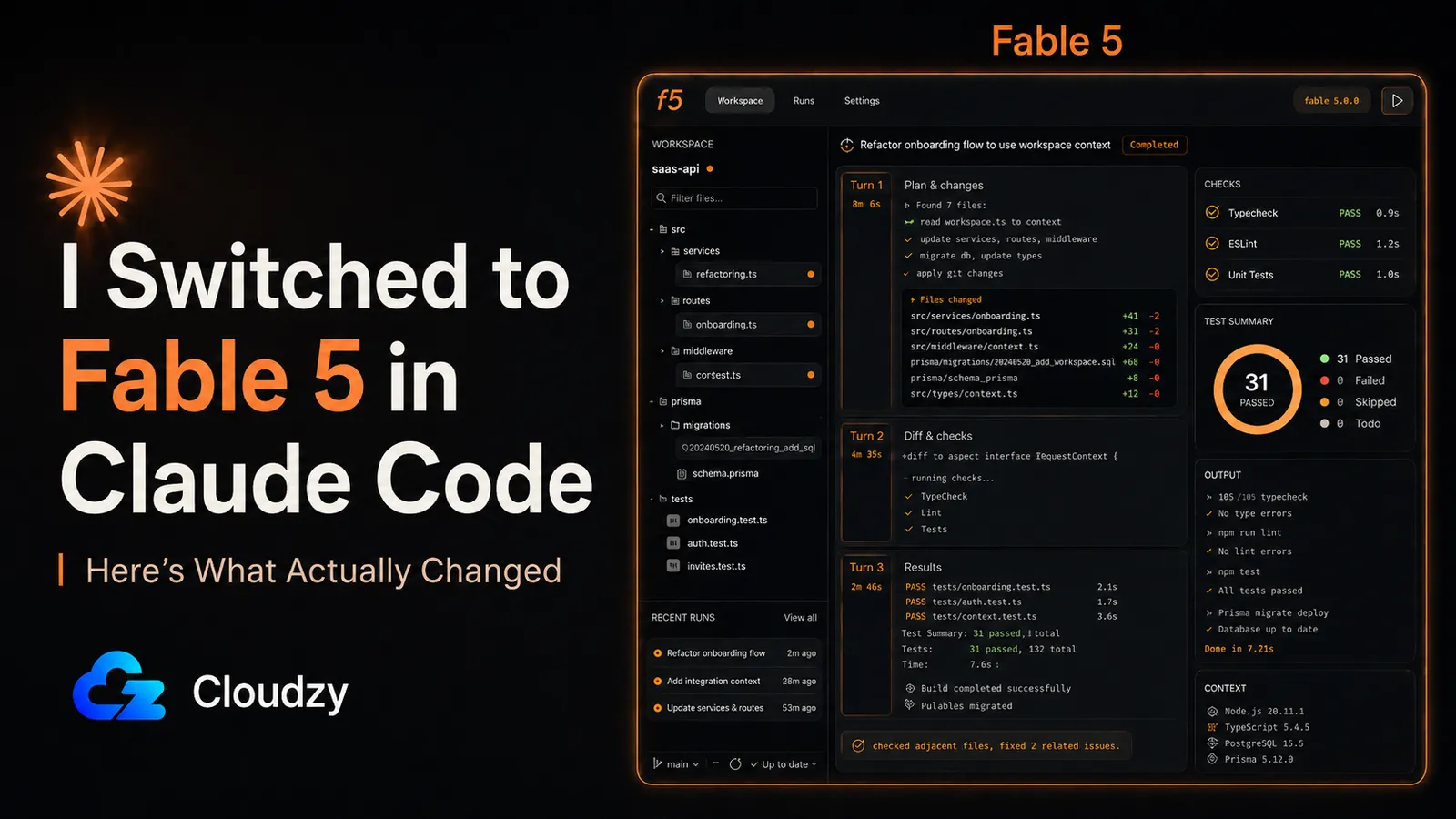
I set my Claude Code default to Fable 5 on day one and handed it the kind of multi-file task that usually eats my whole afternoon. I went to make coffee. By the time I sat back down it had finished, and it had quietly fixed two adjacent things I hadn't even asked about.
This is a real switch on real work, not a benchmark readout. And it costs 2x what I was paying for Opus 4.8, so "is it worth it" is a genuine question, not a rhetorical one. Three things genuinely changed in how I work. One thing is honestly frustrating. Here's everything, plus what to try yourself in under an hour.
The Short Version
Three real changes: complex multi-file refactors land in fewer turns because Fable 5 checks its own work before handing it back; sub-agent delegation runs without you babysitting it; and vision tasks read screenshots and reconstruct your logic with way less hand-holding. The one letdown: a safeguard sometimes fires and routes you to Opus 4.8. You find out in the response, not before you submit, and you get an Opus answer when you expected Fable 5. My bottom line: worth it on hard, long-horizon work. Test it on a real task before you commit the rate, because on trivial work the 2x is just 2x.
Fewer Turns, Because It Checks Its Own Work
That refactor I mentioned: the version of it I'd run on Opus 4.8 a week earlier took eight or nine back-and-forth turns, two of which were me catching a broken build it handed back. Fable 5 closed it in three, and it had already gone looking for the bugs instead of waiting for me to find them. The reason is that Fable 5 holds more context and self-verifies before handoff. Simon Willison hit the same thing harder: in his day-one impressions he describes the model finding and fixing several underlying library issues on a task that only asked it to fix one.
So the difference here isn't speed. It's that Fable 5 checks its own work before handing it back, so you catch fewer broken builds and burn fewer turns cleaning up after it. A developer in the HN release thread put it as the model "finding bugs the others created"; a Canva engineer in the same thread reported "half the tokens with better results" and pull requests with less code to review. If you want the one benchmark number behind the feel: Anthropic puts Fable 5 at 80.3% on SWE-Bench Pro versus Opus 4.8's 69.2%. I felt the gap before I read the number.
The change isn't that it's faster. It's that fewer of its outputs come back broken.
Sub-Agent Delegation That Doesn't Need Babysitting
I handed it a three-stage refactor and it finished two stages before I looked up. That's the second change, and it's the one I didn't expect. Fable 5's long-horizon behavior means you can delegate a multi-stage task and it'll work through the stages on its own instead of stopping to check in after every move. The pairing that makes this real is Dynamic Workflows, Anthropic's parallel sub-agent orchestration (generally available since late May), and not standard single-session mode. In the HN thread, one developer described complex database migrations completing in a single session where Opus had failed repeatedly.
Here's the real caveat, and it matters: on the Pro plan you can hit rate limits inside a 30-minute window, which kills the long unsupervised run you just got excited about. One developer in the thread hit the ceiling within 30 minutes of agent work. The capability is real. The Pro-plan rate ceiling is also real. Max is where this actually works without constant interruption.
The delegation finally works without supervision. Just know the Pro tier will rate-limit you before you get a full run, so this is really a Max-plan win.
Vision Tasks Are a Different Experience Now
I dropped a screenshot of a messy UI component into the session and asked what it was doing. It read the layout and reconstructed the logic without me describing a single element. That's the third change: Fable 5 reads screenshots and codebase diagrams and gives you usable output with far less hand-holding than I'm used to. A developer in the HN thread who spent half an hour stress-testing it called it "incredibly good at the visual aspects of UI design," and that tracks with what I saw.
This is the lightest of the three changes. But it's the one that quietly removes a step I didn't realize I was tired of.
The One Thing That's Frustrating
I sent it a task that should have just run, and it came back as a refusal-routed Opus response. What's happening underneath: a safeguard classifier fires on cybersecurity-adjacent and a few other sensitive task types, and instead of giving you a Fable 5 response, it routes the request to Opus 4.8. You find out in the response, with no warning before you submit. Anthropic says users are informed when this happens, and technically the response does tell you, but there's no pre-submit heads-up that your task is in scope for the classifier.
The classifier's sweep is broad, too. In the HN thread, one developer got blocked on business-prospecting tooling; another, doing pattern work on health data, called it unusable for their case. To be fair, this is rare: Anthropic says more than 95% of Fable sessions never hit a fallback at all. And there's a separate, much narrower controversy about a behind-the-scenes tuning method that affects frontier AI researchers, not typical builders, so don't conflate the two. The one that'll bite you is the visible Opus fallback. It's not that safety routing exists. It's that it's opaque, and finding out after the fact that you got an Opus answer when you expected Fable 5 is a bad feeling.
Great model, opaque guardrail. The opacity is the part that stings, not the safety itself.
What to Try in Your Next Hour
Switch your Claude Code default to Fable 5 and run it against the multi-file refactor you already have open. That's the whole experiment, and you'll know inside an hour whether it earns the 2x rate for your work. Test it on something genuinely hard, not a trivial task: adaptive thinking is always on, so simple jobs don't show the difference and just cost you more for nothing. If you're on Max or Team, turn on Dynamic Workflows so you see the delegation behavior instead of single-session mode. And feed it a screenshot of your own UI to watch the vision change for yourself.
The switch itself is /model fable or /model claude-fable-5 (you'll need Claude Code v2.1.170 or later). Run it on your real work, decide for yourself, and bail back to Opus if your tasks don't get the lift. No harm done.
Frequently Asked Questions
How Do I Switch to Fable 5 in Claude Code?
Run /model fable or /model claude-fable-5 inside Claude Code, or pass --model claude-fable-5 when you launch it. You'll need Claude Code v2.1.170 or later for Fable 5 to show up as an option.
Will the Safeguards Block My Work in Claude Code?
Mostly no. Anthropic says over 95% of Fable 5 sessions never hit a fallback. But cybersecurity-adjacent and some health-data tasks can route to Opus 4.8. You're informed in the response when this happens, but there's no pre-submit warning, so you find out after the fact. If your work touches those areas, test a real task before you commit Fable 5 as your default.
Is Dynamic Workflows Different From Regular Agent Mode?
Yes. Dynamic Workflows is Anthropic's parallel sub-agent orchestration layer, generally available since late May and default-on for Max and Team plans. It's where Fable 5's unsupervised multi-stage delegation is fully expressed, and standard single-session agent mode won't show you the same long-horizon behavior.



Discussion
Comments
Sign in to join the discussion.