
Login can work while a new requirement no longer fits: a customer wants its own identity provider, several applications need shared sign-in, or the product needs different login branding. The best Auth0 alternatives depend on which behavior must change and who will operate the replacement.
An Auth0 alternative should earn the migration effort by solving a specific constraint. Keeping a working Auth0 integration can be the sensible choice. Start with application and customer login requirements; workforce identity needs a separate evaluation. Shortlist by integration scope first, then decide whether to buy a managed service or operate identity yourself.
TL;DR
| Option | Best-Fit Workload | Deployment Model | Main Trade-Off |
|---|---|---|---|
| Keycloak | Multiple applications sharing sign-in with existing identity sources | Self-operated identity service | You own production configuration, including secure endpoints and administration |
| ZITADEL | A product serving multiple customer organizations with delegated roles | Cloud or self-hosted | Map customers to organizations and projects, then define application access |
| FusionAuth | Customer applications that need different login-page branding | FusionAuth Cloud or self-hosted | Application-specific themes have a different entitlement from tenant themes |
| Logto | Product applications needing a supplied sign-in flow and SDK integration | Cloud or self-hosted | Check administrative access and customization for the chosen deployment |
| Supabase Auth | Applications connecting authentication to Postgres row-level access rules | Hosted service or self-hosted stack | Decide whether you need standalone Auth or the broader Supabase stack |
| Clerk | Managed application login with prebuilt authentication and account components | Managed service with application SDKs | Confirm your framework has the components and customization you need |
| Authentik | Multiple existing internal applications using shared sign-in | Self-hosted identity provider | Match each application's integration method to the appropriate provider |
Keycloak for Multiple Apps and Federated Identity
Keycloak fits applications that need shared sign-in while accepting identities from existing systems. Its project overview documents OIDC/SAML identity brokering and LDAP/Active Directory federation: accepting another source's identities. Its release notes confirm Organizations support; include that customer model in the evaluation.
The trade-off is operating the service: its production guidance covers TLS and administrative endpoint exposure. Check how your existing users map into directory federation before choosing it as a self-hosted Auth0 alternative, including how organization membership will affect the application's access decisions. If a VPS suits that operating model, our Keycloak one-click app provides an app-specific starting point.
ZITADEL for Multiple Customer Organizations
ZITADEL is worth shortlisting when several customers need their own identity administration within one product. Its official repository describes organizations and projects, delegated role management, and organization-specific branding. You can choose ZITADEL Cloud or self-host it, with the customer model driving the evaluation.
An identity organization's membership does not establish your application's data-access rules. For delegated customer administration, map each customer's organization to the projects and roles its users need. Establish who may invite users and assign those roles, then verify that the application still enforces the intended customer boundary.
FusionAuth for Custom Login Across Customer Apps
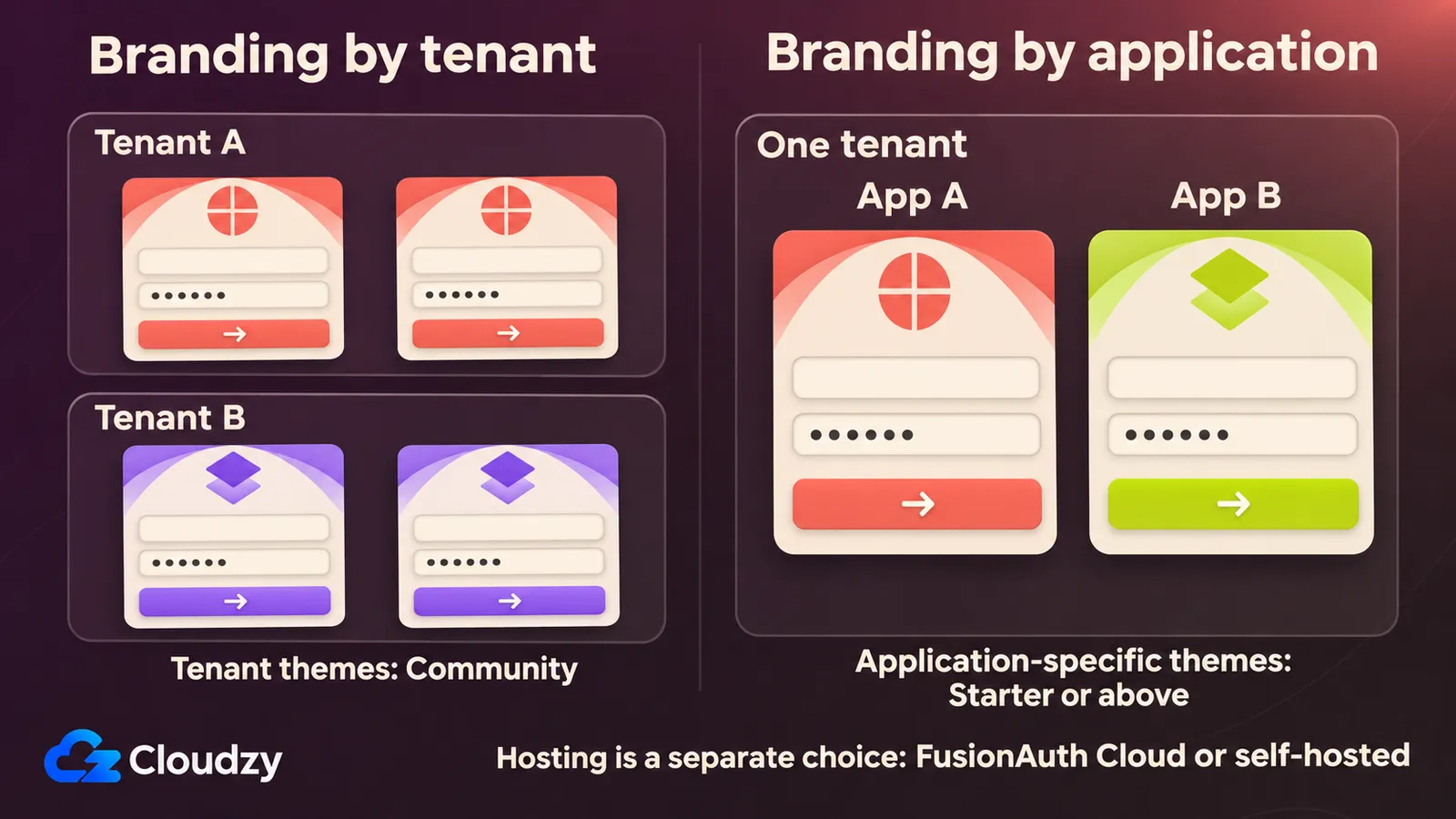
FusionAuth fits customer applications needing distinct login branding. Its application-specific theme documentation describes separate themes for applications using FusionAuth-hosted login pages. That feature requires at least Starter; tenant-level themes are available in Community. The distinction matters when different customer applications must present different identities.
Here, a hosted login page describes the login interface; it does not decide who hosts FusionAuth. The hosting comparison separates FusionAuth Cloud or self-hosting from feature-plan selection. Before evaluating FusionAuth for customer login, decide whether branding varies by tenant or individual application. Match that requirement to the entitlement before choosing infrastructure.
Logto for Product Apps Needing a Ready-Made Login Flow
Logto fits a product that needs a supplied sign-in interface alongside application integration. Its documentation overview describes the login flow, administration Console, APIs, and SDKs. Start here when building and maintaining the login interface is a task you want the identity product to handle.
Logto's OSS setup documentation distinguishes Console team-access restrictions from end-user features, including additional authentication factors. For Logto-based product login, establish whether the chosen deployment supports your administrative team and required sign-in customization. Treat an unmet Console access requirement as a deployment blocker, even if customer sign-in fits.
Supabase Auth for Apps Built Around Postgres
Supabase Auth fits an application where login and database access belong in the same design. Its Auth documentation describes JWT authentication integrated with Postgres row-level security, or RLS: rules controlling access to database rows. Auth can also be used independently of the rest of Supabase.
Choose the integration boundary before choosing the deployment. Running the full stack adds services beyond authentication; its Docker README requires preparation for secrets, network security, and backups. Check whether that wider backend fits your application. Our Supabase one-click app deploys the full stack on a VPS, including Auth; it is not an Auth-only installer.
Clerk for Managed App Login With Prebuilt UI
Clerk is a candidate when a managed login service and prebuilt application components fit your stack. Its Next.js component reference includes authentication, user, and organization components, with appearance customization. Map each existing login and account screen to a documented component in your chosen framework before committing.
The integration begins with a Clerk application in its Dashboard and an appropriate SDK, as its JavaScript repository describes. Treat that repository as integration tooling, not a self-hosted identity server. Record any uncovered behavior as application work; keep it in the migration scope. Next.js documentation alone does not establish identical behavior across every SDK.
Authentik for Multiple Internal Apps and Self-Hosted SSO
Authentik fits several existing internal applications needing SSO, or shared sign-in. Its provider documentation connects applications to authentication methods including OIDC/OAuth2, SAML, LDAP, and a proxy provider. Start by matching each application's supported method to a provider and checking the flows that apply to its users.
This is a narrower recommendation than replacing a product's entire customer-login system. Keep existing-app sign-in integration separate from the product's customer-account requirements when assessing the replacement. Authentik documents a self-hosted Compose installation. Once you have chosen that operating model, our Authentik one-click app provides a starting point on a VPS.
Who Auth0 Is For and When to Keep It
Keep Auth0 when its existing integrations meet your requirements and a replacement has no demonstrated benefit worth the transition. The Auth0 overview documents shared sign-in, enterprise federation, user management, and MFA, meaning additional authentication factors. Those capabilities support retaining functioning login flows while reviewing a specific constraint.
Check the required features against Auth0's current plans; a platform capability is not an inclusion in every subscription. If the available terms fit and you want identity operated as a managed service, staying can avoid an unnecessary migration project. Compare the benefit of changing with integration work and disruption risk. Switching providers needs a reason beyond finding another feature list.
Checks Before Choosing an Auth0 Alternative
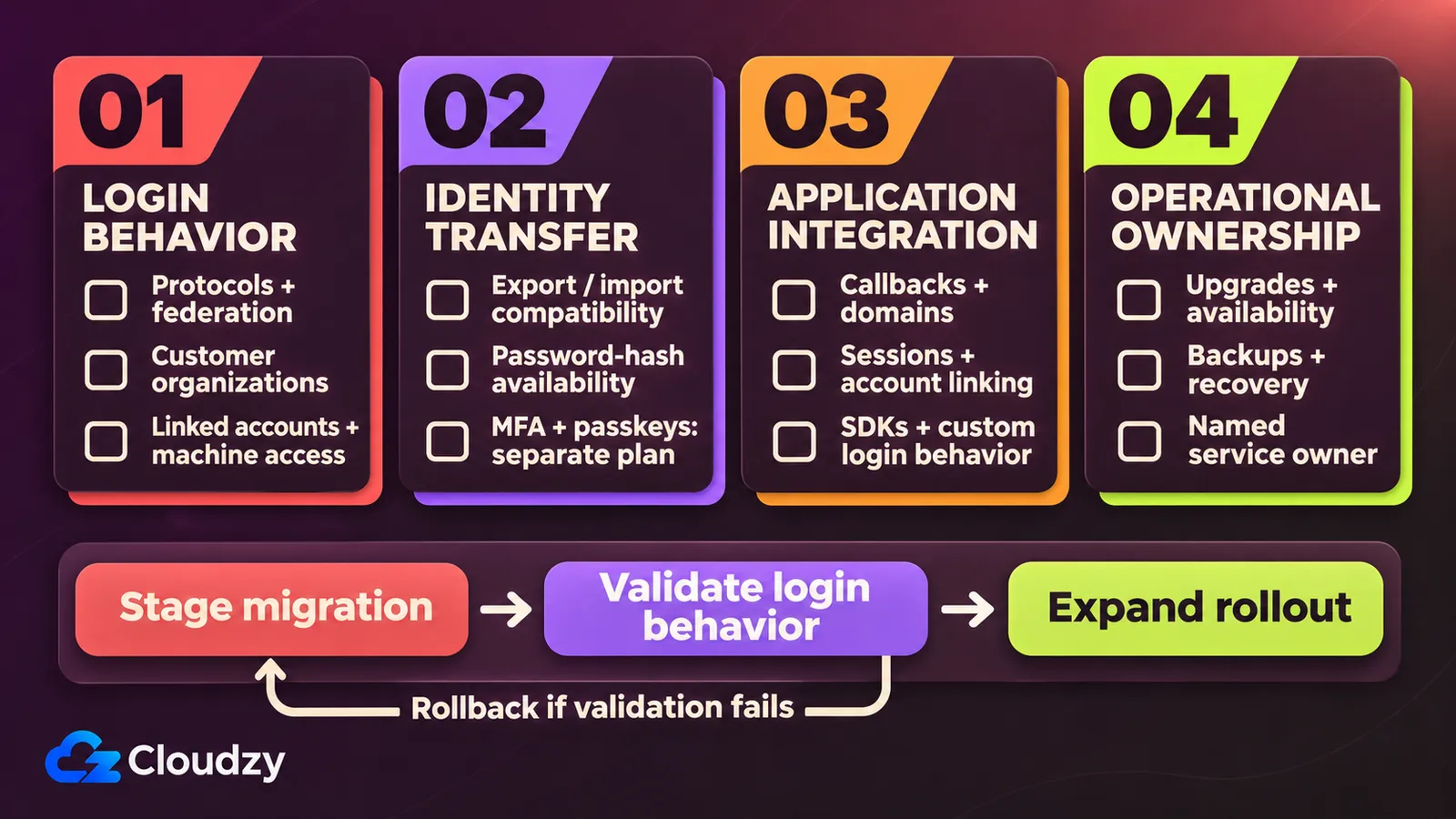
A replacement login screen can look correct while the application still depends on a different customer model or account-linking behavior. Choose an Auth0 alternative by recording what must remain stable, then assigning ownership for the change. Narrow the shortlist to candidates that can demonstrate those requirements in your application.
- Inventory required protocols, federation, customer organizations, and linked accounts. Record machine authentication separately from interactive login.
- Check required features and usage units against the exact service or deployment's current terms. Include administrative access.
- Confirm identity export/import compatibility. Plan factors and passkeys separately, alongside account linking, callbacks, domains, and session behavior.
- Assign upgrades, recovery, backups, and availability to a named owner. Validate the application's login behavior before committing, with a staged migration and a way back if validation fails.
Frequently Asked Questions
Is an Auth0 Alternative Also an Okta Alternative?
An application-login replacement does not automatically qualify as an Okta alternative for workforce identity. Okta Workforce Identity serves employees, contractors, and partners, with onboarding/offboarding and governance access reviews. Evaluate those responsibilities separately from Auth0's application authentication use cases. Shared sign-in alone does not establish suite-wide equivalence.
Can I Export Auth0 Password Hashes Through the API?
For Auth0-hosted database users, password hashes and private keys are unavailable through the API. Auth0's Export Data documentation directs you to request them through support. This operation is unavailable on Free, and Auth0 does not guarantee a specific export time or date. Confirm the receiving system's import compatibility separately.
Does Changing API Authentication Mean Replacing Every Login Flow?
Changing API authentication does not, by itself, require replacing every interactive login flow. Auth0's overview of app and API scenarios includes both. Evaluate service-account requirements separately, then validate whether your application can preserve its current user login while changing the API path. Do not assume split-provider compatibility.

Discussion
Comments
Sign in to join the discussion.