

The RTX 5090 leads this comparison's measured native 4K gaming results. My uncapped-budget recommendation for the best GPU for gaming and streaming is also the 5090, an inference from gaming performance and encoding capacity for simultaneous play, broadcast and recording. It is not a measured game-plus-OBS win.
Spending less changes the answer: Intel's Arc B580 leads the measured FPS-per-dollar and VRAM-per-dollar calculations in the dated US comparison below, and it has the lowest observed entry price. Its small value lead over AMD's RX 9070 GRE can disappear with a modest price change. The GRE buys substantially more gaming speed. Your output codec and the resources left for OBS also affect the recommendation.
GPU Prices and Gaming Results Compared
The RTX 5090 averages 110.8 FPS at native 4K raster settings in Tom's Hardware's June 24, 2026 GPU benchmark hierarchy. All gaming results below use that revision's common suite, with a Ryzen 7 9800X3D and 32GB DDR5-6000 CL30 system. The raster scores are equal-weight geometric means across 11 games. The RT table summarizes eight ray-tracing tests. Settings are high or ultra depending on the game.
Raster means conventional rendering; the RT columns use ray tracing. These are native-resolution results, with no upscaling or generated frames. Both techniques can change the experience in supported games, but mixing their results into this table would change the comparison. A geometric mean summarizes the suite; it does not predict the FPS of each game you play.
Each FPS cell below reads 1440p / 4K. The 8GB and 16GB versions occupy separate rows because their results differ.
| GPU | VRAM | Raster FPS, 1440p / 4K | RT FPS, 1440p / 4K |
|---|---|---|---|
| NVIDIA RTX 5090 | 32GB | 167.3 / 110.8 | 100.8 / 64.1 |
| NVIDIA RTX 5080 | 16GB | 128.3 / 77.4 | 74.0 / 42.1 |
| NVIDIA RTX 5070 Ti | 16GB | 116.8 / 68.6 | 66.2 / 36.7 |
| NVIDIA RTX 5070 | 12GB | 96.4 / 54.3 | 51.5 / 22.7 |
| NVIDIA RTX 5060 Ti 16GB | 16GB | 73.4 / 40.2 | 38.9 / 20.6 |
| NVIDIA RTX 5060 Ti 8GB | 8GB | 68.6 / 28.1 | 26.6 / 7.2 |
| NVIDIA RTX 5060 | 8GB | 59.8 / 21.8 | 24.6 / 6.8 |
| NVIDIA RTX 5050 | 8GB | 45.2 / 17.0 | 18.7 / 6.2 |
| AMD RX 9070 XT | 16GB | 116.5 / 65.8 | 55.5 / 30.1 |
| AMD RX 9070 | 16GB | 104.0 / 57.7 | 47.6 / 25.8 |
| AMD RX 9070 GRE | 12GB | 86.6 / 46.3 | 37.3 / 15.5 |
| AMD RX 9060 XT 16GB | 16GB | 67.3 / 35.2 | 31.0 / 14.9 |
| AMD RX 9060 XT 8GB | 8GB | 62.5 / 29.7 | 20.2 / 7.3 |
| Intel Arc B580 | 12GB | 50.7 / 27.6 | 23.1 / 3.8 |
| Intel Arc B570 | 10GB | 44.3 / 19.6 | 13.1 / 3.3 |
Prices come from Dave James's PC Gamer GPU price watch, updated November 6, 2026. They are the source's rounded US lowest-deal observations at the named retailers. They are neither launch MSRP nor a guaranteed checkout total. Tax, shipping and availability can change what you pay.
The price table combines those November observations with the June gaming results. It does not imply a November gaming retest. FPS/$ uses 1440p native raster FPS, and GB/$100 measures VRAM capacity. Higher is better within each column.
| GPU | Observed US Price | Retailer | 1440p Raster FPS/$ | VRAM GB/$100 |
|---|---|---|---|---|
| RTX 5090 | No quote* | – | N/A | N/A |
| RTX 5080 | $2,260 | Newegg | 0.0568 | 0.71 |
| RTX 5070 Ti | $1,200 | Walmart | 0.0973 | 1.33 |
| RTX 5070 | $890 | Walmart | 0.1083 | 1.35 |
| RTX 5060 Ti 16GB | $850 | Newegg | 0.0864 | 1.88 |
| RTX 5060 Ti 8GB | $499 | Walmart | 0.1375 | 1.60 |
| RTX 5060 | $449 | Walmart | 0.1332 | 1.78 |
| RTX 5050 | $399 | Walmart | 0.1133 | 2.01 |
| RX 9070 XT | $920 | Amazon | 0.1266 | 1.74 |
| RX 9070 | $750 | Amazon | 0.1387 | 2.13 |
| RX 9070 GRE | $570 | Amazon | 0.1519 | 2.11 |
| RX 9060 XT 16GB | $750 | Newegg | 0.0897 | 2.13 |
| RX 9060 XT 8GB | $480 | Newegg | 0.1302 | 1.67 |
| Arc B580 | $330 | Newegg | 0.1536 | 3.64 |
| Arc B570 | No quote* | – | N/A | N/A |
The value comparison covers 13 priced new, current-generation consumer models from this 15-card set. Used, refurbished, older-generation, professional, OEM-only and unpriced regional cards sit outside it. The results support a buying decision within that set; they do not exhaust every GPU you might find for sale.
Choose the Result You Want to Buy
A $350 GPU ceiling and an uncapped 4K build produce different purchase decisions. These five rules keep cost, capacity and simultaneous workload suitability separate. A card can win more than one category when the measurements support it.
| Definition of Best | Rule and Comparison Set | Winner | Boundary |
|---|---|---|---|
| Flagship performance | Highest native 4K raster and RT means in the benchmark's tested consumer set, including RTX 4090 | RTX 5090 | Price-independent gaming result |
| Measured price/performance | Highest 1440p raster FPS / observed USD among the 13 priced rows | Arc B580 | Close result; game-only measurements |
| Resources per dollar | Highest 100 × VRAM GB / USD among those 13 rows | Arc B580 | Capacity only |
| Low-budget entry | Lowest observed new-card price with a hardware encoding path, within a $350 GPU-only ceiling | Arc B580 | Requires compatible PC and game checks |
| Demanding simultaneous workflow | Strongest gaming baseline plus hardware encoding capability for high-detail 4K play, 1080p60 broadcast and separate recording, with no GPU budget cap | RTX 5090 | Capability-based recommendation; no matched live-OBS victory established |
RTX 5090 for Flagship Performance
Against the RTX 4090's 89.1 FPS native 4K raster mean, the 5090 is about 24.4% faster. Its 64.1 FPS 4K RT mean compares with the 4090's 52.2, a roughly 22.8% uplift. It leads both metrics in the tested consumer set, which is the rule for this flagship verdict.
The RT mean sits close enough to 60 FPS that game selection and settings remain consequential. It cannot promise a minimum of 60 FPS in each demanding title, particularly once other work runs alongside the game. Nor does it establish effortless 8K play.
There is no same-snapshot purchase price here for the 5090 or comparison-only 4090. Their launch prices would answer a different question. Keep the performance verdict separate from a purchase-value verdict until you have an applicable price.
Arc B580 for Measured Value and Budget Entry
At the observed $330, the B580 yields 50.7 / 330 = 0.1536 native 1440p raster FPS per dollar. The GRE yields 86.6 / 570 = 0.1519. The B580 leads by about 1.1%, calculated from the unrounded ratios. That is a narrow numerical lead, sensitive to the source's rounded deal prices.
With the GRE held at $570, the B580 ties its FPS/$ at $333.71; below that equality price it leads, above it the GRE leads. With the B580 held at $330, the GRE ties at $563.67 and leads below that price. Treat those as comparison thresholds, not predictions of an available deal. Recalculate if both prices move.
The separate resource calculation is 100 × VRAM GB / USD. For the B580, 100 × 12 / 330 = 3.64GB per $100, the highest capacity return among the priced rows. This counts memory capacity. It says nothing about memory bandwidth, shader throughput or encoder image quality. A game can fit in VRAM and still run too slowly for your preferred settings.
For entry cost, use a GPU-only spending ceiling of $350. The B580 is the cheapest priced new current-generation contender under that ceiling, with a hardware video encoding path. Intel's B-series media specifications also confirm AV1 encoding. The unpriced B570 cannot displace it using a launch MSRP.
Buy for the games you run. The B580's 1080p native raster mean is 71.5 FPS in this suite; its much lower high-resolution RT results show why a favorable ratio does not make it a high-end card. PC Gamer also describes less consistent game behavior than its AMD and NVIDIA alternatives. Check target-game performance on a supported CPU and ReBAR configuration before choosing it. A disappointing game-specific result outweighs a small average value lead.
RX 9070 GRE as a Faster Step Up
The GRE costs $240 more in this snapshot. It buys 35.9 more native 1440p raster FPS in the common suite: about 70.8% more performance for 72.7% more money. That is a substantial speed increase despite the slightly lower FPS/$ ratio.
My recommendation is to pay that step up when the B580's game performance falls short of your 1440p target and the additional cost fits. Both cards have 12GB in this comparison, so the extra spend buys a faster gaming baseline without increasing memory capacity. The GRE's higher RT results can also affect the choice, though its 4K RT mean remains a reason to check settings carefully.
If your games require 16GB or you prefer an NVIDIA encoding workflow, compare the corresponding cards' game results and actual delivered prices, then verify the intended OBS outputs.
Gaming and Streaming on the Same PC
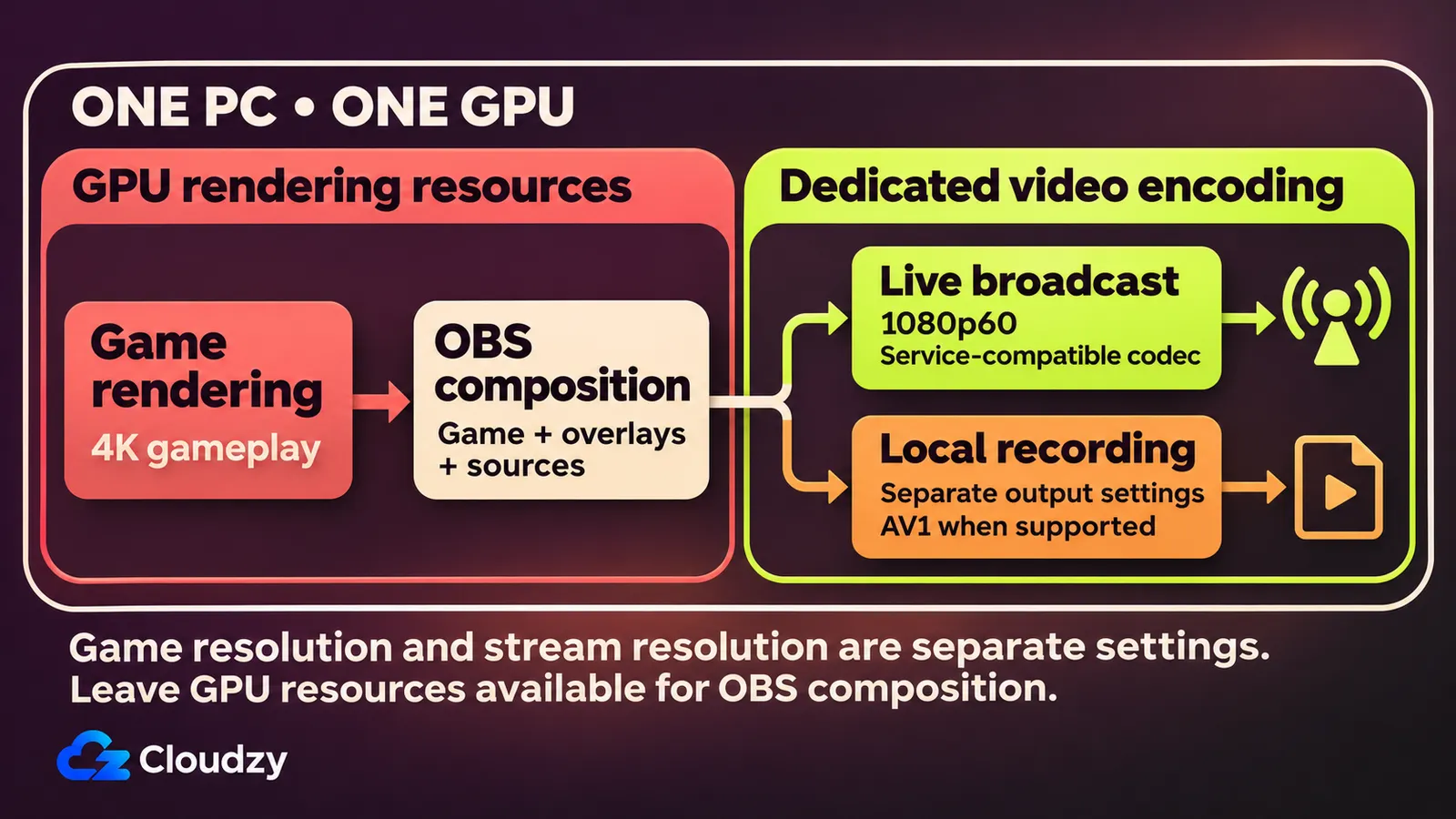
Consider high-detail 4K gameplay, one 1080p60 live broadcast and a separate local recording running together. With an uncapped GPU budget, my recommendation is the RTX 5090. This is a capability-based inference from its leading gaming baseline and hardware encoding capacity. The selected evidence contains no matched cross-vendor game-plus-OBS test proving a simultaneous streaming champion.
NVIDIA's RTX 5090 specifications list three ninth-generation NVENC engines and AV1 encoding. These are physical encoding resources. An encoding session is a software workload, and a software interface is the path an application uses to access hardware. Counting engines does not tell you which engine OBS assigns to each output or how the finished picture compares with another vendor.
You do not need three engines for an ordinary broadcast. A simple single-output stream can use one hardware encoding path. Separate recording makes the requested workload more demanding, but engine count alone does not decide whether it succeeds.
OBS's hardware encoding guidance describes the NVIDIA NVENC, AMD AMF and Intel Quick Sync paths. Hardware encoding generally reduces CPU work; AMF is an interface/framework, not the name of a physical encoder chip. OBS still needs GPU resources to compose and render its scene; hardware video encoding does not remove that work.
For a constrained purchase, start with the B580's $330 path for 1080p play and broadcast, subject to the game and platform checks. The GRE's $570 path is my faster-game alternative for 1440p play with a 1080p broadcast. Neither is an independently measured OBS winner. On the GRE, check that your current driver and OBS expose the compatible AMD hardware encoder and intended output settings; do not infer codec quality from an older Radeon review.
Game resolution and broadcast resolution are separate settings. Playing at 4K does not require sending a 4K stream. Choose the service's accepted output first, then check the card and software path for that codec.
| Destination | Supported Output Boundary | Buying Consequence |
|---|---|---|
| Twitch, 1080p and below | AVC/H.264 in Twitch's announcement | AV1 hardware alone does not improve this ingest path |
| Twitch, 1440p | Enhanced Broadcasting for Partners/Affiliates, using HEVC at up to 9Mbps | Confirm account access and the compatible broadcast setup |
| YouTube Live | H.264, HEVC or AV1 through RTMP/RTMPS, up to 60 FPS | Match encoder, upload capacity and intended output |
| Local recording | AV1 is available on supported hardware/software paths | Check the recording and playback/editing workflow separately |
Twitch's June 17 streaming announcement describes server transcodes for Partners and many Affiliates, with conditions. It does not establish universal AV1 ingest.
YouTube's live encoder settings recommend, for example, 12Mbps for 1080p60 AV1/HEVC versus 17Mbps for H.264. Those are platform settings, not a cross-vendor picture-quality benchmark. Use its CBR guidance and recommended two-second keyframes, and test motion, audio and stream health. A locally successful AV1 recording proves neither Twitch acceptance nor sufficient upload bandwidth.
Check the PC and the OBS Session Before Buying
An existing card that runs your game acceptably can still produce a choppy OBS session. Before spending, reproduce that session with the intended stream and separate recording enabled. Use OBS Stats and the session log to diagnose it, then follow OBS's performance troubleshooting guidance for a controlled retest.
Run the checks in a repeatable order:
- Load a demanding scene in your target game with your normal OBS scene collection. Include the browser sources and filters you intend to use. Record the game settings, game frame cap and output settings so you can compare changes.
- Open OBS Stats and inspect the session log. Separate rendering lag from encoding lag; treat dropped network frames as a connection issue to investigate separately. A GPU replacement is not an established fix for every type of dropped frame.
- Cap the game's frame rate, lower graphics settings or simplify OBS scenes. Reduce browser-source and filter load where practical. Retest one change at a time, with both outputs running, so you can identify which change helps.
- Inspect the resulting recording and live output as well as the counters. Check difficult motion and audio, and watch stream health. If the existing PC now meets your target, keep that result when deciding whether an upgrade is necessary.
For game stutter, log VRAM and frametime behavior alongside OBS's counters. The published gaming averages above contain no per-card 1% lows or OBS output statistics. They cannot supply a fixed streaming-overhead percentage or a universally safe GPU-utilization threshold.
Before ordering, check the exact board maker's PSU recommendation, power connectors and case clearance. A GPU family name does not identify every partner card's physical requirements. Account for any necessary supporting upgrade in the amount you can spend.
For Intel, verify your CPU, motherboard and firmware against Intel's desktop quick-start requirements. Resizable BAR or Smart Access Memory must be enabled for optimal B-series performance. An older unsupported PC should not be expected to reproduce the hierarchy's results. Confirm the required platform support before treating the B580 as the inexpensive upgrade.
Finish with the delivered local price, seller and return terms for the exact memory variant you intend to buy. Recalculate the relevant ratio, check current target-game tests, and make the purchase conditional on a repeatable game-plus-OBS verification using your intended outputs.
FAQ
Should I Replace a Working RTX 4090?
Keep a working RTX 4090 if it already meets your game and OBS requirements. The RTX 5090's measured gaming uplift establishes a faster baseline, but it does not establish upgrade value without your replacement cost and an unmet workload target. Compare the cost of changing cards with the specific problem the change would solve.
Should I Use an Old Second GPU Just for OBS Encoding?
OBS's primary-adapter recommendation generally favors the hardware encoder on your main graphics adapter. Adding another card is not a universal cure for an overloaded session. Test the intended configuration and inspect OBS's logs before buying or installing an extra GPU for that purpose.
Are Used GPUs Included in These Value Picks?
No. These value picks use dated observations for new current-generation cards. Evaluate a used card separately using its delivered price, condition, warranty or return protection, and compatibility with your intended games and OBS outputs. Do not compare its used price against an unavailable new card's MSRP.


Discussion
Comments
Sign in to join the discussion.