

Two threads, two subreddits, the argument running in opposite directions. In r/linux: "Why does everyone hate omarchy so much?" In r/omarchy: "Why is Omarchy good and deserving of all the hype?" Both drew long, serious answers. Neither settled anything.
What struck me reading through both is how often the answers agree. Not about whether Omarchy is good, about what Omarchy is. Some of the strongest replies on either side give near-identical descriptions of the thing and then attach opposite verdicts. And the design doctrine they are both arguing about was written down in 2012, in an essay about a web framework, by the person who later built Omarchy. That essay gives the disagreement a vocabulary that makes the shape of it easier to see.
Other criticisms of Omarchy are separate. The disagreement here is narrower: whether having somebody else make the decisions is the feature or the problem.
Both Camps Are Describing the Same Machine

Here is the case for, from a reply in r/omarchy, the subreddit where people go to defend it: "A lot of people don't care enough to go through hundreds of config files but care enough to use Linux."
And here is the case against, from a reply in r/archlinux: "This is the exact reason why I hate opinionated distros. Because their opinions are garbage."
Read those twice. They are the same sentence with different feelings attached. One says Omarchy makes hundreds of decisions on your behalf, and that is the product. The other says Omarchy makes hundreds of decisions on your behalf, and those decisions are wrong. In these replies, the disagreement is not about what the machine does.
You can watch somebody make the point without picking a side, inside the pro-Omarchy subreddit itself, where a commenter wrote that Arch "is all about freedom of choice, do it how you want," while Omarchy "…tells you how you should do everything from the start. And that's ok too."
Much of the hype and the hate is one observation with two verdicts attached.
When two people agree on the premise and disagree only on the conclusion, neither one has much left to hand the other.
The Word Omarchy Uses for Itself
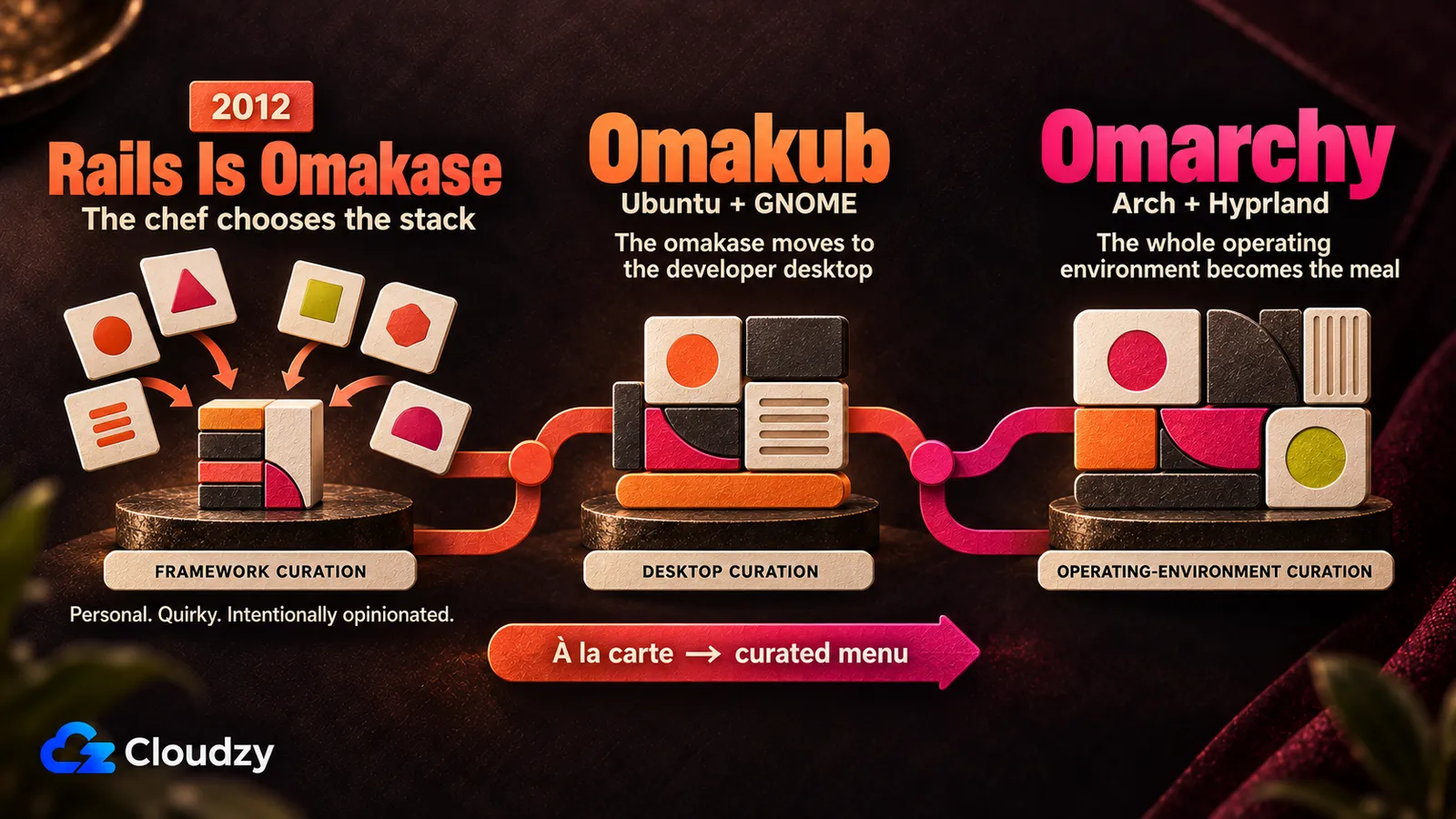
The current manual names the category in Omarchy's own words: "Omarchy is an omakase Linux distribution based on Arch, the tiling window manager Hyprland, and the desktop construction-kit Quickshell." Omakase: you do not order. The chef decides, and their judgment is what you are buying.
The predecessor puts the lineage in writing. Omakub, the Ubuntu-based predecessor that is now retired, describes its own succession this way: "So the omakase moved from Ubuntu to Arch, from GNOME to Hyprland, and became Omarchy. Not a layer on top of somebody else's distribution, but the whole meal."
Which sends you back to 2012, and to an essay about Ruby on Rails.
"Rails is omakase. A team of chefs picked out the ingredients, designed the APIs, and arranged the order of consumption on your behalf according to their idea of what would make for a tasty full-stack framework. The menu can be both personal and quirky. It isn't designed to appeal to the taste of everyone, everywhere."
Read that now and it is uncanny. That essay opens by describing the alternative: "à la carte software environments" where "in order to eat, you must first carefully look over the menu of options to order exactly what you want," and where "you're going to have to know what you want." That reads like a description of Arch, published more than a decade before Omarchy existed. It even sets the boundary condition the current fight keeps circling: substitutions are allowed, within reason.
Counting the Courses Is the Wrong Review
Two lines from opposite ends of the argument, doing the identical thing. From one commenter in the r/linux thread: "The 'distro' is basically just a fancy install script." From the current manual: "There's zero bloat here: Just everything I use."
Both are counting. One counts the contents and calls the list thin; the other counts the contents and calls the list complete. It is the single most repeated move in this conversation, and it turns up across the coverage I read.
Omarchy's defenders are owed something before anything else, and it is not small. Shipping taste is difficult work. Choosing every default so that the choices agree with each other and still hold up on a stranger's laptop is a harder problem than assembling those components badly, and "it's just dotfiles" quietly reclassifies curation as the absence of work. A reply further down the r/archlinux thread concedes the outcome without much affection: "Omarchy isn't really for Linux users imo. It's a gateway drug for people who use Windows or Mac. I think we should just be happy for the additional user base." Something worked here, and an inventory count cannot see it.
Because an inventory count is how you judge a grocery store. You walk the aisles, you tally what is stocked, and a longer list is a better store. A tasting menu does not work that way, and neither does a system built on the same premise. So here is the question I would want answered before installing anything like this: is this taste good, and do I want somebody else exercising it on my machine, indefinitely?
The Part of the Deal That Gets Skipped
A post in r/archlinux is titled "I dumped Omarchy and went back to a fresh un-opinionated Arch." Its author, u/phx32259, gave it about 63 days (long enough that this is not a first-boot reaction). The line usually pulled from it is about keybinds and a Neovim config coming back changed after an update, which he reports as his own experience and which at least one commenter in the thread disputes. Take it as one person's account of what happened on his machine, because that is what it is, and because the argument does not need it to be anything more.
The sentence he wrote next is the one worth sitting with: "Yeah I know it is an opinionated install, I didn't realize it was going to be opinionated updates as well."
That is the deal, discovered from the inside. A tasting menu is a standing agreement that the chef keeps deciding, including about a dish you had grown attached to.
This was not a scandal. He worked out what he wanted, which in his own words was stock Arch plus "a preconfigured Hyprland and development environment," not a system that would keep re-deciding on his behalf. That is à la carte, and wanting à la carte is a completely reasonable thing to want. It is also worth knowing about yourself before you install anything.
What I keep coming back to is that the current manual states this cost in plain language. The current manual warns that system updates may occasionally restore certain configs to their original condition, while preserving the user's changes in a backup file.
Where the Menu Metaphor Runs Out
Substitutions are allowed, within reason. That was written about a web framework, and it is carrying far more weight now than it was asked to carry in 2012.
If you dislike something Rails picked, you delete a line from your Gemfile, or you pick a different framework next project, and your week is unaffected. If you dislike something your desktop picked, the thing being substituted is where your hands go. Keybinds are muscle memory built over years, and they are most of what makes a machine feel like yours rather than like a rental.
That is where the comparison stops being useful to me. You can leave a restaurant between courses. An operating system holds your machine, your workflow, and a decade of habits you cannot drop on a Tuesday afternoon.
I do not think that settles anything against Omarchy. A curated system for people who never wanted to make those decisions is a defensible product, and the people it landed with are not wrong about their own preferences. It does mean the agreement is heavier than the comparison makes it sound, in both directions. Whether it is too heavy is a question about you, and no menu can answer it.

Build on a Linux VPS with root access, NVMe, and AMD EPYC power.
View Linux Plans

Discussion
Comments
Sign in to join the discussion.