

You have a VPN, a server, a domain, or an email account to pay for, and a checkout page asking for a card tied to your name and your bank. The workarounds that used to answer that problem have shifted: a prepaid card can be declined online, a voucher shop can ask you to register, some exchanges have stopped selling Monero, and one well-known mixing service no longer exists.
Anonymous payment methods still work, but most now come with a condition, such as a per-payment cap, an identity check past a threshold, or a coordinator you have to choose yourself. The test for all of them is the same. After the payment clears, who can still connect it to you?
TL;DR
- Mailed cash, where a provider accepts it, leaves no bank or card record, which makes the account you pay into the weaker link.
- Paysafecard PINs pay without registration up to a per-payment cap that varies by country, though some shops require an account.
- Privacy.com's virtual cards hide your card number from shops but verify your identity at signup. Cash App limits send-and-receive activity to $1,000 within any 30-day period before higher-limit identity verification; buying bitcoin also requires identity verification.
- Bitcoin mixing changed in 2024: the zkSNACKs coordinator shut down and Samourai's Whirlpool closed after its founders' arrests. Wasabi coinjoin works through a coordinator you configure.
- Monero hides sender, receiver, and amount by default, but some exchanges have dropped it in some regions, so swaps and peer-to-peer trades are the routes that work without an exchange listing or an exchange account.
- Your email address, signup IP address, and app-store billing can link an account to you however you paid.
Private or Anonymous: Who Can Still See the Payment
A payment is private when some of the parties handling it cannot see who you are. It is anonymous when none of them can link it to your identity. Most methods on this list are private: each hides you from some parties, while at least one company or public record still holds the link.
Every online payment passes through some combination of these parties:
- The merchant, who sees whatever the checkout collects: name, email address, billing address, card number.
- The issuer or processor, such as Paysafecard, Cash App, or a card network, which sees the transaction and the result of any KYC (know your customer) identity checks it ran on you.
- Your bank, which sees where you spent money, though usually not what you bought.
- Anyone reading a public blockchain, if you paid in bitcoin.
- Authorities with legal process, who can request records from any of the above.
A threat model answers two questions: who you are protecting yourself against, and what they could learn. Keeping your card number from a poorly secured shop is a different job from keeping your name from the service you pay. Pick the party you are hiding from before you pick the method.
Anonymous Payment Methods Compared
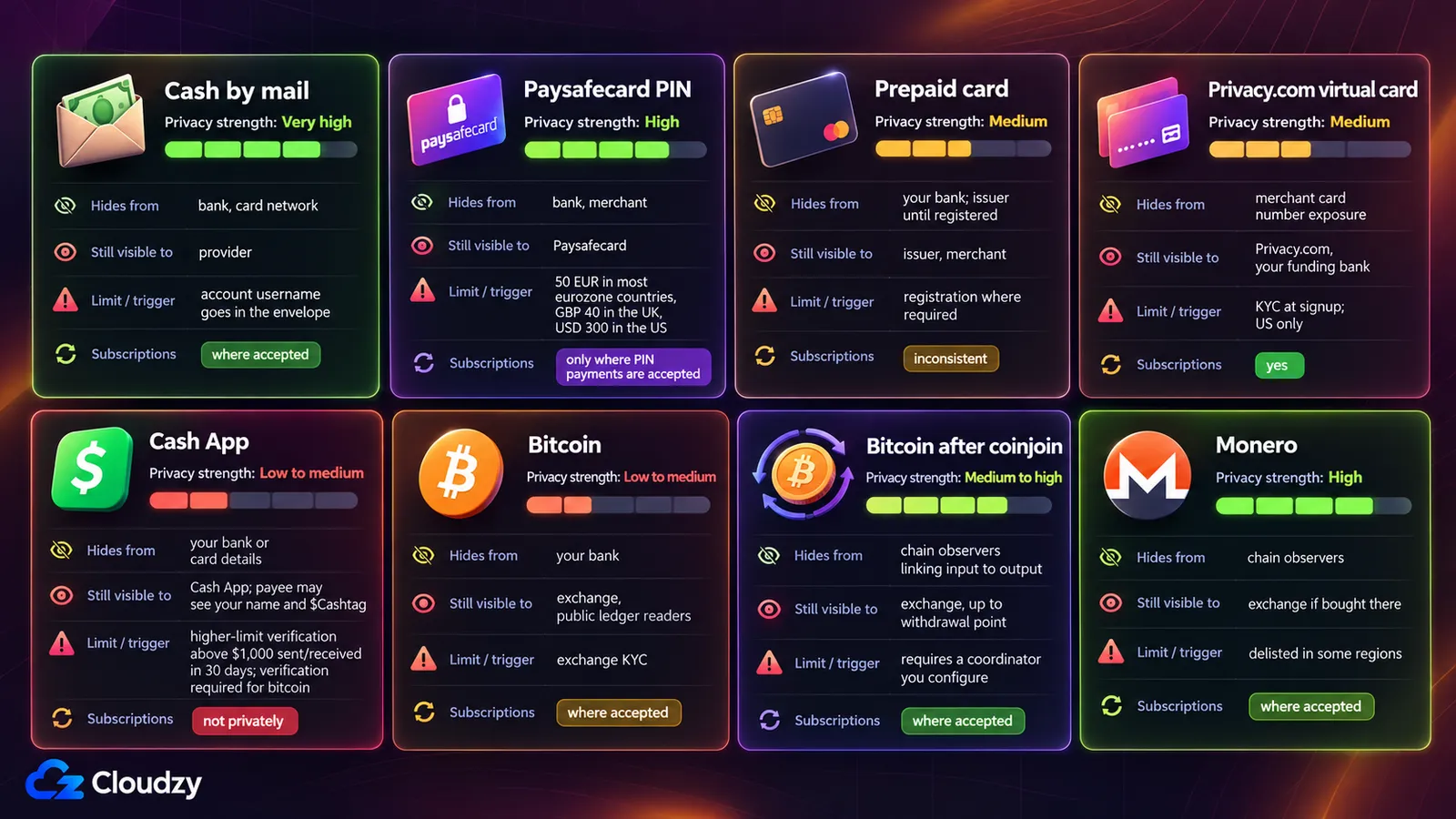
Cash and Monero keep the most parties out of a payment. Vouchers, prepaid cards, virtual cards, and Cash App each hide you from one or two parties while a company in the middle keeps a record, and most carry a spending cap or an identity check at a set threshold. Limits and caps in this article are as of October 2026 and can change, so check the provider's own page before relying on them.
| Method | Example | Hidden From | Still Visible To | Limit or ID Trigger | Works for Online Subscriptions? |
|---|---|---|---|---|---|
| Cash in person | Banknotes paid at a counter | Bank, card network | The seller | No ID check, but many countries cap cash payments by law | Only by buying a voucher or gift card |
| Cash by mail | Proton | Bank, card network | The provider | Your account username goes in the envelope | Where accepted |
| Paysafecard PIN | Paysafecard | Bank, merchant | Paysafecard | Per payment: 50 EUR in most eurozone countries, GBP 40 in the UK, USD 300 in the US | Where the shop takes PINs |
| Prepaid card | Store-bought prepaid card | Your bank; the issuer, until registered | Issuer (transactions), merchant | Registration, where required | Inconsistently |
| Virtual card | Privacy.com | Merchant (your card number) | Privacy.com, your funding bank | KYC at signup; US only | Yes |
| Peer-to-peer app | Cash App | Your bank or card details | Cash App; the person you pay may see your name and $Cashtag | Higher-limit verification above $1,000 sent/received in 30 days; verification required for bitcoin | Not privately |
| Bitcoin | BTC | Your bank | The exchange, public ledger readers | Exchange KYC | Where accepted |
| Bitcoin after coinjoin | Wasabi | Chain observers (which input paid which output) | The exchange, up to your withdrawal | A coordinator you configure | Where accepted |
| Monero | XMR | Chain observers | The exchange, if you bought there | Delisted in some regions | Where accepted |
How Each Method Holds Up
Each method below opens with its current status and the limit or identity check it carries. They run from cash to cryptocurrency, where the payment itself moves off bank and card records, and the public ledger and the exchange that sold you the coins become the records to consider.
Cash, Including Cash by Mail
Cash handed over in person leaves no bank or card record. Mailed cash extends that to online services where the provider accepts it, on strict terms. Proton's payment options page says Proton accepts USD, EUR, or CHF by post, refunds nothing bought with cash, and takes no responsibility for lost shipments.
Proton credits mailed cash to your account, and that credit pays the subscription, so monthly billing means a new envelope and a new chance of loss at every renewal. Mailed cash suits a yearly plan better. In person, cash mostly buys something else on this list, such as a Paysafecard PIN or a gift card for the service.
Prepaid Vouchers Like Paysafecard
Paysafecard still works without an account. You pay with a 16-digit PIN, and Paysafecard's how-it-works page says it uses no personal data for those payments. Each unregistered payment is capped, at 50 EUR in most eurozone countries, GBP 40 in the UK, and USD 300 in the US, and some shops require registration for every transaction.
At checkout, a yearly plan priced above the cap will not go through as one unregistered payment. Whether a shop accepts a bare PIN is its own decision, so check before you buy the voucher.
Registering trades privacy for higher limits, and only up to a point. Paysafecard's Austrian registration page says a standard account there allows transactions up to 250 EUR a month, and that Unlimited status requires verification. Idle credit can also shrink, on a schedule that depends on the country. Paysafecard's UK fees page says a monthly service fee comes off remaining voucher credit from the second month, while its US fees page starts that fee only after 24 months of inactivity, so check your own country's page before holding credit.
Prepaid and Virtual Cards
A virtual card hides your card number from the shop, not your identity from the card company. Privacy.com's own explainer says the service is limited to US citizens or legal residents aged 18 or older with a US bank account, and that Privacy.com verifies identity before cards work. A store-bought prepaid card may let you pay without attaching your name at purchase, but registration and activation rules vary by card and country.
Privacy.com collects your name, address, and phone number and links a checking account, calling this a mandatory KYC procedure under anti-money laundering (AML) laws. What you get is compartmentalization: a card can lock to the first merchant that charges it or close after one use, so a breach at one shop exposes a number that works nowhere else. It hides nothing from Privacy.com.
Once a prepaid card is registered to your name and address, it carries the same identity a debit card would. That is security theater: it looks like a privacy measure and changes nothing about who can see the payment.
Peer-to-Peer Apps Like Cash App
Cash App is not an anonymity tool toward the person you pay. Cash App's privacy notice says it may show other users your name, $Cashtag, prior transaction history, when you joined Cash App, and contact-related signals. Its current limits page says you can send and receive up to $1,000 within any 30-day period before identity verification raises those limits.
Cash App also requires identity verification before you can buy bitcoin and may request additional information when verification requires it. It is a convenient peer-to-peer payment service.
Bitcoin and Other Transparent Coins
Bitcoin is pseudonymous, not anonymous. Bitcoin.org's privacy guidance states that all bitcoin transactions are public, traceable, and permanently stored, and that anyone can see the balance and transactions of any address. In my assessment, the weak point is usually the exchange, where the coins were tied to the identity you verified.
The chain holds no names. They enter at the on-ramp, where ordinary money becomes crypto. An exchange that runs KYC records that your verified identity withdrew a specific amount to a specific address, and every later payment from that address can be followed back along the ledger. A private wallet or a VPN does not undo that, because the link sits in the exchange's records and on the chain.
Breaking the trail after purchase is the job of coinjoin, below. Speed and fees are separate questions from privacy, and which cryptocurrencies work well for payments depends on both.
Coinjoin After the Coordinator Shutdowns
Bitcoin coinjoin still works, but the defaults are gone. zkSNACKs shut down its coordinator on June 1, 2024, and Wasabi now coinjoins only through a coordinator you configure. Samourai Wallet's Whirlpool closed when its founders were arrested in April 2024, and JoinMarket archived its code in April 2026.
A coinjoin is one bitcoin transaction built by several people, each adding coins as inputs and fresh addresses as outputs, so an observer cannot tell whose input paid which output. The coordinator is the server that runs the round: it accepts registrations, builds the transaction, and collects signatures. Wasabi's coinjoin documentation describes the protocol as trustless, meaning nobody can steal, and private, meaning even the coordinator cannot spy.
The coordinator does decide who takes part. It sets a round's minimum amount, checks which inputs may register, and can ban coins from later rounds. Wasabi's getting-started guide says a coordinator must be configured before you can coinjoin, so you choose the operator and accept that it may be unavailable or selective. That asks for less trust than a custodial mixer, where you hand coins to a service and rely on it to send different coins back; with coinjoin you keep your keys.
The IRS announcement of the founders' arrest reports Samourai's servers and domain seized, and both founders were sentenced in November 2025 to five and four years in prison for a conspiracy to operate an unlicensed money transmitting business that knowingly moved criminal proceeds. JoinMarket's final release notes warn against using the code without independent confidence that it is not exploitable.
Privacy Coins: Monero, Zcash, and Dash
The Monero project says the sender, receiver, and amount of every Monero transaction are hidden by default. Zcash supports both shielded and transparent transactions. Its wallet guidance says wallets may shield transactions by default, make privacy optional, or support only transparent transactions. Dash's documentation states that its CoinJoin mixing is disabled by default.
Monero uses three mechanisms. A stealth address is a one-time address the sender creates for each payment, so the recipient's published address never appears on the chain. A ring signature signs a transaction on behalf of a group of possible senders, so an observer cannot tell which one spent. RingCT, short for Ring Confidential Transactions, hides the amount.
The cryptography in Zcash and Dash works. The privacy set depends on how each system is used: Zcash wallets can be shielded by default, optional, or transparent-only, while Dash CoinJoin remains opt-in.
The harder problem with Monero is buying it. Kraken's support notice states that Kraken halted XMR trading and deposits for clients registered in the European Economic Area on 31 October 2024, citing regulatory changes. Monero bought on an exchange that verified your identity starts out tied to your name, whatever the chain hides afterward.
Monero only helps where a service accepts it. At Cloudzy, we accept XMR for Linux VPS plans, and our Monero VPS page states our position: no KYC on the standard crypto payment paths, an email address collected for billing and account access, and compliance with applicable AML laws where a case calls for review. That email address is an identifier, and it deserves the same care as the payment.
Getting Monero Without an Exchange Account
Two routes give you Monero without an exchange account: an atomic swap from bitcoin using eigenwallet, or a peer-to-peer trade on a network running Haveno, such as RetoSwap. Both keep the coins in your own wallet and run over Tor. Both take more time and attention than an exchange.
An atomic swap is a trade between two blockchains that either completes for both parties or does not happen, so neither side can take the other's coins without sending its own. eigenwallet, formerly UnstoppableSwap, swaps bitcoin for Monero peer-to-peer, with no account and your keys under your control. The trade-off is that you need bitcoin first, and if it came from an exchange that verified you, the bitcoin side of the swap carries that history.
Haveno is non-custodial exchange software that runs over Tor, and you alone hold your wallet keys. The Haveno project does not endorse any networks, so you trade on a third-party network that runs it, such as RetoSwap. RetoSwap's FAQ notes that trade times depend on the payment method and your trade partner's availability, disputes go to an arbitrator, and your trade account details are shared with the person you trade with. Removing the exchange shrinks the set of parties without emptying it: your trade partner remains, and so does an arbitrator if the trade is disputed.
Once the coins sit in your own wallet, securing them is your job, and cold storage for larger balances keeps the keys offline.
What Links a Private Payment Back to You
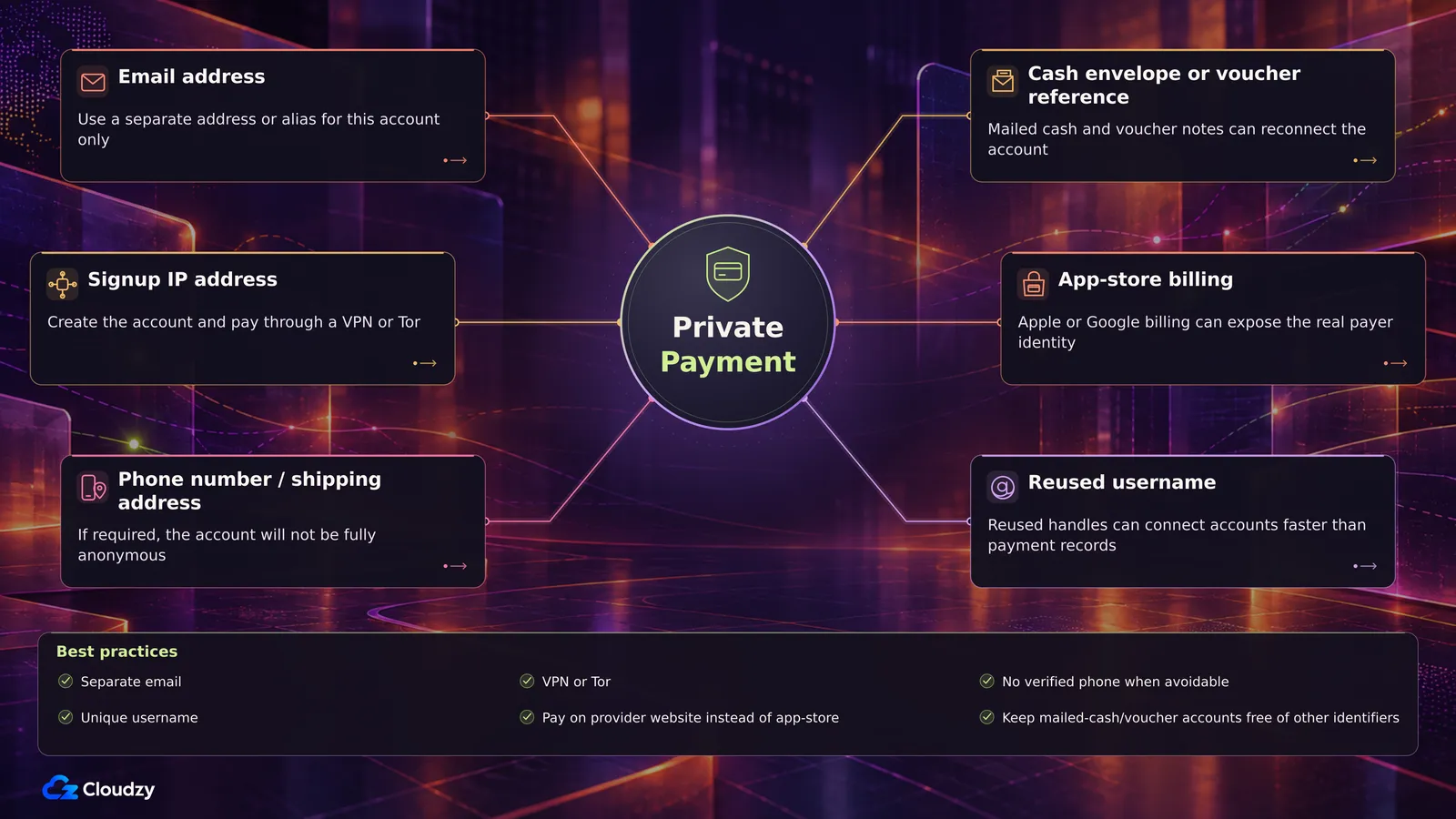
A private payment still lands in an account, and that account usually holds more identifiers than the payment did: an email address, a signup IP address, a phone number, a reference on a cash envelope, app-store billing. Any one of them can reconnect the purchase to you, and on many subscriptions they can expose more than the payment method does.
Each has a practical fix:
- The email address. Use a separate address or alias for this account only, since a provider that collects little else usually still holds one.
- The signup IP address. Create the account and pay through a VPN or Tor. A VPN changes who sees your IP address: the VPN provider sees it, and the service you pay sees the VPN's.
- The phone number and shipping address. Leave them out wherever a digital service does not need them. A service that insists on a verified phone number is telling you the account will not be anonymous.
- The reference on a cash envelope or voucher note. Mailed cash needs one so the provider can credit you, so keep that account free of other identifiers.
- App-store billing. A subscription bought inside a phone app bills through your Apple or Google account and the name and card behind it. Pay on the provider's website instead.
- A reused username. A handle you use elsewhere links accounts faster than a payment record. Pick one used nowhere else, and let a self-hosted password manager remember which handle and alias belong to which account.
Receiving Payments Privately
BTCPay Server lets you accept bitcoin, on-chain and over Lightning, without a payment processor in the middle. It is self-hosted and non-custodial, payments go straight to your own wallet, and BTCPay's comparison page states that BTCPay Server will never ask a merchant for any personal identification.
BTCPay Server 2.1.0 moved Monero and Zcash support into plugins, so accepting XMR is an extra install. If you bill only a few clients, a Monero address from your own wallet is simpler. A limit remains: a customer who pays with exchange-bought bitcoin leaves a trail that ends at your address.
BTCPay Server runs on a Linux VPS from any provider. At Cloudzy, we offer a one-click BTCPay Server set up with Bitcoin Core and Lightning, and you can pay for the server in bitcoin.
Which Method Fits Your Situation
Every option below costs something: waiting on the mail, staying under a voucher's cap, qualifying for a US-only card, or spending time on a swap or a coinjoin round. Match the cost you can accept to the situation you are in.
- Paying for a VPN, email, or VPS subscription without crypto: mail cash where the provider accepts it, or use a voucher or gift card the service takes.
- Paying with crypto while minimizing identity links: Monero from an atomic swap or peer-to-peer trade, sent from your own wallet.
- Already holding exchange-bought bitcoin: coinjoin through a coordinator you have configured, accepting that it decides who joins.
- Keeping card details from online shops, when you do not need to hide your identity from the card company: a virtual card locked to one merchant, if you are eligible.
- Making a small one-off payment: a Paysafecard PIN within your country's cap, at a shop that accepts PINs without registration.
Where the Rules Are Heading
Regulation is tightening on the companies that handle payments. From 10 July 2027, the EU's Anti-Money Laundering Regulation bars credit institutions, financial institutions, and crypto-asset service providers from keeping accounts that allow anonymous transactions, including through privacy coins. Anonymous prepaid instruments are already capped under earlier EU rules.
Article 79(1) of Regulation (EU) 2024/1624 prohibits those providers from keeping:
any account otherwise allowing for the anonymisation of the customer account holder or the anonymisation or increased obfuscation of transactions, including through anonymity-enhancing coins.
The obligation falls on banks, payment companies, and exchanges. The regulation defines anonymity-enhancing coins as those that anonymize transfers either systematically or optionally, but it does not name Zcash, Dash, or any other coin individually. Recital 160 excludes providers of self-hosted wallets and wallet software with no access to or control over those wallets, and Article 79 places no prohibition on individuals holding coins.
Prepaid limits predate it. The 2018 amendment to the EU AML directive lets EU member states waive identity checks on a prepaid instrument only if it cannot be reloaded or is limited to EUR 150 a month, holds no more than EUR 150, and is not used for remote payments above EUR 50.
Paying privately has legal limits. A service can lawfully require identity verification before it takes your money. Operating a mixing service for others can end in prosecution, as the Samourai case shows. And paying privately does not change what you owe in tax or what you must report. This is general information, not legal advice, and the rules differ by country.
Frequently Asked Questions
Is Bitcoin an Anonymous Payment Method?
No. Bitcoin addresses carry no names, but the ledger is public and permanent, so one link between an address and your identity exposes every payment that address makes. An exchange that verified you when you bought the coins creates that link. Coinjoin can break the trail afterward, through a coordinator you configure.
Can You Still Pay With Paysafecard Without ID?
Yes, for PIN payments within Paysafecard's per-payment cap, which varies by country. Some online shops require a Paysafecard account for every transaction, and higher account limits require verification. The PIN itself can be bought at a sales outlet with cash.
What Is the Most Anonymous Way to Pay Online Without Crypto?
Cash sent by mail, where the provider accepts it, leaves no bank or card record. A voucher or gift card bought with cash is the next option, within its spending limits. Either way, sign up with a separate email address over a VPN or Tor, or the account can still identify you.
Is Monero Being Banned?
Not for individuals holding it under EU rules. From 10 July 2027, the EU's Anti-Money Laundering Regulation bars banks, financial institutions, and crypto-asset service providers from keeping accounts that allow anonymization, including through privacy coins. Article 79 does not prohibit individuals from holding Monero in self-hosted wallets. Some exchanges, including Kraken for clients in the European Economic Area, have already stopped offering Monero.
Is a Virtual Card Like Privacy.com Anonymous?
No. It is a breach-containment tool. A card can lock to one merchant or close after one use, so a leaked number stops working elsewhere, but Privacy.com holds your verified identity and linked bank account, so every purchase is tied to your name on its side.
How Can I Receive Money Anonymously?
Not automatically. A self-hosted processor such as BTCPay Server removes a payment company from the middle, and a Monero wallet hides transaction details on-chain, but your email, domain, hosting account, network metadata, or information shared with the payer can still identify you. Neither changes your tax or reporting obligations.






Discussion
Comments
Sign in to join the discussion.