
You could write your next small JSON endpoint in the stack you already know. Or you could use it to try Go. I built one for this Go programming language review, including a dependency that fails on purpose and an operation that waits until it's canceled. Is Go worth learning when shipping in your existing stack would already be straightforward?
TL;DR
Go is worth learning for backend work. Its strongest selling point is how little extra machinery I needed to build, check, and package this service. I value that more than clever syntax. The error handling gets repetitive, and concurrency still demands careful design, but I consider those acceptable costs for this kind of application. My verdict is 4/5: a language I'd choose for a new small service, with no compelling reason here to rewrite a working one.
How Go Simplifies Building a Small Service
Go gave my small HTTP/JSON service a convenient format, test, and build workflow. I could check formatting, run the application tests and static checks, then produce an executable without adding a framework or third-party module. That was a useful local-development benefit; the test suite's quality still depended on the cases I wrote.
The service had /health and a greeting endpoint accepting a JSON name. Two additional endpoints exercised failure and cancellation. I used net/http for routing and serving, with encoding/json for request and response bodies. The dependency list contained the fixture module and standard-library packages, so there wasn't an external framework installation to evaluate.
The fixture's go.mod declared the module and Go version; source and tests lived together. A valid greeting returned 200 with {"message":"hello Ada"}, and the health endpoint returned a JSON status. I could inspect validation and responses without framework defaults hiding those decisions.
gofmt -d main.go main_test.go initially showed two field-alignment differences. I applied the spacing corrections and the final check returned no diff. go test ./... passed, go vet ./... completed without findings, and a build with CGO_ENABLED=0 produced the executable I later ran.
The tooling is my favorite part of Go. Having formatting, tests, static checks, and builds in one coherent workflow removes decisions I don't want to spend a small service project making. An opinionated formatter is a sensible compromise: I'd rather accept its layout than keep debating mine. That's why I give the development workflow 4.5/5. The appeal is less setup and fewer distractions between writing a handler and checking whether it works.
The limitation showed up in what a green command couldn't tell me. A test that checked only a successful greeting would've passed without evaluating malformed input or a failed dependency. I had to specify those outcomes. The commands made verification convenient, but they didn't write the service's behavior contract for me.
One Go convention I used was a small interface for the operation behind a handler. Its Run method accepted a context and name, then returned a message and error. The successful operation, failing operation, and waiting operation each supplied that method. The handler could accept any of them without an inheritance tree.
Go's FAQ explains implicit interface satisfaction: a type implements an interface by supplying its methods, without an implements declaration. In this fixture, that let me compose the handler with a different operation for each path. The practical adjustment is to think about the behavior the caller needs, then give it that small contract.
Here, substitution made failure and waiting behavior explicit while keeping the HTTP response logic in one place. I'd want that kind of concrete reason before introducing another interface.
What Takes Practice After the Syntax Clicks
A readable Go handler still needs deliberate error handling and a plan for work that outlives a request. In my fixture, the choices were visible at each returned error and at the waiting operation's cancellation point. Go's FAQ describes its error-handling design around returned values; choosing the application response remains your job.
I had the handler decode one JSON object, reject unknown fields, check for trailing objects, and validate a nonempty name. The missing-name case returned 400 with {"error":"name is required"}. Malformed JSON and an unknown field each returned 400 with {"error":"invalid JSON"}. A second JSON object returned a separate one-object-required error.
Those were decisions in the fixture, not language defaults. The decoder error and the name check had different meanings, so I gave them different response paths. I also checked the result of response encoding and logged write failures. A successful decode wasn't permission to ignore everything that could fail afterward.
The failing operation deliberately returned an error. The handler checked it, logged the injected failure, and returned 502 with {"error":"dependency failed"}. That error never became a success response, and the client didn't receive the operation's internal error text. The assertion checked both the status and complete body.
My idiomatic learning cost rating is 3.5/5. I could keep this application's structure small, but choosing where to return an error, translate it into an HTTP response, or log it took more judgment than copying the success path. Readable syntax is a promising starting point; I wouldn't use it to predict how quickly you'll become comfortable with Go conventions.
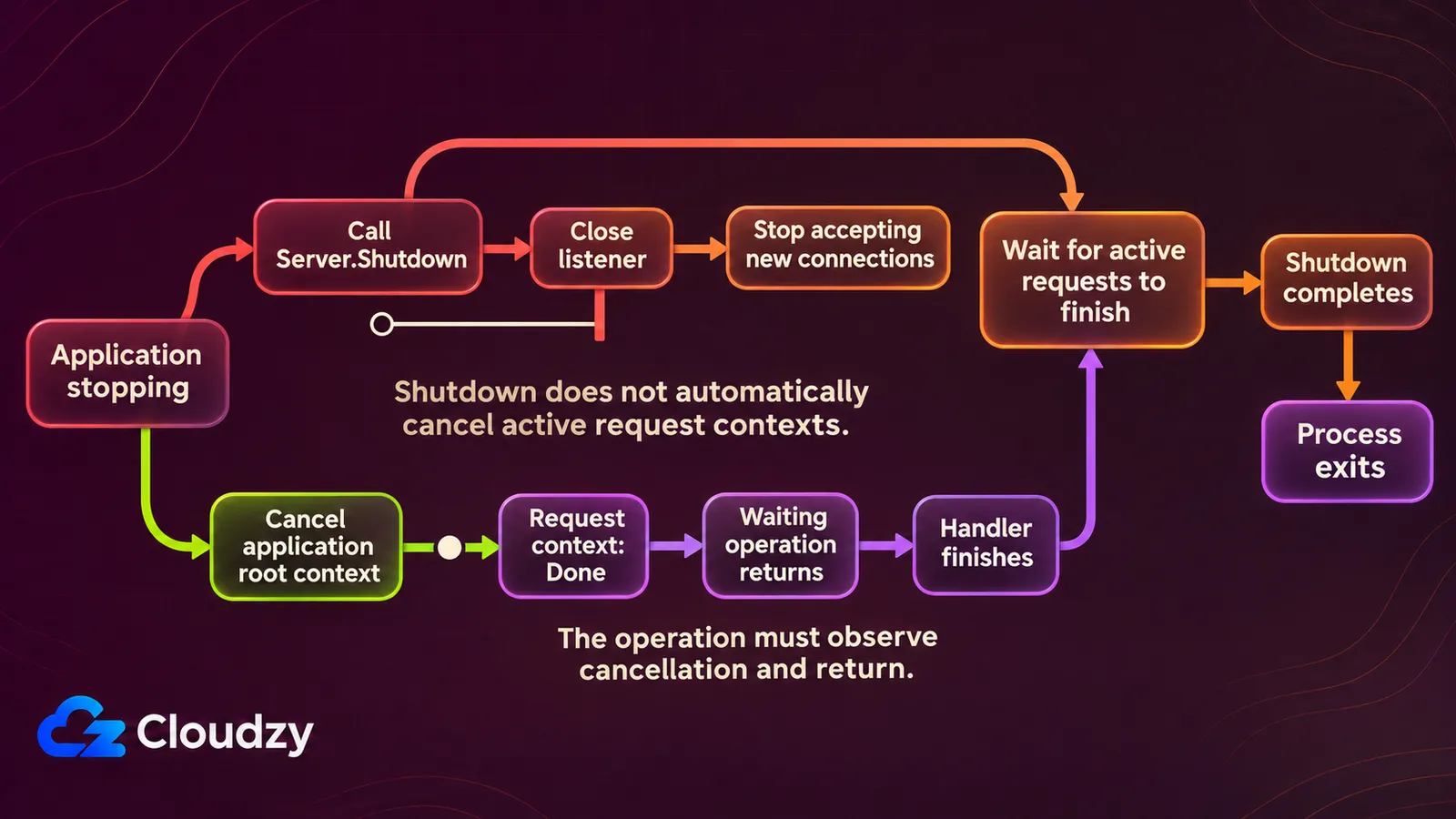
Cancellation needed a different kind of test. The waiting operation blocked until its context's Done channel closed. A context carries a cancellation signal across function calls; the operation must respond to that signal. The context package's cancellation contract gives work a way to know it should stop. It doesn't supply the work's cleanup logic.
For the deterministic unit test, I first waited for an entry signal from the operation. Then I canceled the request context, asserted that the operation observed context.Canceled, and waited for the handler to finish. The handler returned the fixture's cancellation response, 408 with {"error":"operation canceled"}. I'd change that status: 408 is for a timeout receiving the request, not for canceling work after the request has been decoded. For a request interrupted by server shutdown, I'd use 503 if a response can still be sent.
That design choice is relevant to goroutines, Go's concurrently executing functions. Starting concurrent work is only part of using it. Go's code-review guidance on goroutine lifetimes says their exit conditions should be clear, and warns that garbage collection won't terminate a goroutine blocked on a channel. Passing a context down is useful only if the receiving operation cooperates.
I also tested shutdown with an active loopback request. The service's root context supplied the base context for its requests. Canceling that root reached the waiting operation; the operation returned, its response drained, and the server finished shutdown inside the fixture's two-second bound. A new TCP connection to the listener then failed.
Go's net/http documentation says Server.Shutdown closes listeners and waits for active connections to become idle. My root-context cancellation was a separate application choice. The shutdown deadline bounded the wait; the fixture included a close fallback if it expired, although that fallback wasn't exercised in this session.
I wouldn't copy these settings unchanged. This operation cooperated, with no database transaction or background job to finish. Your shutdown policy needs a response when a dependency doesn't stop as expected.
Finally, go test -race ./... completed without reporting a race. I enabled cgo for that check and used the environment's GCC compiler. The race detector's runtime-path limitation is explicit: code paths that aren't executed can't produce a finding. My result applies to the exercised fixture paths.
I like Go's explicit error handling more than I like writing it. Seeing the failure path beside the operation makes a handler easier to inspect, but repeating that plumbing is tedious. I accept the repetition because I value the visibility. Concurrency deserves a more cautious endorsement: goroutines are convenient, but cancellation and shutdown still need deliberate coordination. I'd choose Go for that control, not because I expect it to make concurrent programming easy. My rating here is 3.5/5.
What a Go Executable Still Needs When You Run It
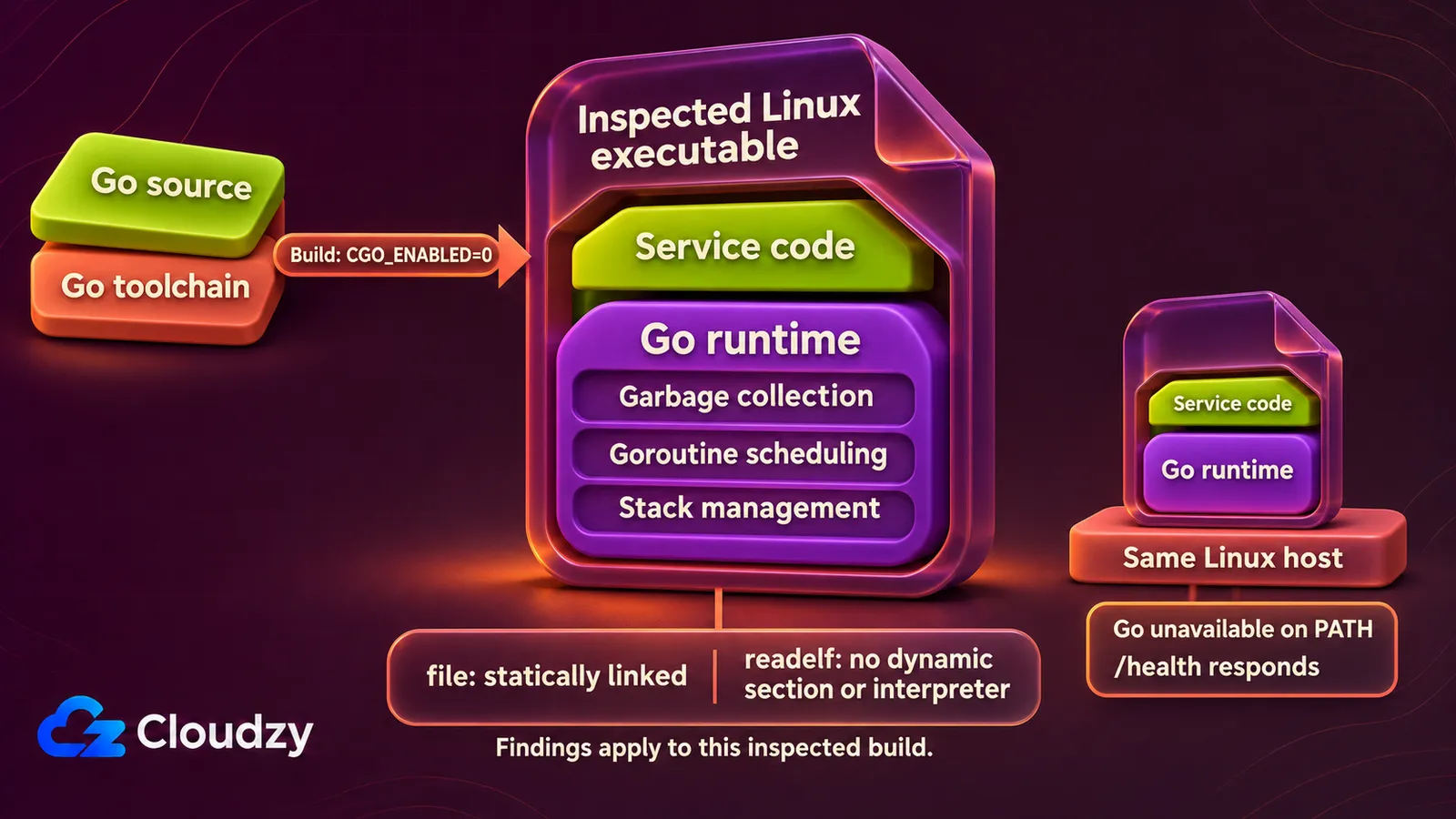
My CGO_ENABLED=0 service executable served /health with Go absent from PATH. It still contained Go's runtime: the FAQ's runtime explanation includes garbage collection, concurrency, and stack management. The distinction is between the runtime inside the program and the development toolchain used to build it. This result belongs to this inspected artifact.
I checked the file before running it. file identified a statically linked Linux x86-64 ELF executable. readelf found no dynamic section and no interpreter entry; ldd reported that it wasn't a dynamic executable. Build metadata confirmed the release build had cgo disabled. These observations gave me a firmer basis than assuming that an executable must have no dependencies.
The run used a child environment with PATH=/usr/bin:/bin, no GOROOT variable, and an assertion that go couldn't resolve on PATH. The binary selected a loopback port, answered the health request, then exited successfully after SIGTERM. The probe confirmed the listener no longer accepted a connection.
That was a restricted environment on the same Linux host, not a second-machine deployment. The toolchain still existed elsewhere in the filesystem. The result demonstrates that this inspected program didn't require invoking Go or installing a Go toolchain into its runtime environment. It doesn't establish portability to every operating system or architecture.
The cgo boundary deserves care. Go's source-installation documentation describes cgo support for importing C libraries and the C compiler required to build with it. If your application adds such dependencies, inspect the resulting artifact again. This fixture's static-link result can't tell you which libraries another build needs on its target.
I rate deployment/runtime trade-offs at 4/5. Delivering this artifact as an executable was convenient, and I could verify its dependencies directly. I would keep the dependency check in the release process as the application changes. The result is evidence about a build, not a permanent property of the project's language choice.
Garbage collection also has an operational cost even when you don't install a separate runtime. The Go garbage-collector guide describes a trade-off involving CPU time and memory. Reclaiming unused memory doesn't tell you how much a particular service needs under its own workload. I didn't measure memory consumption in this test.
The guide calls Go's memory limit soft: the runtime may exceed it to avoid spending excessive time collecting. Don't treat that setting as a guaranteed whole-process ceiling or protection against out-of-memory failure. I'd evaluate memory behavior with representative inputs before choosing capacity or a limit; this endpoint provides no general hardware floor.
There was also a clear difference between launching the binary and operating a complete service. My fixture had no authentication, persistent data, or HTTPS configuration. I didn't test supervision, a reverse proxy, or recovery after a host restart. Those are separate release decisions, and a successful local health request can't settle them.
For code checks beyond the tools I ran, I'd consider Go linting for unchecked returns, especially if an assistant helps write handlers. Keep application-specific assertions alongside those checks: a linter doesn't know which dependency failure should produce which response.
When Learning Go Pays Off and When to Keep Your Stack
I'd try Go on the next small HTTP service when its development workflow and executable delivery solve a specific inconvenience. A companion command-line tool is another reasonable learning project. I'd keep a working stack when changing languages adds cost without a project benefit, or when essential libraries or memory-control requirements point elsewhere.
For a new service with a narrow HTTP boundary, I liked inspecting response handling without assembling a framework. I'd use that opportunity to try Go before committing a larger application to it.
I'd also consider a companion CLI that calls an existing service or automates a development task. Go's official use-case categories include cloud/network services and command-line interfaces. Those categories support the scope of those projects. They don't establish market share, superiority, or what your particular tool will cost to maintain.
I haven't built the CLI in this review. Keeping that experiment separate from a critical backend lets you evaluate the new conventions without a migration deadline.
For an existing application, I'd want a written reason to change. If the current stack has the needed integrations and your failure paths are already understood, learning another language can happen in a separate project. A cleaner build command alone wouldn't convince me to discard that application knowledge. Keeping the stack makes sense even when you enjoy writing Go.
Library fit can flip the decision, too. The Python project's scientific and numeric applications page names SciPy, pandas, and IPython. If the next service depends on that ecosystem's existing analysis code, I'd prefer keeping that code close to its libraries over introducing a language boundary for this review's tooling benefits. That doesn't make the same workload impossible in Go.
If direct memory control determines the project, I'd investigate Rust before committing. The Rust book's ownership chapter describes memory-safety guarantees without requiring a garbage collector. You'll need to weigh the cost of learning Rust's ownership model against the control you need. I didn't run a Python or Rust implementation, so this is a workload condition, not a performance comparison.
For a new small HTTP service, Go would be on my shortlist because I like the combination of a straightforward development workflow and executable delivery. I'd accept its repetitive error handling for those benefits. I'd keep Python when the application depends heavily on its analysis libraries, and investigate Rust when avoiding garbage collection is a requirement. Go earns my 4/5 for this job. It doesn't need to win every workload to be a good choice.
For your first trial, build a delivery-status service with one JSON endpoint and a fake downstream operation. Finish when tests distinguish a valid request from bad input and downstream failure, cancellation reaches the operation, and shutdown stops new work within your chosen bound. Inspect the executable and run it with the toolchain removed from PATH. Then compare the maintenance choices you had to make with those in your existing stack before moving a larger project.
FAQ
A small service test won't tell you whether Go suits a first programming course or improves your chances with a particular employer. Those decisions need different evidence. Learning resources raise a third question: where to begin when you want to work through the language yourself.
Is Go a Good First Programming Language?
Go can be a sensible first language if you like the projects it supports and have teaching material that explains programming fundamentals. The official learning hub includes introductory coding material. I'd judge the lessons and exercises before choosing: a readable language doesn't replace learning how to reason about a program.
Will Learning Go Guarantee a Job?
I wouldn't treat learning Go as a job guarantee. Technical usefulness and employment are separate judgments. Check the requirements of roles relevant to your location and the work you want to do, then build evidence that you can solve those problems. Completing a language exercise doesn't establish that fit.
Where Should You Start Learning Go Today?
Start with Go's official learning hub and its Tour of Go to explore the language's conventions. Choose exercises around something you want to build, and use the current package documentation when a behavior is unclear. I'd favor material you can test over a course promising mastery on a fixed timetable.

Discussion
Comments
Sign in to join the discussion.