

A workflow can reach a point where the next input is a category: which queue, which document, which action deserves review. A paragraph leaves more work for the application. The Jev decision model's promise is easier to understand at that boundary, where a judgment has to become something code can use.
The familiar Claude or ChatGPT interaction invites a written response. Jev invites a question with possible answers. I find that interface interesting because it makes the judgment step explicit, while leaving several harder questions about reliability open.
What Jev Returns When You Supply the Possible Answers
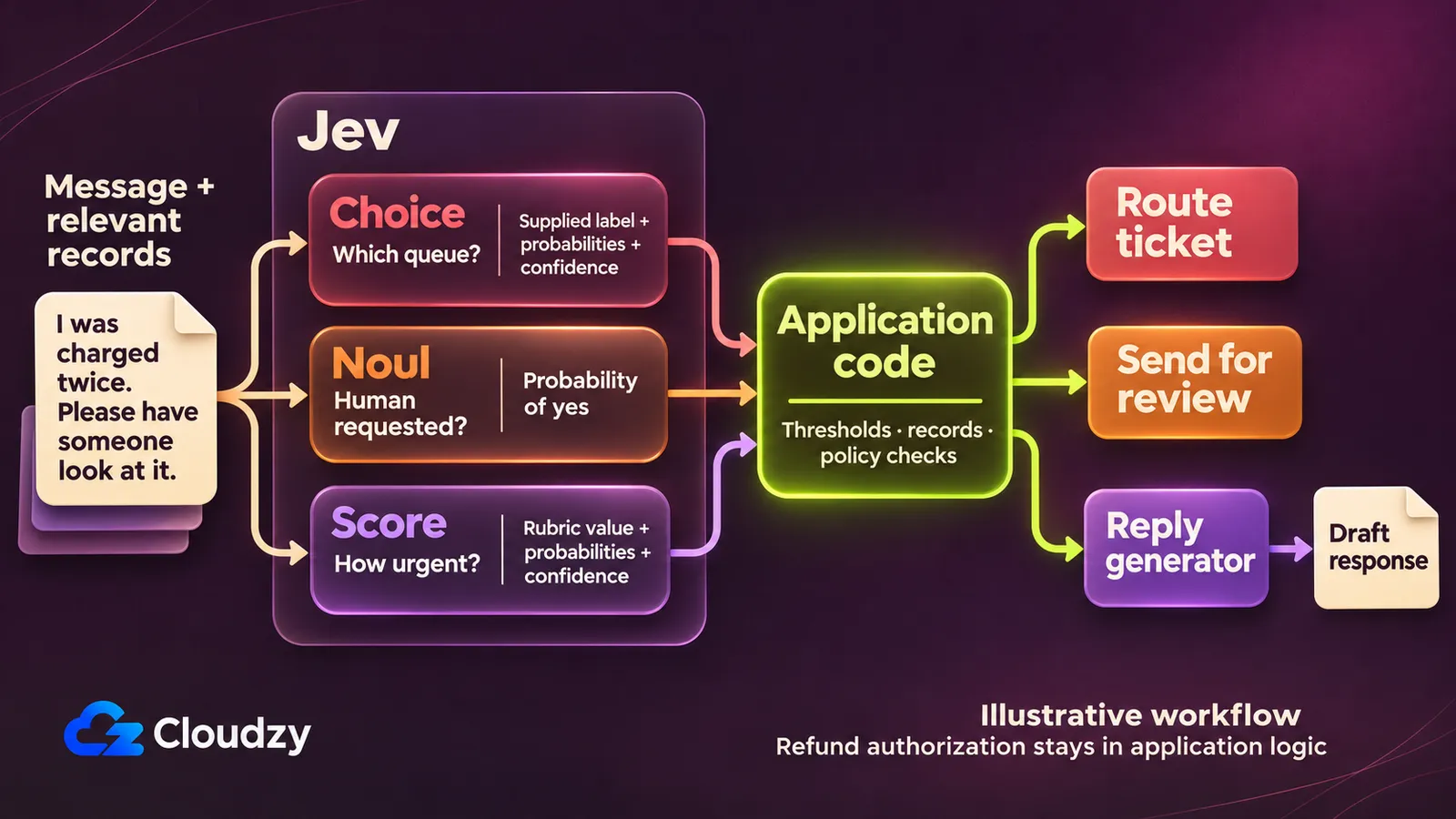
Jev is TypeSafe AI's decision model: you supply the state to evaluate and define the possible answers, then receive typed decisions and probabilities. TypeSafe's System One concept documentation describes an interface for judgments that software can consume directly. The caller sets the answer space before the model evaluates the request.
Consider an illustrative support message: "I was charged twice. Please have someone look at it." This is a hypothetical workflow, not a recorded Jev run. The state contains the message and the relevant records. The application asks which queue should receive it, whether the customer requested a human, and how urgent the message is.
You supply billing, technical, and other as queue options. Each option gets a description of what belongs there. For urgency, you supply an ordered rubric: routine means no reported interruption; elevated means an unresolved problem needs attention; urgent means an immediate interruption needs attention. The yes/no question asks specifically whether the customer requested a human.
TypeSafe calls each supported question shape a primitive. The three primitives below cover this text-based example. Jev 1.14, the current release, also adds an experimental Box primitive that returns a bounding box locating something in an image.
| Primitive | Supplied Question and Answer Space | Kind of Returned Result |
|---|---|---|
Choice |
Which queue? Billing, technical, or other | The highest-probability supplied option, probabilities for every option, and derived confidence, per the Choice response documentation. |
Score |
How urgent? Ordered, described rubric levels | A probability-weighted rubric value that can lie between levels, with probabilities and confidence, per the Score response documentation. |
Noul |
Has the customer requested a human? | The probability of yes/true, without a separate confidence property, per the Noul uncertainty documentation. |
The labels may be strings, but they're strings you supplied. A queue name returned to your code is a selected label; the model hasn't composed a new explanation.
In this example, ordinary code still verifies the transactions and checks refund policy. A generator writes the customer reply. Picking a queue authorizes no refund. When a judgment sits inside an agent workflow, the software around the model owns the surrounding control and tool permissions. The decision call occupies one step in that application.
How Jev Differs From Structured LLM Outputs
Jev's claimed distinction concerns specialization and how outputs are produced. Generative APIs already support structured outputs: Anthropic's Claude structured-output documentation describes JSON schemas and strict tool inputs through constrained decoding. A schema specifies the allowed structure and types. Valid structure, however, doesn't establish that the model interpreted the input correctly.
OpenAI’s Structured Outputs guide says completed, non-refusal outputs follow the supplied supported JSON Schema. Applications still need to handle refusals, incomplete responses, and API errors. That is an OpenAI API capability, not a specification of behavior across the ChatGPT application.
OpenAI's Handling mistakes guidance explicitly says Structured Outputs can still contain mistakes. Schema validity can coexist with a wrong answer.
A schema can require a category from a supplied list, so returning one of your labels isn't exclusive to a decision model. Anthropic's combined-use example also contains open text fields, including a summary. The response can therefore mix constrained fields with generated language. These are capabilities of the Claude API; a comparison with the familiar ChatGPT application shouldn't silently become a claim about every app surface or model.
Anthropic's invalid-output guidance documents exceptions to schema compliance, including refusals, token limits, and enum capitalization. The guarantee has a defined API scope. Keep the structural promise precise before comparing a specialized model against it.
TypeSafe's Jev introduction describes a new model architecture, a parallel sampler, and decision-oriented training called Reinforcement Learning for Calibrated Decisions (RLCD). TypeSafe says Jev produces decision probabilities in parallel, instead of generating an output string token by token. Those are vendor design claims; they don't disclose enough to reconstruct the model's neural internals.
At the interface, the difference is concrete. With a text field, you're asking a generator to compose an answer within a container. With Jev's described decision interface, you're asking the model to evaluate the possibilities already specified in the request. TypeSafe's specialization claim includes how that judgment is trained and produced, beyond the container holding the result.
Classification predates Jev: the related-work section of the preprint Evaluating and Benchmarking the System One Model Jev describes zero-shot classification with pretrained models, including classification without task-specific training.
A restricted output vocabulary doesn't by itself establish a new capability or better decisions. My reading of the distinction is a purpose-built decision interface backed by a claimed specialization. Whether that specialization helps a particular task requires evidence beyond a well-formed response.
Why Repeated Decisions Make the Promise Useful
I find Jev's appeal in the ability to describe a judgment at request time, using the documented interface to ask questions over supplied state. A repeated semantic decision can become an explicit application step without a separately trained classifier for each question. That's an interpretation of the design, not a measured explanation of Jev's attention.
TypeSafe’s model documentation says Jev is not trained on customer requests or responses. You shape the task through the request: the state provides the material to evaluate, while the question and criteria describe the judgment. Domain knowledge can enter as reference material without being presented as a per-customer change to the model.
I would make the question description the first place to inspect when a decision disappoints. "Has the customer requested a human?" gives the supplied message a specific condition to satisfy. "Does this need attention?" leaves you to define what attention means. My heuristic is to write the condition clearly enough that two people reading the same state could discuss the same judgment. If they disagree about what you're asking, fix the question before interpreting the returned probability.
The multiple-question guidance explains that independent questions can share state in one request. The application can ask the judgments it needs over the same material. Additional questions still add input-token cost; grouping them isn't a promise that additional work is free or that latency remains unchanged.
Why a Valid Decision Can Still Be Wrong
A valid Jev decision can still misinterpret its input. TypeSafe's introduction describes a type-error guarantee, while its current limitations documentation describes mistakes within that output boundary. Returning an allowed answer establishes that the response fits the requested shape; it doesn't establish that the answer matches the facts.
Suppose, hypothetically, a message says, "The delivery was late, but it arrived yesterday." You ask whether delivery is pending or complete. A model could latch onto "late" and select pending. Pending is a legal supplied label. It is also the wrong interpretation of that message. This counterexample illustrates the distinction; it isn't an observed Jev response.
TypeSafe’s current limitations documentation says Jev can read instructions literally and struggle with indirect reasoning. Implied conditions or several layers of reasoning can therefore change the quality of a decision even when the set of possible outputs is tiny.
The same page documents unreliable counting and date/time comparisons. It recommends keeping mathematical logic in code. An ordered rubric shouldn't be treated as a substitute for calculating an exact quantity: a meaningful-looking score and correct arithmetic are different requirements.
TypeSafe also documents distraction from irrelevant state, contradictory instructions, and effects from Choice option order. Adversarial content can steer Jev’s answer. Output restrictions don't establish immunity to prompt injection. The attacker can influence which permitted option wins.
What Jev's Probabilities and Confidence Tell You
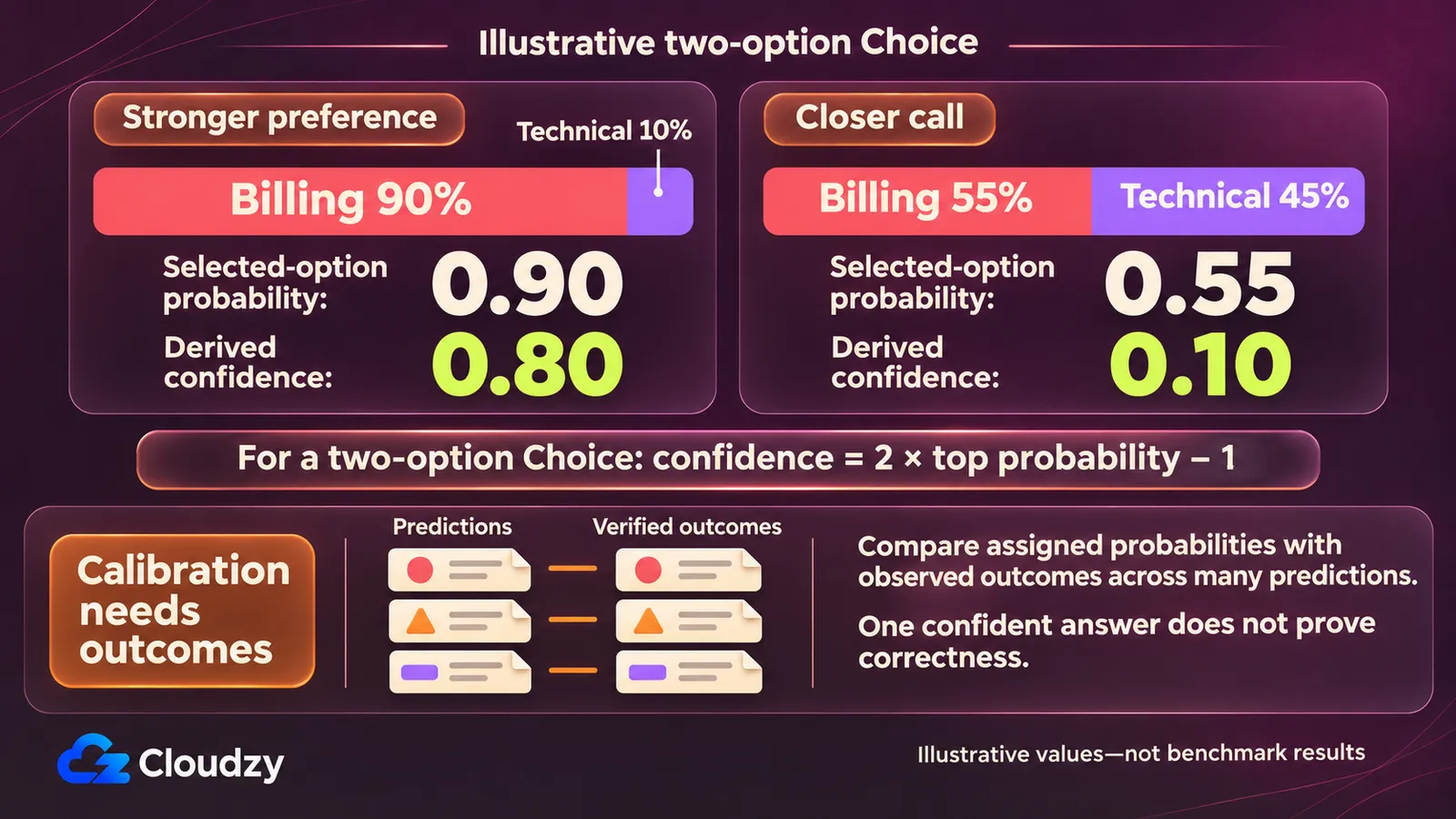
Jev's selected-option probability and derived confidence describe different quantities; neither is guaranteed accuracy for one answer. TypeSafe's confidence documentation describes confidence as a summary of the returned distribution. Its calibration explanation says probabilities are optimized against outcomes across groups of predictions, without guaranteeing that an individual prediction is correct.
The selected-option probability is the model's assigned probability for that particular answer. Derived confidence describes how decisively the distribution favors an answer. I would read that confidence as a measure of preference. It isn't an inspection stamp from a separate check of the facts.
Picture two distributions without assigning invented measurements. In one, probability concentrates on one answer. In the other, probability spreads across several plausible answers. TypeSafe's confidence measure expresses a clearer preference in the first case and greater uncertainty in the second.
Calibration asks a further question about outcomes: across predictions assigned a certain probability, does the observed frequency of correct outcomes match that probability? You need predictions and their outcomes to assess that relationship. Looking at one confident answer can't establish it.
TypeSafe's threshold guidance ties appropriate thresholds to the domain, the consequences of an error, and observed performance on the use case. It calls for testing on your own data. There is no universal confidence value that authorizes a safe action.
What Jev's Performance Claims Can Establish
Jev's performance claims apply to the evaluated workflows and comparison conditions. TypeSafe's demonstration caveats acknowledge that its short input favors the model. A result under those conditions can support that comparison; it can't establish that Jev is faster, cheaper, or more accurate for every decision task.
The vendor introduction describes a simplified demonstration query and selected comparator settings. Its LLM evaluation wrapper asks the generative models for decisions compatible with the decision API, including probabilities. TypeSafe notes that this can be slower and more expensive than asking for decisions without probabilities. What the comparator has been asked to return belongs beside the headline result.
The independent preprint Evaluating and Benchmarking the System One Model Jev, by Tobias Deußer, Lorenz Sparrenberg, and Rafet Sifa, evaluates a pinned Jev version on public datasets with frozen prompts. Its limitations section excludes proprietary generative comparators, uses prompts written for Jev, and scores the open-model references without reasoning. Its probes also cannot rule out memorized question-answer pairs. The study supplies task-dependent evidence, not peer-reviewed proof of universal superiority.
I haven't replicated those measurements. I would carry forward a narrower question: which bounded judgment does your workflow need, and what evidence would show that this model handles that judgment well enough?
Frequently Asked Questions
Why Is Jev Called a System One Model?
TypeSafe's System One naming explanation borrows the fast, intuitive versus slower, deliberate thinking distinction popularized by Daniel Kahneman. For Jev, the name emphasizes focused judgments. It is a naming analogy, not evidence that Jev has human cognition or a technical classification that applies to every language model.
Can Jev Work With Images, Audio, or Video?
TypeSafe’s current model documentation lists text and image input for Jev 1.13 and 1.14. PNG and JPEG images are supported through an experimental feature enabled with the TypeSafe-Danger-Zone-Images: true request header. TypeSafe says image features are not yet production-ready. Audio and video are not natively supported; they require preprocessing into supported inputs.
Can Jev Explain Why It Chose an Answer?
TypeSafe's current generation limitations say the model isn't trained to generate text; the concept documentation also excludes written explanations of reasoning. Jev's decision outputs therefore aren't a written account of why it chose an answer. They don't provide a reasoning trace you can read as the model's explanation.



Discussion
Comments
Sign in to join the discussion.